

Most vegans need four supplements as a baseline: vitamin B12, vitamin D (algae-derived D3 when possible), algae-based EPA/DHA, and one or more of iron, calcium, zinc, or iodine depending on diet and lab results. Blood testing, not guesswork, should set the dose. The details below cover which forms work, how much to take, and how to read the numbers on your next lab report.
TL;DR:
- Blood testing should guide supplement doses, with B12, ferritin, vitamin D, and thyroid function being the most critical markers for vegans.
- Algae-derived D3 is more effective than D2 and should be verified with labels for vegan sourcing and proper dosage.
- Algae oil provides preformed EPA and DHA, making it the best long-chain omega-3 source for vegans, especially when supplement doses specify actual EPA and DHA amounts.
- Iron supplementation depends on individual blood levels, with ferritin testing necessary before taking chelated forms like iron bisglycinate, especially for women and athletes.
- Choosing supplements with transparent labels, third-party verification, and forms proven to absorb well prevents waste and potential harm at improper doses.
Table of Contents
- Why Supplements For Vegans Start With B12
- Vitamin D Testing And Vegan-Friendly Dosing
- Algae Oil: The Vegan Answer To Fish Oil
- Iron Needs On A Plant-Based Diet
- Getting Enough Calcium Without Dairy
- Zinc And Iodine: Small Doses, Real Consequences
- What Your Labs Are Actually Telling You
- How To Pick A Supplement That Won't Waste Your Money
- Medications Vegans Should Watch With Supplements
- Gut Health: Probiotics And Prebiotics Worth Considering
- Fueling Vegan Athletes: Protein And Energy Support
- Nutrasmarts' Take On Getting Vegan Supplementation Right
- Where To Go Next With Your Supplement Choices
- Sources
Why Supplements For Vegans Start With B12
Vitamin B12 sits in a category by itself. It's the one nutrient a strict vegan diet cannot reliably supply without fortified foods or a supplement, because B12 is made by bacteria and concentrated in animal tissue, not synthesized by plants. Skipping it isn't a minor gap. Left unaddressed for years, low B12 can cause irreversible nerve damage, and the NIH Office of Dietary Supplements flags vegans as a group at elevated deficiency risk.
Two supplementation patterns work well in practice:
- A daily dose of cyanocobalamin, taken with food, typically recommended by health professionals
- A weekly dose of cyanocobalamin for those who prefer less frequent dosing, as advised by clinicians
- Methylcobalamin as an alternative active form, though evidence doesn't show it outperforms cyanocobalamin for most people
Pro Tip: Fortified nutritional yeast and plant milks help, but don't rely on them alone; serving sizes and fortification levels vary too much between brands to guarantee adequate intake.
Serum B12 is the first lab to check. If it comes back borderline, ask about a methylmalonic acid (MMA) test, since MMA rises before serum B12 drops and catches deficiency earlier. Anyone with numbness, tingling, or persistent fatigue should loop in a clinician rather than self-treat.
Vitamin D Testing And Vegan-Friendly Dosing
The lab value that matters is 25-hydroxyvitamin D, usually written as 25(OH)D. It's the storage form of the vitamin and the one clinicians use to define deficiency and sufficiency, according to the NIH's vitamin D fact sheet. Most vegans have two practical hurdles: less sun exposure than the body needs in many climates, and traditional D3 supplements sourced from lanolin, which comes from sheep's wool.
Algae-derived D3 solves the sourcing problem, and it appears to raise blood levels more effectively than plant-based D2 in comparative research. That makes it the better default choice over D2 for anyone supplementing on a vegan diet.
- Typical maintenance doses run in a moderate range daily for adults without a diagnosed deficiency
- Higher therapeutic doses may be used short-term but should be clinician-directed after a blood test confirms low levels
- Retesting after 8 to 12 weeks shows whether the dose is working
Pro Tip: Check the label for the words "algae-sourced" or a vegan certification mark. "D3" alone doesn't tell you the source, and plenty of D3 capsules still use lanolin.
Algae Oil: The Vegan Answer To Fish Oil
Flaxseed, chia, and walnuts supply ALA, a plant omega-3, but the body converts only a small fraction of ALA into the long-chain forms, EPA and DHA, that support brain and cardiovascular health. That conversion bottleneck is well documented, and it's the main reason vegans often run lower on long-chain omega-3s than omnivores, according to a review of omega-3 status across diet patterns.
Algae oil sidesteps the conversion problem entirely, since it delivers preformed EPA and DHA harvested from the same microalgae that fish accumulate their omega-3s from in the first place.
- A daily dose of algae-based EPA/DHA supplements at levels commonly recommended for general maintenance
- People managing triglycerides or joint discomfort sometimes use higher doses, but that's a conversation for a clinician, not a label
- Check the supplement facts panel for the actual EPA and DHA milligram amounts, not just "algae oil 500 mg," since the oil itself isn't the active ingredient
- Third-party testing seals (USP, NSF, or similar) indicate the product was checked for contaminants and label accuracy
Iron Needs On A Plant-Based Diet
Plant iron, called non-heme iron, absorbs less efficiently than the heme iron found in meat. Vitamin C dramatically improves that absorption. Pairing lentils or spinach with citrus, bell peppers, or tomatoes at the same meal can meaningfully raise how much iron your gut actually takes up.
Not every vegan needs an iron supplement, and taking one without a reason carries real risk, since excess iron builds up in tissue and can cause organ damage over time. Research on iron status in vegetarians points to ferritin testing as the right first step before supplementing, not a symptom checklist.
- Premenopausal women and people doing heavy endurance training face the highest risk of low iron stores
- Low ferritin, alongside low hemoglobin, is the pattern that usually justifies supplementation
- Iron bisglycinate is a chelated form that tends to cause less GI upset than ferrous sulfate
- Retest ferritin after a few months rather than supplementing indefinitely on autopilot
Roughly one in three women of reproductive age already runs low on iron regardless of diet, which is exactly why testing before supplementing matters more than assuming vegan equals deficient.
Getting Enough Calcium Without Dairy
Calcium-set tofu, fortified plant milks, tahini, and some fortified orange juices supply calcium in forms the body absorbs reasonably well. Almonds and white beans contribute smaller amounts. Harvard Health's guidance on plant-based nutrient needs treats fortified foods as the practical backbone of vegan calcium intake, because getting to target through unfortified whole foods alone is genuinely hard.
Spinach and Swiss chard look calcium-rich on paper but deliver far less usable calcium than the label suggests, since oxalates in those greens bind calcium and block much of the absorption.
- Calcium-set tofu (check the label; not all tofu uses calcium sulfate)
- Fortified plant milks and juices with substantial calcium content per serving
- Tahini, almonds, and cooked white beans in smaller supporting amounts
- Consider a supplement when fortified foods aren't part of your regular routine, or when a bone-density scan flags a concern
Anyone with a family history of osteoporosis or a low-impact fracture should ask a clinician whether a bone-density scan is warranted before defaulting to supplements. Nutrasmarts' bone density supplement guide breaks down how calcium works alongside vitamin D and K2 for long-term skeletal health.
Zinc And Iodine: Small Doses, Real Consequences
Phytates in grains, legumes, and seeds bind zinc and reduce how much of it your gut absorbs, which is why a review of zinc status in plant-based diets finds vegans trending lower on zinc intake and blood levels than omnivores. Soaking beans and grains overnight, sprouting, and fermenting foods like tempeh all cut phytate content and improve absorption without needing a pill.
Iodine is trickier because the range between too little and too much is narrower than most nutrients. Research on iodine sources shows plant-food iodine content swings widely depending on soil and water content, and seaweed varies so much between species that eating it regularly can just as easily push intake too high as too low.
- Use iodized salt as a steady, predictable baseline source
- If supplementing, choose a measured dose consistent with dietary recommendations rather than relying on seaweed snacks of unknown potency
- Zinc gluconate or citrate tend to be gentler on the stomach than zinc oxide
- A TSH test is a reasonable first check if you suspect thyroid symptoms tied to iodine imbalance
Pro Tip: Kelp supplements are the most common way people accidentally overdose on iodine. One serving can contain more than ten times a normal daily amount, so read the label in micrograms, not "servings of seaweed."
What Your Labs Are Actually Telling You
Guessing which supplement you need wastes money and sometimes causes harm, particularly with iron and iodine, where excess is its own health problem. A short lab panel answers the question directly. Reviews of nutrient status in vegan populations consistently point to blood biomarkers, not symptoms, as the reliable way to confirm a shortfall before starting a supplement.
Here's the order that makes sense for most vegans working with a clinician:
- Serum B12, with a follow-up MMA test if the result is borderline or symptoms suggest deficiency despite a "normal" B12 number.
- Ferritin and hemoglobin, especially for menstruating women, endurance athletes, or anyone reporting fatigue.
- 25(OH)D, ideally drawn at the end of winter when levels typically hit their lowest point.
- TSH, if iodine intake is inconsistent or thyroid symptoms like unexplained weight change or fatigue show up.
Testing before supplementing isn't caution for its own sake. It's the difference between correcting an actual gap and adding a pill that does nothing, or in the case of iron and iodine, one that actively causes harm at the wrong dose.
Dosing should scale to what the labs show, not to a generic multivitamin's fixed amount. A vitamin D reading of 15 ng/mL calls for a materially different approach than a reading of 28 ng/mL, even though both technically fall short of optimal. Nutrasmarts' deficiency symptom guide and ingredient database exist for exactly this stage: cross-checking a lab result or a symptom against the dosing forms and ranges that clinical research actually supports, rather than whatever a product label claims.
How To Pick A Supplement That Won't Waste Your Money
Not every product labeled "vegan" is formulated the same way, and the difference between a well-made supplement and a mediocre one usually shows up in three places: the ingredient form, the label transparency, and third-party verification.
- Ingredient form matters more than the vitamin name. Algae-sourced D3 beats D2 for raising blood levels. Iron bisglycinate and zinc citrate cause less stomach upset than the cheaper sulfate or oxide forms often used to cut costs.
- Look for a certified vegan mark, not just a claim on the front of the bottle. Gelatin capsules and lanolin-derived D3 both slip into products marketed loosely as "plant-based."
- Third-party testing seals (USP, NSF, or ConsumerLab) indicate someone independently verified what's actually in the bottle matches the label.
- Dosing transparency counts too. A label that lists "vegan omega-3 blend 500 mg" without breaking out actual EPA/DHA milligrams is hiding the number that matters.
Pro Tip: A single-nutrient supplement usually beats a multivitamin when you have a confirmed deficiency in one area, since multivitamins spread modest doses across a dozen nutrients and rarely provide enough of the one you actually need.
A comprehensive vegan multivitamin makes more sense as a broad safety net for someone with no test results yet, or as maintenance once individual deficiencies have already been corrected with targeted dosing.
Medications Vegans Should Watch With Supplements
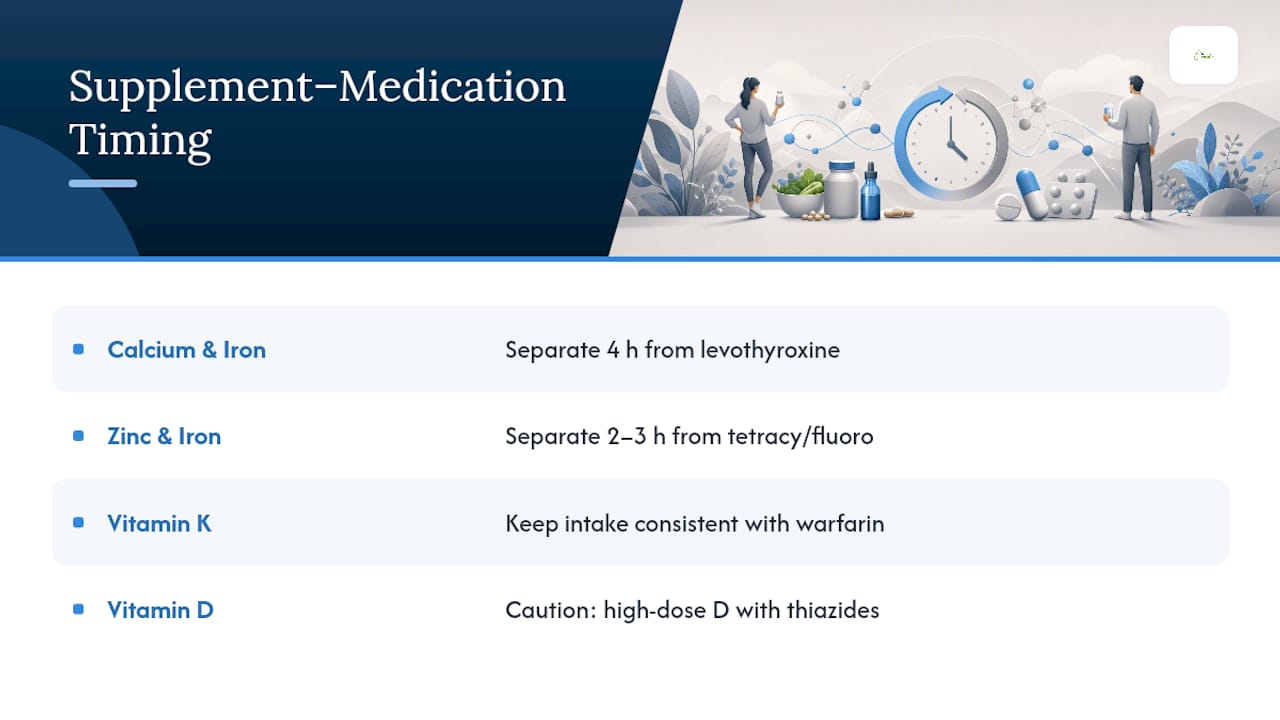
Supplement and medication interactions aren't unique to vegans, but a few combinations come up often enough in plant-based diets to flag directly. Calcium supplements can blunt the absorption of levothyroxine, a common thyroid medication, so most guidance recommends spacing them four hours apart. The same spacing rule applies to iron supplements and levothyroxine, since iron binds the medication in the gut.
Vitamin K, concentrated in leafy greens that many vegans eat in large quantities, can interfere with warfarin's blood-thinning effect. That's not a reason to avoid greens. It's a reason to keep intake consistent week to week so a doctor managing warfarin dosing isn't working against a moving target.
Zinc supplements taken long-term and in high doses can interfere with copper absorption and with certain antibiotics, including tetracyclines and fluoroquinolones, when taken at the same time. Iron carries the same antibiotic-timing issue. Separating the doses by two to three hours generally resolves it.
High-dose vitamin D can raise calcium levels in the blood, which matters for anyone on thiazide diuretics, since that combination can push calcium higher than either would alone. Anyone on regular prescription medication, vegan or not, should mention every supplement to a pharmacist or physician, since interaction risk depends on dose and timing more than on the supplement being plant-derived.
Gut Health: Probiotics And Prebiotics Worth Considering
A vegan diet tends to be naturally high in fiber, which already feeds gut bacteria better than most omnivore diets manage. That's an advantage, but it doesn't mean probiotic supplementation is pointless for vegans who deal with bloating, irregularity, or a diet that shifted quickly toward more legumes and cruciferous vegetables.
Vegan-certified probiotic capsules use plant-derived or synthetic delivery shells instead of gelatin, and strains like Lactobacillus rhamnosus and Bifidobacterium lactis show up most often in general digestive-support formulas. Fermented foods, sauerkraut, kimchi, tempeh, and unsweetened plant-based yogurts, deliver live cultures without a capsule at all, and they're a reasonable first move before reaching for a supplement.

Prebiotics matter just as much and get less attention. They're the fiber types that feed the bacteria already living in your gut: inulin, found in chicory root and Jerusalem artichokes, and resistant starch, found in cooled cooked potatoes, green bananas, and legumes. A sudden jump in legume or cruciferous vegetable intake, common when someone transitions to vegan eating, is also the most frequent cause of new bloating. That's usually a fiber-adjustment issue, not a sign something is wrong, and it typically settles within a few weeks as gut bacteria adapt.
Fueling Vegan Athletes: Protein And Energy Support
Protein needs don't change because someone eats plants instead of meat, but hitting those targets takes more planning on a vegan diet, since plant proteins are generally less concentrated per calorie than animal sources. Active vegans, particularly those doing regular resistance training or endurance work, typically need somewhere in the range of 1.2 to 2.0 grams of protein per kilogram of body weight daily, with the higher end reserved for serious strength training.
Pea protein and soy protein isolate are the two most complete plant protein powders, meaning they supply all nine essential amino acids in reasonable proportions. Blended plant proteins (pea plus rice, for instance) often round out the amino acid profile even further, since the strengths of one plant protein tend to cover the gaps in another.
Creatine deserves specific mention for anyone training seriously. It's naturally found almost exclusively in meat and fish, so vegan athletes typically start with lower muscle creatine stores than omnivores, and supplementing with creatine monohydrate is one of the more evidence-backed ways to close that gap. Iron and B12 status also deserve closer monitoring in vegan athletes, since heavy training increases turnover of both, and fatigue that looks like overtraining sometimes turns out to be a correctable nutrient gap instead. Nutrasmarts' athletic performance supplement research covers dosing specifics for creatine, protein timing, and the nutrients training intensity tends to draw down fastest.
Nutrasmarts' Take On Getting Vegan Supplementation Right
The biggest mistake we see isn't skipping supplements. It's supplementing broadly instead of specifically, tossing a multivitamin at the problem instead of pulling actual lab numbers first. B12 is close to a universal need for strict vegans, and algae-based D3 and EPA/DHA solve real, well-documented gaps. Iron, calcium, zinc, and iodine are different. They depend entirely on your individual diet and blood work, not a blanket rule.
Test first. Prioritize the nutrients the evidence backs hardest. Choose forms that actually absorb well, algae D3 over lanolin D3, bisglycinate over sulfate. And when a label or a claim seems uncertain, cross-check it against real research rather than marketing copy. Our ingredient database and comparison tools exist for that exact step.
— NutraSmarts
Where To Go Next With Your Supplement Choices
You don't need to guess your way through a supplement aisle once you know which numbers to check. Nutrasmarts built its ingredient database around exactly that gap: over 1,300 evidence-rated profiles tied to clinical research, so you can look up a specific nutrient, form, or dose before you buy instead of after.
If you already have lab results in hand, the supplements-by-symptom search lets you match what's actually low, ferritin, B12, vitamin D, to supplement options backed by real research rather than whatever's trending. Comparing two products side by side gets easier with the Compare tool, which lines up ingredient forms and doses so you're not squinting at two different labels trying to figure out which one actually has more usable D3. And if you formulate supplements yourself, the free Supplement Facts label creator generates FDA-compliant labels without the spreadsheet headache.
Start with one search: type in the nutrient your last blood test flagged, and see what the evidence actually supports before your next purchase.
This article is general information, not a substitute for advice from a qualified doctor. Consult a qualified healthcare professional about your own circumstances before acting on anything here.
Sources
- Vitamin B12 — Health Professional Fact Sheet (NIH Office of Dietary Supplements)
- Meeting nutrient needs on a plant-based diet — Harvard Health