

Nootropic ingredients are compounds — botanical extracts, nutrients, amino acids, omega-3 fatty acids, cholinergics, stimulants, and synthetic or prescription substances — used to support memory, attention, mood, or stress resilience. Evidence quality varies sharply by class. Citicoline, DHA, caffeine paired with L-theanine, and Bacopa monnieri (with consistent dosing over weeks) show the strongest human-trial support. Stimulants like caffeine work acutely; adaptogens like ashwagandha and Rhodiola rosea require sustained use. Prescription compounds such as modafinil sit in a different regulatory category entirely.
The highest-evidence categories at a glance:
- Cholinergics: Citicoline, alpha-GPC (memory, acetylcholine support; strong-to-moderate human evidence)
- Omega-3s: DHA/EPA (membrane integrity, anti-inflammatory; strong evidence in older adults)
- Stimulant stack: Caffeine + L-theanine (acute focus and reduced jitteriness; strong evidence)
- Botanical adaptogens: Bacopa monnieri, ashwagandha, Rhodiola rosea (memory, stress resilience; moderate evidence with cumulative dosing)
- Mushrooms: Lion's Mane / Hericium erinaceus (nerve growth factor support; limited-to-moderate human evidence)
- Amino acids / metabolic: Creatine, L-tyrosine (short-term mental fatigue, stress; moderate evidence)
- Prescription/synthetic: Modafinil, racetams (wakefulness, cognition; prescription or unapproved status in the U.S.)
Safety caveat: The FDA does not recognize "nootropic" as a regulatory category. Some products sold under that label contain unapproved drug ingredients such as vinpocetine, phenibut, and racetams. Third-party testing and label verification are non-negotiable before formulating or consuming any nootropic product.
Table of Contents
- What "nootropic" actually means — and what the FDA says about it
- The full catalog of common nootropic ingredients
- How nootropic ingredients actually work in the brain
- Which ingredients have the strongest human-trial evidence?
- How Nutrasmarts rates ingredients and what tools are available
- Safety, drug interactions, and U.S. regulatory cautions
- How to choose, dose, and combine nootropic ingredients responsibly
- Key Takeaways
- The gap between nootropic marketing and what the evidence actually supports
- Research-backed ingredient tools built for formulators
- Useful sources and further reading
What "nootropic" actually means — and what the FDA says about it
The word nootropic was coined by Romanian chemist Cornelius E. Giurgea in 1972 to describe substances that enhance learning and memory, protect the brain from injury, and carry minimal toxicity. That original pharmacological definition was strict. Under it, very few compounds qualify. Today, the term functions primarily as a marketing label, applied to everything from a cup of green tea to prescription wakefulness agents.
The FDA does not have a distinct regulatory category called "nootropic." Every substance sold in the U.S. falls under one of two frameworks: a dietary supplement (governed by DSHEA 1994) or a drug (requiring pre-market approval). That distinction matters enormously for formulators. An ingredient that has been studied as a drug — or that FDA has determined does not meet the definition of a dietary ingredient — cannot legally be marketed in a supplement, regardless of how many nootropic brands include it.
Practical examples of where this gets complicated: vinpocetine, a cerebral vasodilator derived from the periwinkle plant, has been flagged by FDA as potentially an unapproved new drug when found in supplements. Racetams like piracetam are not approved drugs in the U.S. and are not lawfully sold as dietary supplements either. Phenibut, a GABA-B agonist widely sold in "focus" products, sits in the same gray zone. Formulators must check whether an ingredient has a New Dietary Ingredient (NDI) notification on file with FDA, whether it was marketed as a supplement before October 15, 1994 (the DSHEA grandfather date), or whether it has been investigated as a drug — any of those conditions changes what you can legally put on a label.
For science-backed supplement choices that stay within the dietary supplement framework, the distinction between "marketed as nootropic" and "legally and safely formulated as a dietary supplement" is the first filter to apply.
The full catalog of common nootropic ingredients
The profiles below cover mechanism, typical clinical dose ranges drawn from human trials, evidence tier, onset, and key formulation or safety notes. An evidence-tier summary table follows the profiles.
Cholinergics
Citicoline (CDP-choline) Citicoline is a choline donor that supplies both choline and cytidine (which converts to uridine) to support phosphatidylcholine synthesis and acetylcholine production. It is one of the best-studied cognitive ingredients in human trials, with evidence for memory benefits particularly in older adults and populations with mild cognitive complaints. Typical studied doses run 250–500 mg/day. Evidence tier: strong-to-moderate for memory in at-risk populations; more mixed in healthy young adults. Onset is gradual, with measurable effects in trials at 4–12 weeks. Formulation note: water-soluble, stable, low hygroscopicity, minimal taste issues.

Alpha-GPC Alpha-glycerophosphocholine delivers choline with high bioavailability and crosses the blood-brain barrier efficiently. Studied doses range from 300–600 mg/day for cognitive support. Evidence tier: moderate (human trials in Alzheimer's and age-related cognitive decline; limited RCT data in healthy adults). Formulation caution: highly hygroscopic — requires moisture-controlled processing and often a silica flow agent.
Amino acids and metabolic substrates
L-theanine An amino acid found almost exclusively in Camellia sinensis (tea), L-theanine promotes alpha-wave activity in the brain and modulates GABAergic pathways, producing a calm-alert state without sedation. On its own, typical studied doses are 100–200 mg. Its most evidence-supported application is the caffeine + L-theanine combination, which improves sustained attention and reduces the jitteriness associated with caffeine alone. Evidence tier: strong for the combination; moderate as a standalone. Onset: acute (30–60 minutes). Formulation note: stable, water-soluble, mild umami taste that can require masking in flavored products.
L-tyrosine (and N-Acetyl-L-Tyrosine) A precursor to dopamine, norepinephrine, and thyroid hormones, L-tyrosine is most studied for maintaining cognitive performance under acute stress, sleep deprivation, or cold exposure. Typical studied doses: 500–2,000 mg of L-tyrosine, or 300–600 mg of the more bioavailable N-Acetyl-L-Tyrosine (NALT). Evidence tier: moderate for stress-induced cognitive decline; limited for baseline cognitive enhancement. Onset: acute. Caution: avoid in individuals on MAOIs or thyroid medications.
Creatine Best known for athletic performance, creatine also supports cerebral phosphocreatine stores, which buffer ATP during high-demand cognitive tasks. Human trials show benefits for short-term memory and mental fatigue, particularly in sleep-deprived or vegetarian populations. Typical studied dose: 3–5 g/day. Evidence tier: moderate for cognitive fatigue and short-term memory. Onset: days to weeks with loading or steady dosing. Caution: individuals with pre-existing kidney conditions should consult a clinician before use.
Stimulants
Caffeine Caffeine blocks adenosine receptors, reducing perceived fatigue and increasing dopamine and norepinephrine signaling. It is the most widely consumed psychoactive substance on earth and has the most consistent human evidence for acute alertness, reaction time, and attention. Typical studied dose: 75–200 mg per serving. Evidence tier: strong for acute alertness and attention. Onset: 30–60 minutes; duration 4–6 hours. Side effects: insomnia, anxiety, and dependency with chronic high-dose use. Formulation note: pairs well with L-theanine at a 1:2 caffeine-to-theanine ratio to moderate stimulant side effects.

Omega-3 fatty acids
DHA and EPA Docosahexaenoic acid (DHA) is a structural component of neuronal cell membranes, and eicosapentaenoic acid (EPA) has anti-inflammatory properties relevant to brain health. For DHA/EPA clinical evidence and dose guidance, the picture is clearest in older adults and populations with low baseline omega-3 intake. Typical studied doses: 1–2 g/day combined DHA+EPA, with DHA-dominant formulas preferred for cognitive endpoints. Evidence tier: strong in older adults and deficient populations; moderate in healthy adults. Formulation caution: oxidation-prone; requires antioxidant protection (e.g., mixed tocopherols) and nitrogen-flushed packaging.
Botanical adaptogens and memory herbs
Bacopa monnieri A cornerstone of Ayurvedic medicine, Bacopa contains bacosides that inhibit acetylcholinesterase, reduce oxidative stress, and modulate serotonin pathways. The critical point for anyone evaluating it: Bacopa typically requires 4–6 weeks of consistent daily dosing before cognitive benefits appear in trials. Typical studied dose: 300–450 mg/day of a standardized extract (45% bacosides). Evidence tier: moderate for memory acquisition and retention. Common side effect: GI discomfort, particularly nausea — taking it with food reduces this significantly. Formulation note: bitter taste; encapsulation or flavor masking recommended.
Ashwagandha (Withania somnifera) Ashwagandha is an adaptogen that modulates the HPA axis, reducing cortisol and supporting stress resilience. Cognitive benefits in human trials are largely secondary to stress reduction rather than direct nootropic action. Typical studied dose: 300–600 mg/day of a root extract standardized to withanolides (KSM-66 and Sensoril are common standardized forms). Evidence tier: moderate for stress and anxiety; limited for direct cognitive enhancement. Onset: 4–8 weeks for stress endpoints. Caution: sedative in high doses; best taken in the evening. Avoid in pregnancy and in individuals on thyroid medications. For detailed ashwagandha dosage and research, Nutrasmarts maintains a full ingredient profile.
Rhodiola rosea Rhodiola is a Siberian adaptogen whose active compounds (rosavins and salidroside) modulate monoamine neurotransmitters and reduce fatigue under stress. Typical studied dose: 200–600 mg/day of a standardized extract (3% rosavins, 1% salidroside). Evidence tier: moderate for mental fatigue and stress resilience; limited for direct memory enhancement. Onset: 1–4 weeks. Caution: not recommended for individuals with bipolar disorder or manic-depressive psychosis. For evidence-based stress management stacks, Rhodiola is one of the better-supported options.
Ginkgo biloba Ginkgo extract (standardized to 24% flavone glycosides, 6% terpene lactones) improves cerebral blood flow and has antioxidant properties. Typical studied dose: 120–240 mg/day. Evidence tier: moderate for age-related cognitive decline; limited for healthy adults. Important drug interaction: Ginkgo inhibits platelet aggregation and should not be combined with anticoagulants like warfarin or taken before surgery.
Panax ginseng Ginsenosides in Panax ginseng modulate neurotransmitter systems and have anti-inflammatory effects. Typical studied dose: 200–400 mg/day of standardized extract. Evidence tier: limited-to-moderate for working memory and mental fatigue. Caution: contraindicated in hypertension; can interact with stimulants and blood-thinning medications.
Mushrooms
Lion's Mane (Hericium erinaceus) Lion's Mane contains hericenones and erinacines that stimulate nerve growth factor (NGF) synthesis, supporting neuronal maintenance and potentially neuroplasticity. Typical studied dose: 500–3,000 mg/day of dried mushroom or 50–500 mg of concentrated extract. Evidence tier: limited-to-moderate — promising human trials exist, but most are small and short-term. Onset: weeks to months. Formulation note: earthy flavor; extract standardization varies widely across suppliers, so specifying beta-glucan content matters for formulators.
Acetylcholinesterase agents and flagged ingredients
Huperzine A Derived from Huperzia serrata moss, Huperzine A inhibits acetylcholinesterase, increasing acetylcholine availability. It has shown cognitive benefits in small human trials, particularly in Alzheimer's patients. Typical studied dose: 50–200 mcg/day. Evidence tier: limited in healthy adults; moderate in Alzheimer's trials. Regulatory note: FDA has raised questions about whether Huperzine A qualifies as a lawful dietary ingredient, placing it in a similar gray zone to vinpocetine. Formulators should verify current NDI status before inclusion.
Vinpocetine A synthetic derivative of vincamine (from the periwinkle plant), vinpocetine improves cerebral blood flow and has neuroprotective properties in preclinical models. FDA has stated that vinpocetine may be an unapproved new drug when included in dietary supplements. Evidence tier: limited in healthy adults. Regulatory status: uncertain/flagged — avoid in supplements targeting the U.S. market without legal review.
Prescription-class example
Modafinil Modafinil is a wakefulness-promoting agent approved by FDA for narcolepsy, shift-work sleep disorder, and sleep apnea. It modulates dopamine, norepinephrine, and orexin systems. It is frequently cited in nootropic discussions because of its off-label use for cognitive enhancement. Evidence tier: strong for wakefulness in approved indications; moderate for cognitive enhancement in healthy adults. Regulatory status: Schedule IV controlled substance — prescription required; not legally sold as a dietary supplement. Dependency risk is lower than classical stimulants but not zero. This is the clearest example of why the dietary supplement and prescription drug categories must be kept distinct.
Quick-reference comparison table
| Ingredient | Primary claimed benefit | Typical clinical dose | Evidence tier | Onset | Key caution |
|---|---|---|---|---|---|
| Citicoline | Memory, focus | 250–500 mg/day | Strong-moderate | 4–12 weeks | Generally well tolerated |
| Alpha-GPC | Memory, acetylcholine | 300–600 mg/day | Moderate | 4–8 weeks | Hygroscopic; process carefully |
| L-theanine + Caffeine | Focus, calm alertness | 100–200 mg + 75–200 mg | Strong (combo) | 30–60 min | Insomnia at high caffeine doses |
| Creatine | Mental fatigue, memory | 3–5 g/day | Moderate | Days–weeks | Kidney caution in susceptible people |
| DHA/EPA | Memory, neuroprotection | 1–2 g/day | Strong (older adults) | Weeks–months | Oxidation; antioxidant packaging needed |
| Bacopa monnieri | Memory acquisition | 300–450 mg/day | Moderate | 4–6 weeks | GI discomfort; take with food |
| Ashwagandha | Stress resilience | 300–600 mg/day | Moderate | 4–8 weeks | Sedative at high doses; avoid in pregnancy |
| Rhodiola rosea | Mental fatigue, stress | 200–600 mg/day | Moderate | 1–4 weeks | Avoid in bipolar disorder |
| Ginkgo biloba | Cerebral blood flow | 120–240 mg/day | Moderate (older adults) | 4–8 weeks | Anticoagulant interaction |
| Lion's Mane | Neuroplasticity, NGF | 500–3,000 mg/day | Limited-moderate | Weeks–months | Standardization varies |
| Huperzine A | Acetylcholine, memory | 50–200 mcg/day | Limited (healthy adults) | Days–weeks | Regulatory gray zone in U.S. |
| Modafinil | Wakefulness, cognition | Rx-determined | Strong (approved uses) | 1–2 hours | Schedule IV; prescription only |
How nootropic ingredients actually work in the brain
Most cognitive enhancers target one of five broad biological systems. Understanding which mechanism an ingredient uses helps you build rational stacks and avoid redundant or conflicting combinations.
Acetylcholine system (cholinergics) Citicoline and alpha-GPC supply choline, the rate-limiting substrate for acetylcholine synthesis. Huperzine A takes the opposite approach: it inhibits the enzyme that breaks acetylcholine down. Stacking a choline donor with an acetylcholinesterase inhibitor like Huperzine A can amplify cholinergic tone, but it also amplifies the risk of cholinergic side effects (nausea, cramping, bradycardia). Formulators should be cautious about combining these at high doses.
Monoamine and adenosine systems (stimulants and adaptogens) Caffeine works by blocking adenosine receptors, which normally accumulate during waking hours and signal fatigue. The result is acute alertness and faster reaction time. L-tyrosine supports dopamine and norepinephrine synthesis, which is why it helps most under conditions of acute stress or sleep deprivation rather than baseline enhancement. Rhodiola's rosavins appear to modulate monoamine oxidase activity, contributing to its anti-fatigue effects.
Membrane structure and neuroinflammation (omega-3s) DHA is literally built into neuronal cell membranes. Higher membrane DHA content improves fluidity and receptor function, and DHA-derived mediators (resolvins, protectins) actively resolve neuroinflammation. This is a slow structural process, which is why omega-3 benefits accumulate over months rather than days.
HPA axis and stress response (adaptogens) Ashwagandha and Rhodiola both modulate the hypothalamic-pituitary-adrenal axis, reducing cortisol output under chronic stress. The cognitive benefits in human trials are largely downstream of stress reduction rather than direct neurotransmitter manipulation. This matters for formulators: marketing these as "focus" ingredients is less accurate than positioning them for stress resilience and sustained mental performance.
Neurotrophic factors (mushrooms, Bacopa) Lion's Mane stimulates NGF synthesis via hericenones and erinacines. Bacopa's bacosides appear to support dendritic branching and synaptic density. Both mechanisms are slow and structural, as many nootropic mechanisms remain better characterized preclinically than in human pharmacology.
Acute vs. cumulative mechanisms This distinction is the most practically important one for setting expectations. Caffeine, L-theanine, and L-tyrosine produce effects within an hour. Bacopa, ashwagandha, DHA, and Lion's Mane require weeks to months of consistent dosing. Mixing these timelines in a single formula is fine, but consumers need to know that the botanical components are not responsible for the acute effect they feel on day one.
Pro Tip: When building a stack, map each ingredient to its mechanism first. If two ingredients target the same pathway (e.g., two acetylcholinesterase inhibitors), you are not doubling the benefit — you are doubling the side-effect risk. Combine ingredients across mechanisms instead: a choline donor + an adaptogen + DHA covers three distinct systems with minimal interaction risk.
Which ingredients have the strongest human-trial evidence?
The honest answer is that the evidence base for most dietary nootropics is thinner than the marketing suggests. No non-drug dietary supplement has met the original strict pharmacological criteria for the term "nootropic." That said, some ingredients have a genuinely meaningful body of human RCT data.
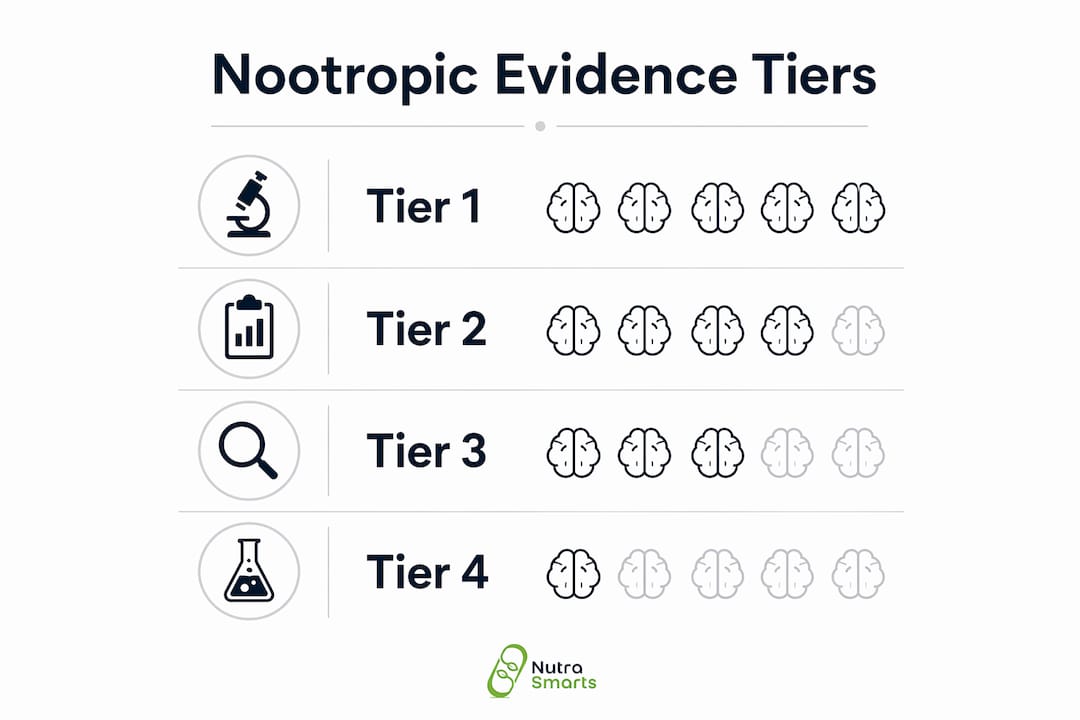
Tier 1 — Strong human evidence (RCTs and meta-analyses)
Caffeine is the clearest case: decades of controlled trials confirm acute improvements in alertness, reaction time, and attention. The caffeine + L-theanine combination has multiple RCTs showing improved sustained attention with reduced jitteriness versus caffeine alone. DHA and EPA have strong evidence for cognitive outcomes in older adults and populations with low baseline intake, supported by large observational studies and several RCTs. Citicoline has a solid body of human trial data for memory in older adults and mild cognitive impairment.
Tier 2 — Moderate evidence (multiple human trials, some inconsistency)
Bacopa monnieri has the most consistent moderate-tier evidence among botanical nootropics, with several RCTs showing memory improvements after 4–6 weeks of dosing. Creatine shows reliable benefits for short-term memory and mental fatigue in controlled trials, particularly in sleep-deprived or vegetarian subjects. Ashwagandha has multiple RCTs for stress and anxiety reduction, with cognitive benefits appearing secondary to that effect. Rhodiola rosea has human trial support for mental fatigue, though trial quality varies.
Tier 3 — Limited or preliminary evidence
Lion's Mane has promising small trials but lacks large, well-powered RCTs in healthy adults. Ginkgo biloba has a mixed record: earlier trials in age-related decline were more positive; more recent large trials have been less convincing for prevention in healthy adults. L-tyrosine's evidence is largely confined to stress-induced cognitive impairment rather than baseline enhancement. Huperzine A has Alzheimer's trial data but limited evidence in healthy populations.
Tier 4 — Preclinical or insufficient human evidence
Many novel botanical extracts, peptides, and synthetic compounds circulating in the nootropic market fall here. Preclinical data (cell cultures, rodent models) does not reliably predict human cognitive outcomes. Formulators should treat animal-only data as hypothesis-generating, not as a basis for label claims.
How Nutrasmarts rates ingredients and what tools are available
Nutrasmarts maintains a supplement ingredient database covering over 1,300 evidence-rated ingredient profiles, each linked directly to peer-reviewed studies and clinical trial citations. The evidence-tier methodology assigns ratings based on the quality and quantity of human trial data: randomized controlled trials and meta-analyses anchor the higher tiers; observational data and preclinical studies inform lower tiers. Every profile includes the dose range studied in trials, the primary endpoint measured, and the population studied, so you can assess whether a finding applies to your target consumer.
For formulators, the side-by-side comparison tool lets you pull two or more ingredients and compare their evidence tiers, dose ranges, and interaction flags in one view. The workflow is straightforward: search for an ingredient, open its study list, check the dose and endpoint, then compare against a second candidate. That process takes minutes rather than hours of PubMed searching.
The free Supplement Facts label creator is built for FDA compliance and generates accurate labels without spreadsheet math. It handles serving size calculations, daily value percentages, and the formatting requirements that FDA specifies for dietary supplement labels, which is particularly useful when you are iterating on a formula and need a compliant label at each version.
Safety, drug interactions, and U.S. regulatory cautions
Safety profiles differ sharply by ingredient class, and the regulatory picture in the U.S. adds another layer of complexity that formulators cannot ignore.
Common side effects by class:
- Botanical adaptogens (Bacopa, ashwagandha): GI discomfort is the most common complaint, especially on an empty stomach. Bacopa's nausea is dose-dependent; taking it with food largely resolves it.
- Stimulants (caffeine): Insomnia, anxiety, elevated heart rate, and dependency with chronic high-dose use. Individuals sensitive to caffeine should start at 50–75 mg and assess tolerance.
- Creatine: Generally well tolerated. Individuals with pre-existing kidney disease or those on nephrotoxic medications should consult a clinician before use.
- Cholinergics (high-dose alpha-GPC, Huperzine A): Nausea, cramping, and bradycardia at excessive doses. Combining multiple cholinergic agents amplifies this risk.
- Ginkgo biloba: Bleeding risk due to platelet inhibition. Contraindicated with warfarin, aspirin at high doses, and other anticoagulants.
Key drug-interaction patterns:
Serotonergic caution applies when combining adaptogens or amino acid precursors with SSRIs, SNRIs, or MAOIs — L-tyrosine is a direct precursor to catecholamines and is contraindicated with MAOIs. Ginkgo's anticoagulant effect is clinically significant. Ashwagandha can potentiate thyroid hormone levels, which matters for anyone on levothyroxine. Rhodiola is contraindicated in bipolar disorder. CYP3A4 interactions are relevant for some botanical extracts when combined with medications metabolized by that pathway. When in doubt, a clinician review before starting any nootropic regimen is the right call, particularly for individuals on prescription medications.
U.S. regulatory flags:
The FDA does not pre-approve dietary supplements before they reach market, but it does take enforcement action against products containing unapproved drug ingredients. Vinpocetine, phenibut, and racetams (including piracetam) are the most commonly flagged examples. Huperzine A's status is contested. The Operation Supplement Safety (OPSS) program, run by the Department of Defense, maintains a list of high-risk ingredients and tainted products that is a useful cross-reference for formulators.
Formulation compliance checklist:
- Verify NDI status or pre-DSHEA market history for every ingredient.
- Use third-party testing (NSF International, USP, Informed Sport) to confirm identity, potency, and absence of adulterants.
- Ensure label claims are structure/function claims, not disease claims — the latter require drug approval.
- Include the required FDA disclaimer on all structure/function claims. For a detailed breakdown of FDA disclaimer requirements, Nutrasmarts has a dedicated guide.
- Document your ingredient sourcing and standardization specifications for each batch.
For any product targeting populations with neurological conditions, reviewing medical disclaimer and emergency guidance standards is a practical step before finalizing labeling and marketing copy.
This article is general information, not medical or legal advice. Confirm current FDA regulatory status and drug interactions with a qualified clinician or regulatory professional before formulating or consuming any nootropic product.
How to choose, dose, and combine nootropic ingredients responsibly
For health-conscious consumers
Start with your goal. Memory support, acute focus, stress resilience, and sleep-related cognitive fatigue each point to different ingredient classes. Someone dealing with work-related stress and mental fatigue has a stronger evidence case for ashwagandha or Rhodiola than for a high-dose cholinergic stack. Someone looking for acute focus during a demanding project has a clearer path with caffeine + L-theanine.
Before adding anything, review your current medications with a pharmacist or physician. The drug-interaction risks above are real and underappreciated. Start at the lower end of the studied dose range and give botanical ingredients at least 4–6 weeks before evaluating whether they are working. Expecting Bacopa to sharpen your memory after three days is the most common reason people conclude it "doesn't work."
Track your response. A simple daily note on sleep quality, mood, and cognitive performance costs nothing and gives you actual data rather than impressions.
For formulators
Dose translation from human RCTs is the most important step and the most commonly skipped. The dose that produced an effect in a trial is the dose you should formulate to. Underdosing to reduce cost is the fastest way to produce a product that does not work and that generates negative reviews.
Standardization matters more than source. A Bacopa extract standardized to 45% bacosides is a different ingredient from a 20% extract at the same gram weight. Specify the standardization on your COA and on your label.
Starter stack frameworks:
- Acute focus: Caffeine (100–150 mg) + L-theanine (200 mg) + citicoline (250 mg). All three have strong-to-moderate human evidence, complementary mechanisms, and well-characterized safety profiles.
- Stress resilience: Ashwagandha (300–600 mg KSM-66) + Rhodiola rosea (200–400 mg, 3% rosavins) + L-theanine (200 mg). Targets HPA axis modulation and GABAergic calm without stimulant load.
- Long-term brain support: DHA (1,000 mg) + citicoline (250 mg) + Lion's Mane extract (500 mg). Covers membrane integrity, acetylcholine substrate, and NGF support. Slow-onset; position as a 3-month program.
Red flags that warrant stopping supplementation: new or worsening anxiety, palpitations, significant GI distress, unusual mood changes, or any sign of allergic reaction. These are not "detox" symptoms — they are signals to stop and consult a clinician.
For consumers moving from ingredient research to finished products, the cognitive supplement reviews at Nutrasmarts cover 144 products with evidence-based ratings, which is a practical next step after identifying the ingredient classes that fit your goals.
Key Takeaways
The strongest evidence for dietary nootropic ingredients sits with citicoline, DHA/EPA, and the caffeine + L-theanine combination; botanical adaptogens like Bacopa and ashwagandha have solid moderate-tier support but require consistent dosing over weeks before effects appear.
| Point | Details |
|---|---|
| Evidence varies sharply by class | Caffeine + L-theanine and DHA/EPA have the strongest human-trial support; most botanical nootropics are moderate-tier at best. |
| Botanicals need time | Bacopa monnieri requires consistent daily dosing over several weeks before cognitive benefits appear in trials. |
| Regulatory status is not optional | Vinpocetine, phenibut, and racetams are flagged by FDA as potentially unapproved drugs in supplements; verify NDI status before formulating. |
| Stack across mechanisms | Combining ingredients that target different pathways (cholinergic + adaptogen + omega-3) is more rational than doubling up on the same mechanism. |
| Nutrasmarts ingredient database | Use Nutrasmarts's 1,300+ evidence-rated profiles and free Supplement Facts label creator to verify dose ranges and build compliant formulas. |
The gap between nootropic marketing and what the evidence actually supports
The nootropic category has a marketing problem that the evidence does not fully solve. Most products promise acute, dramatic cognitive enhancement from ingredients whose human-trial data shows modest, cumulative effects in specific populations — often older adults or people under clinical stress, not healthy 25-year-olds pulling all-nighters.
The ingredients with the most consistent human evidence — citicoline, DHA, caffeine + L-theanine, Bacopa — are not glamorous. They work slowly, require consistent dosing, and produce effects that are real but not dramatic. That gap between expectation and reality is where most consumer disappointment lives. Formulators who close that gap honestly, by setting accurate timelines and positioning ingredients for what they actually do, build more durable brands than those chasing the next novel compound with a single rodent study behind it.
The other underappreciated point: nootropics are adjuncts, not replacements. Sleep deprivation, chronic stress, and a poor diet will outpace any supplement stack. The evidence for sleep, exercise, and dietary omega-3 intake on cognitive function is stronger than the evidence for most nootropic ingredients. A well-formulated product used by someone who sleeps seven hours and exercises regularly will outperform the same product used by someone who sleeps five hours and is chronically stressed. Formulators and consumers both benefit from being honest about that hierarchy.
What actually works in practice is a narrow, evidence-led stack built on ingredients with RCT support, dosed at the levels studied in trials, and given enough time to work. That is less exciting than a 12-ingredient proprietary blend, but it is what the data supports.
Research-backed ingredient tools built for formulators
Knowing which nootropic ingredients have human-trial support is only half the job. The other half is translating that evidence into a formula with accurate doses, compliant labeling, and documented sourcing. Nutrasmarts was built specifically for that workflow.
The ingredient database gives you direct access to 1,300+ evidence-rated profiles, each linked to the clinical trials that support the dose and endpoint claims. You can search by symptom, mechanism, or ingredient name, then open the study list to check trial design, population, and dose. The side-by-side comparison tool lets you stack two or more candidates and compare evidence tiers and interaction flags before committing to a formula. For consumers looking to match ingredients to specific health concerns, the symptom-to-supplement search covers everything from brain fog to joint pain with evidence-based product recommendations.
For formulators at the labeling stage, the free Supplement Facts label creator generates FDA-compliant labels with correct formatting, daily value calculations, and serving size math — no spreadsheets required. Start with the ingredient database to verify your doses, then build your label directly in the tool.
Useful sources and further reading
Regulatory guidance
- OPSS: Nootropics — Drugs vs. Dietary Supplements for Brain Health — Primary source for U.S. regulatory framing, flagged ingredients (vinpocetine, phenibut, racetams), and safety overview. Use for regulatory and safety sections.
- FDA: Unapproved Drugs — Enforcement context for ingredients that cross the supplement/drug line.
- FDA: Unproven Alzheimer's Disease Products — Relevant for cognitive-claim compliance and fraud risk.
Clinical reviews and meta-analyses
- PMC: Nootropics as Cognitive Enhancers — Types, Dosage and Side Effects (PMC9415189) — Comprehensive review covering mechanisms, dosage, and side effects across ingredient classes. Use for dose data and mechanism summaries.
- PubMed: Bacopa monnieri human trial (PMID 24252493) — Cumulative dosing timeline and GI side effects. Use for Bacopa onset and safety notes.
- PMC: Cognitive effects of omega-3 (PMC4772061) — DHA/EPA evidence in human trials.
- Health Open Research: Understanding nootropics and cognitive enhancement — Mechanism mapping and preclinical-vs-human evidence gaps.
- WebMD: Nootropics / Smart Drugs Overview — Accessible summary of caffeine + L-theanine evidence and general safety context.
Nutrasmarts tools and ingredient profiles
- Nutrasmarts Ingredient Database — 1,300+ evidence-rated profiles with clinical trial links. Primary resource for dose verification and formulation decisions.
- Nutrasmarts Supplement Facts Label Creator — Free FDA-compliant label tool for formulators.
- Nutrasmarts: Ashwagandha profile — Dose, standardization, and side-effect detail for one of the most commonly formulated adaptogens.
- Nutrasmarts: Omega-3 and brain function — Clinical evidence and dose guidance for DHA/EPA in cognitive applications.