

Supplement efficacy evidence is the scientifically validated proof that a dietary supplement produces its claimed health benefits in human subjects. The formal term used by researchers and clinicians is clinical efficacy evidence, and it sits at the center of every serious supplement decision. Without it, you are spending money on biological plausibility rather than demonstrated results. The challenge is that evidence quality varies widely across ingredients, doses, and populations, which means no two supplements should be evaluated the same way. This guide breaks down how that evidence is generated, graded, and applied so you can make genuinely informed choices.
What is supplement efficacy evidence, and why does it matter?
Supplement efficacy evidence refers to the body of scientific data, primarily from human clinical trials, that confirms whether a supplement produces a measurable health benefit under controlled conditions. The word efficacy is precise: it describes performance under ideal, controlled study conditions, as opposed to effectiveness, which describes real-world performance. Both matter, but efficacy data from randomized controlled trials (RCTs) is the foundation regulators, clinicians, and serious researchers build on.
The distinction matters because biological plausibility is not the same as clinical benefit. A compound can have a known mechanism of action in cell cultures or animal models and still fail to produce meaningful outcomes in humans. Rigorous human clinical outcomes are required before any strong efficacy claim can be made. This is the gap that separates marketing language from science.

For consumers, understanding what is evidence-based supplementation means recognizing that a supplement backed by three small, uncontrolled studies is categorically different from one supported by multiple large RCTs with consistent results. Nutrasmarts links every ingredient in its database to peer-reviewed studies and clinical trial citations precisely because that distinction is invisible on most product labels.
What types of scientific studies provide evidence for supplement benefits?
Not all studies carry equal weight. The hierarchy of evidence for supplement effectiveness studies runs from weakest to strongest in this order:
- Anecdotal reports and case studies: Individual accounts with no control group. Useful for generating hypotheses, not for confirming efficacy.
- Observational studies (cohort and cross-sectional): Track supplement users over time but cannot eliminate confounding. People who take supplements often have healthier lifestyles overall, which inflates apparent benefits. Randomized trials protect against exactly this kind of bias.
- Randomized controlled trials (RCTs): Participants are randomly assigned to supplement or placebo groups, eliminating selection bias. These are the gold standard for establishing efficacy.
- Systematic reviews and meta-analyses: Pool data from multiple RCTs to identify consistent patterns across studies. These sit at the top of the evidence pyramid.
A concrete example illustrates how much study design matters. A review of 46 RCTs in elite athletes found that caffeine at 3 to 6 mg per kilogram of body weight consistently improved certain performance metrics, while nitrate supplementation showed limited effects. That is a meaningful finding precisely because it came from randomized data, not self-reported athlete surveys.
Common problems that undermine supplement effectiveness studies include small sample sizes, short study durations, industry funding, and the use of surrogate endpoints (measuring a biomarker rather than an actual health outcome). Placebo effects are a particular concern. Placebo effects are especially strong when both the patient and the physician believe strongly in the supplement, which means open-label or poorly blinded studies routinely overestimate benefit.
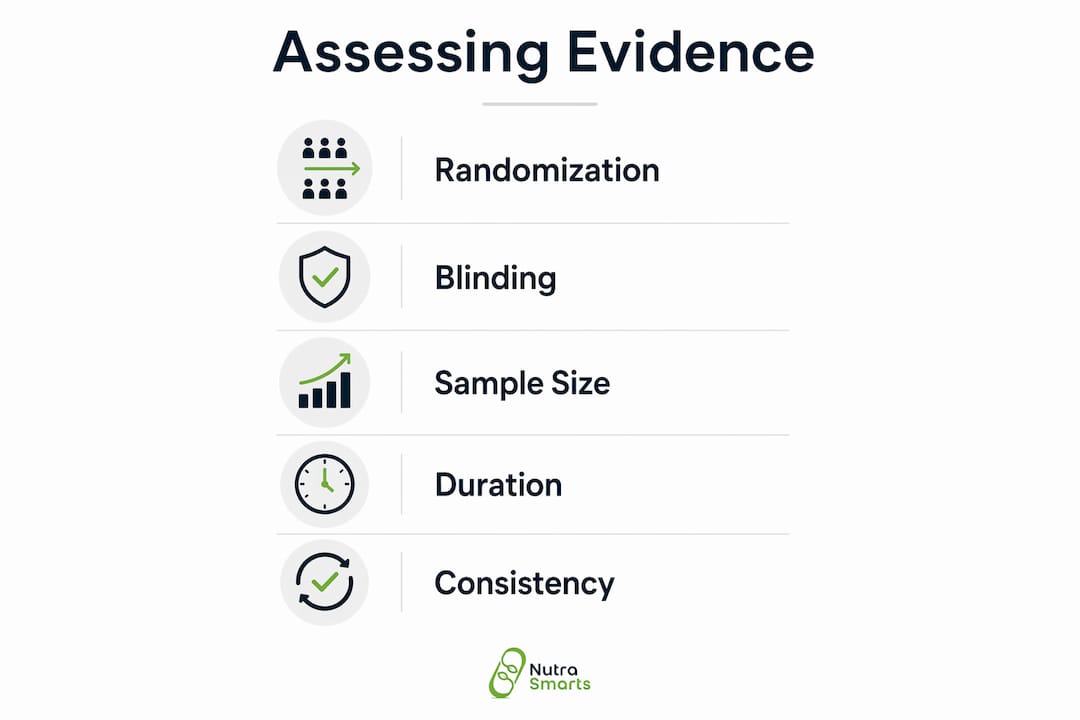
Pro Tip: When evaluating a supplement study, check three things immediately: Was it randomized? Was it blinded? And was the sample size large enough to detect a clinically meaningful difference? If any of these are missing, treat the results as preliminary.
How does regulatory oversight affect supplement efficacy claims?
The regulatory framework governing supplements in the United States is fundamentally different from the one governing pharmaceutical drugs. Under the Dietary Supplement Health and Education Act (DSHEA), manufacturers do not have to prove safety or efficacy to the FDA before bringing a product to market. The FDA's role is primarily post-market: it acts after a product is already on shelves, usually in response to reported harm.
This creates a structural gap between what a label says and what the science supports. Supplement labels are permitted to carry "structure/function" claims under DSHEA, such as "supports immune health" or "promotes joint comfort." These claims must be truthful, but they do not require FDA evaluation for disease outcomes. Labels must include a disclaimer stating the claim has not been evaluated by the FDA and the product is not intended to diagnose, treat, cure, or prevent any disease.
The practical consequences for consumers are significant:
- A supplement can be legally sold with compelling label language and zero RCT data behind it.
- "Clinically studied" on a label does not mean the study was randomized, peer-reviewed, or conducted on the final product formulation.
- Third-party certifications from organizations like NSF International or USP verify purity and label accuracy, not clinical efficacy.
- Understanding non-compliant supplement labels helps you spot the difference between a legitimate claim and a legal but misleading one.
The FDA does not validate efficacy before sale. That responsibility falls entirely on the consumer, which is why independent evidence review is not optional. It is the only protection you have.
How is supplement efficacy evidence evaluated and graded scientifically?
The most widely used framework for grading evidence in clinical medicine is the GRADE system (Grading of Recommendations, Assessment, Development, and Evaluations). GRADE rates evidence certainty across four levels: high, moderate, low, and very low, based on five factors that can reduce confidence in a finding.
| GRADE factor | What it means for supplement evidence |
|---|---|
| Risk of bias | Were the trials properly randomized and blinded? |
| Inconsistency | Do results vary significantly across studies? |
| Indirectness | Was the study population similar to you? |
| Imprecision | Was the sample large enough for reliable conclusions? |
| Publication bias | Are negative results missing from the literature? |
High-certainty evidence from well-designed RCTs translates into strong recommendations. Low-certainty evidence, which is the category most supplements fall into, means the true effect could be substantially different from what studies suggest. Large vitamin D trials illustrate this clearly: randomized evidence shows no benefit for fractures, falls, or heart disease at 2,000 IU per day, and possible harm at doses above 4,000 IU per day. That finding overturned years of observational data suggesting vitamin D was broadly protective.
GRADE also incorporates evidence-to-decision frameworks, which weigh certainty of evidence against values, feasibility, and the risk-benefit balance for a specific individual. GRADE and evidence-to-decision frameworks are why a supplement with moderate-certainty evidence might still be recommended for one population and not another. Context is inseparable from the grade.
Pro Tip: When reading a supplement research summary, look for the GRADE certainty rating or an equivalent label like "strong evidence" versus "preliminary evidence." Resources like the peer-reviewed evidence guide from Nutrasmarts translate these ratings into plain language.
What nuances and pitfalls should you watch for when reading supplement studies?
Validating supplement claims requires more than finding a positive study. Several factors routinely distort how evidence is interpreted, and missing them leads to poor decisions.
Population mismatch is one of the most common errors. Evidence from elite athletes cannot be generalized to the general public without matching the context. The 46-study caffeine review noted that female athletes represented only about 10% of participants, which limits how confidently those findings apply to women. Dosing, training status, and baseline nutrient levels all interact with supplement effects in ways that population-specific data must address.
Biological plausibility versus clinical benefit is another critical distinction. Magnesium plays a role in over 300 enzymatic reactions. That is a biological fact. It does not automatically mean that magnesium supplementation improves sleep, reduces anxiety, or prevents migraines in people who are not deficient. The mechanism exists; the clinical outcome must still be proven in controlled trials.
Additional pitfalls worth knowing:
- Surrogate endpoints: A supplement that improves a biomarker (like homocysteine levels) has not necessarily reduced the risk of the disease that biomarker is associated with.
- Industry-funded studies: Trials funded by supplement manufacturers show positive results at higher rates than independently funded research.
- Short study duration: Many supplement trials run for 8 to 12 weeks. Chronic disease outcomes require years of follow-up data.
- Misdiagnosis confounding: If a person's fatigue is caused by iron deficiency anemia and they take an iron supplement, the improvement reflects correcting a deficiency, not a general efficacy claim for iron in healthy populations.
Efficacy must be assessed ingredient by ingredient and outcome by outcome. Assuming that one positive study for one ingredient in one population applies broadly is the most expensive mistake supplement consumers make.
Practical steps to assess supplement efficacy evidence for your health decisions
Applying scientific support for supplements to your own choices does not require a research degree. It requires a structured approach.
- Start with PubMed or Examine.com. Search the specific ingredient and the specific health outcome you care about. Look for systematic reviews and RCTs first. Ignore press releases and brand websites as primary sources.
- Check the dose. A study showing benefit at 500 mg of a compound is irrelevant if the product you are considering contains 50 mg. Supplement dosage directly impacts real-world effectiveness in ways that labels rarely make clear.
- Read the label critically. Structure/function claims with FDA disclaimers tell you the manufacturer has not submitted efficacy data for regulatory review. That is not automatically disqualifying, but it means the burden of evidence falls on you to find independent research.
- Apply GRADE thinking. Ask: How many trials exist? Are results consistent? Was the study population similar to me? Is the effect size clinically meaningful, not just statistically significant?
- Use curated ingredient databases. Nutrasmarts maintains a database of over 800 ingredients, each linked to peer-reviewed citations, so you can compare supplement ingredients side by side based on actual evidence rather than marketing claims.
- Consult a healthcare professional. A physician, registered dietitian, or clinical pharmacist can interpret evidence in the context of your specific health status, medications, and risk factors. Evidence-based supplementation is always personalized.
Key takeaways
Supplement efficacy evidence is the clinical proof that a supplement works. Without randomized trial data graded by frameworks like GRADE, any claimed benefit remains unverified.
| Point | Details |
|---|---|
| RCTs are the gold standard | Randomized controlled trials eliminate the selection bias that inflates observational study results. |
| FDA does not verify efficacy | Supplements reach shelves without pre-market proof of benefit; independent research review is your responsibility. |
| GRADE grades certainty, not just results | Evidence is rated on bias, consistency, indirectness, imprecision, and publication bias before a recommendation is made. |
| Population context changes everything | Findings from elite athletes or specific deficiency groups do not automatically apply to the general public. |
| Dose and outcome must match | A positive study only applies when the dose, formulation, and measured outcome match your specific situation. |
The uncomfortable truth about supplement evidence
At Nutrasmarts, we have reviewed thousands of ingredient citations, and the pattern is consistent: the supplements with the loudest marketing tend to have the thinnest evidence. That is not a coincidence. When the regulatory bar for making a claim is low, marketing fills the gap that science leaves open.
What genuinely surprises most people is how few supplements have high-certainty GRADE evidence for the outcomes they are most commonly sold for. Vitamin D for bone health in non-deficient adults. Omega-3s for cardiovascular events in people already eating fish. Antioxidant megadoses for cancer prevention. In each case, the observational data looked compelling, and the RCT data told a different story. That pattern should make every consumer more skeptical, not more credulous.
The good news is that scientific literacy is a learnable skill. You do not need to read every trial. You need to know what questions to ask: Was it randomized? What was the dose? Who was the population? What was the actual outcome measured? Those four questions filter out the majority of misleading supplement claims before you spend a dollar.
We also believe that individualized evaluation matters more than categorical rules. Some supplements have strong evidence for specific populations with specific deficiencies or conditions. Dismissing all supplements because some lack evidence is as unscientific as accepting all claims at face value. The goal is calibrated judgment, grounded in the best available data.
— NutraSmarts
Make evidence work for your supplement decisions
Knowing the science is only half the equation. Applying it to your specific health concerns is where most people get stuck.
Nutrasmarts is built for exactly this step. The ingredient database covers over 800 compounds, each linked to clinical trial citations, so you can search by symptom and find supplements by health concern backed by actual peer-reviewed data rather than label copy. If you want to go deeper on a specific ingredient, the Supplement Facts Tool helps you analyze label claims against FDA compliance standards. And if you are comparing two products, the side-by-side comparison guides let you evaluate evidence quality, dosing, and ingredient transparency in one place. Start with the evidence. Nutrasmarts makes that practical.
FAQ
What is supplement efficacy evidence in simple terms?
Supplement efficacy evidence is the scientific proof, primarily from randomized controlled trials, that a dietary supplement produces a measurable health benefit. It is distinct from marketing claims, which do not require FDA evaluation before a product is sold.
How do I know if a supplement has strong scientific support?
Look for multiple randomized controlled trials with consistent results, reviewed through a framework like GRADE. High-certainty evidence means the true effect is unlikely to differ substantially from what the studies show.
Why doesn't the FDA require efficacy proof for supplements?
Under DSHEA, supplement manufacturers are not required to prove efficacy before marketing a product. The FDA regulates quality and safety post-market, which means the burden of evaluating evidence falls on the consumer and their healthcare provider.
Can a supplement study be positive but still misleading?
Yes. Studies with small samples, short durations, surrogate endpoints, or industry funding regularly produce positive results that do not hold up in larger, independent trials. Placebo effects also simulate benefits, particularly in open-label studies without proper blinding.
Does evidence from athlete studies apply to everyone?
Not directly. Research in elite athletes, such as the caffeine performance data from 46 RCTs, reflects specific doses, training loads, and physiological baselines. Applying those findings to a sedentary adult or a different demographic requires matching the population context carefully.