
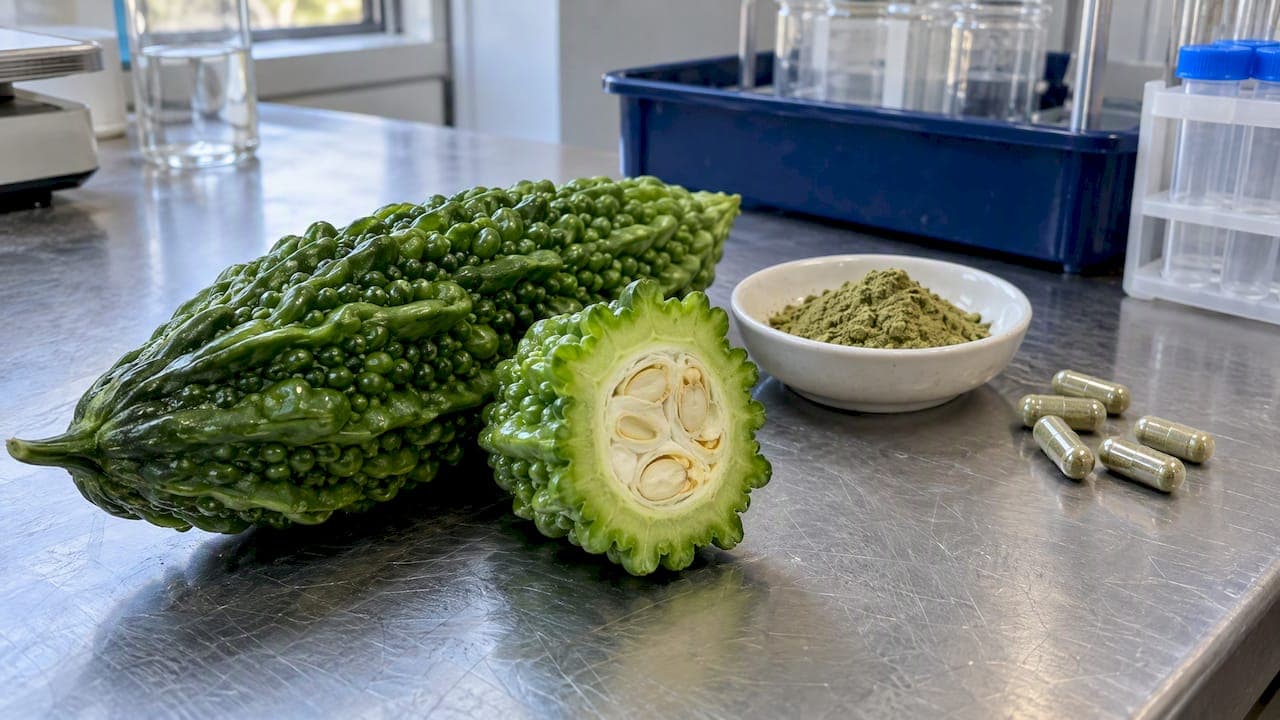
If you are choosing between the two for blood sugar, berberine has the larger and more consistent body of human trials. Bitter melon has a weaker and more contradictory record. Neither replaces diabetes medication, and both can cause trouble if you take prescription drugs. Below we compare them on evidence, dosing, safety and interactions, so you can decide what to bring to your next appointment.
TL;DR
- Berberine has more randomized trials behind it. A meta-analysis of 27 trials with 2,569 patients covered type 2 diabetes, high lipids and hypertension.
- Bitter melon looks weaker. A 2024 meta-analysis concluded its metabolic effect cannot be determined from the available trials.
- Both are unsafe in pregnancy, and both commonly upset the stomach.
- Berberine's main risk is interactions with other drugs. Bitter melon's is low blood sugar when it is stacked on diabetes medication.
- If you have diabetes or take any prescription, talk to your clinician before starting either one.
Table of Contents
- What each one actually is
- Side-by-side comparison
- What the trials show for blood sugar
- Doses people use
- Safety: where the two differ
- The mistake that does real harm
- Our perspective
- How to compare these and similar ingredients yourself
- Find evidence-rated options by symptom
- FAQ
- Sources
What each one actually is
Berberine is a bitter-tasting alkaloid found in several plants. It is sold as an isolated, standardized compound, usually in capsules. That matters for comparison: a berberine capsule is mostly one molecule, so a trial dose is easier to match to a product. You can read our full profile on the berberine ingredient page.
Bitter melon (Momordica charantia, also called bitter gourd) is a vegetable eaten across Asia. As a supplement it appears as dried fruit powder, extract or juice. Those forms contain many compounds in unpredictable ratios, so two products labeled "bitter melon" can differ a lot. See our bitter melon ingredient page for the forms and doses studied.
The terms are interchangeable in one respect only: bitter gourd and bitter melon are the same plant.
Side-by-side comparison
| Question | Berberine | Bitter melon |
|---|---|---|
| Form | Isolated compound | Whole fruit powder, extract or juice |
| Human trial base | Dozens of randomized trials | Fewer, smaller, mixed results |
| Glucose evidence | Possible benefit, rated weak by NCCIH | Inconsistent, no clear effect in pooled data |
| Typical side effects | Diarrhea, cramping, constipation, gas | Diarrhea, abdominal pain |
| Pregnancy | Avoid | Avoid |
| Main interaction concern | Alters how the liver handles other drugs | Additive low blood sugar with diabetes drugs |
| Product consistency | Easier to standardize | Highly variable |
What the trials show for blood sugar
Berberine
The NCCIH overview of diabetes and dietary supplements lists berberine, along with chromium and cinnamon, among supplements with weak evidence of a possible benefit. That is a measured phrase, and it is the right one.
The larger picture is more encouraging. The meta-analysis of 27 randomized trials pooled 2,569 patients and looked at type 2 diabetes, hyperlipidemia and hypertension, with berberine compared against placebo, lifestyle intervention and other drugs. A separate systematic review of randomized trials examined berberine's effect on glycemic and insulin-related traits, including whether results differ by sex, since berberine affects sex hormones.
Two cautions apply. Most trials are short and many come from Asian cohorts, so you cannot assume the results carry over to everyone. And berberine is often compared with metformin because both act on similar pathways, but a supplement is a cruder tool than a precision drug. Dose-response is less predictable. The same meta-analysis literature is why we treat berberine as promising, not proven.
Bitter melon
The bitter melon record is messier. The 2024 systematic review and meta-analysis in the title says it plainly: the metabolic effect cannot be determined from the clinical evidence. In the pooled data, there was no significant difference from placebo for fasting glucose or HbA1c across 9 trials and 414 patients.

One frequently cited human trial is the 2011 comparison with metformin in newly diagnosed type 2 diabetes. Bitter melon at 2,000 mg a day showed a glucose-lowering signal, including a drop in fructosamine, but it was less effective than 1,000 mg a day of metformin. That is a modest result, not a case for swapping a drug for a supplement.
Why do search results seem more upbeat? Many top pages lean on animal and test-tube work, or on small trials. Rodent data on bitter melon's flesh and skin tells you little about what a capsule does in an adult with prediabetes.
So which is better?
On the evidence we can cite, berberine is ahead: more trials, a more consistent direction, and a standardized compound. Ahead is relative, though. Neither is endorsed for routine blood sugar management by diabetes organizations, because the data are inconsistent and side effects are real. A fair summary is that berberine is the more credible candidate and bitter melon is the more uncertain one.
Doses people use
Trial doses for berberine fall in the range of 200 to 1,000 mg, taken two to three times a day, per the research we reviewed. Many people start lower, around 500 mg, because the stomach side effects tend to rise with dose. Our posts on starting at 500 mg to limit side effects and on berberine dosage timing walk through how that looks in practice.
Bitter melon doses are much less settled. The metformin comparison trial used 2,000 mg a day. Because extracts and powders vary, a milligram figure on one label is not equivalent to the same figure on another. If a product does not say which plant part and extract ratio it uses, treat any dose claim with suspicion.
Safety: where the two differ
Pregnancy and breastfeeding
Avoid both. According to the NCCIH, berberine is not advised in pregnancy or while breastfeeding because of a risk of bilirubin buildup in infants that can damage the brain. Bitter melon is also advised against in pregnancy because of concerns about fetal malformations. If you are pregnant or trying to conceive, ask your obstetrician before taking any herbal product.
Digestive side effects
Both commonly cause diarrhea and abdominal pain. Berberine's gut effects are one reason to start low and take it with meals. If symptoms persist, stop and tell your clinician.
Drug interactions
This is where the practical risk lives, and where the two supplements split.
Berberine inhibits CYP enzymes, which the liver uses to process many medications. That can make some drugs build up toward toxicity or work less well, in ways you cannot predict from the label. If you take a drug that is monitored through blood levels, your prescriber may want to check them when you start or stop berberine. Combining berberine with metformin can also compound side effects such as diarrhea and stomach upset, so the pair needs a conversation with your care team first.
Bitter melon is mainly a low blood sugar story. If you use insulin or a sulfonylurea, adding a second glucose-lowering agent can push you too low without anyone adjusting your doses. Dizziness or sweating may not be recognized as a supplement effect. The FDA explains the general risk in its guidance on mixing medications and dietary supplements, and its page on drug interactions is a good primer on why a pharmacist should see your full list.
Who should especially check first: anyone with diabetes, anyone on blood pressure or cholesterol drugs, anyone taking a medication with a narrow safety margin, anyone with kidney disease, and anyone who is pregnant or nursing. Your pharmacist can usually screen a supplement against your medications in a few minutes.
The mistake that does real harm
"Natural" does not mean safe, and it does not mean gentle. The NCCIH five-point guide on type 2 diabetes and supplements starts by telling people with diabetes to talk with a health care provider before taking any supplement. It also warns that some supplements are linked to kidney disease, a particular concern for people with diabetes.
Stopping prescribed medication in favor of an herb can lead to serious blood sugar swings and, over time, complications. If your goal is to reduce medication, the safe route is to work on it with the prescriber who manages your dose.
Our perspective
We built NutraSmarts around a simple idea: an ingredient page should tell you what the trials found, at what dose, and how strong the evidence really is, with no product hype. Applied here, that gives an unglamorous answer. Berberine has the stronger case, but "stronger" still means weak-to-moderate, short-duration evidence. Bitter melon should be rated lower on current data.
We would also push back on the framing of the question. Choosing between the two is the second decision. The first is whether you have a managed plan, meaning labs, a clinician and a sense of what you want the supplement to do. A supplement taken without that is a guess, whichever one you pick. And if you are comparing berberine with something other than bitter melon, our berberine vs inositol comparison uses the same evidence-first approach.
— NutraSmarts
How to compare these and similar ingredients yourself
You can apply the same checklist to any supplement:
- Look for pooled trial data, not a single study. Meta-analyses of randomized trials beat animal work every time.
- Check the population. Were participants like you: same condition, age, background?
- Match the dose. Use the dose and form the trials used, not the label's marketing dose.
- Read the safety section first. Pregnancy, interactions and kidney or liver concerns come before benefits.
- Ask your pharmacist to run the product against your medication list.
Our blood sugar supplement reviews and metabolic health picks apply that checklist across many ingredients, and our post on matching trial doses for insulin resistance shows how to do step 3.
Find evidence-rated options by symptom
If you are not sure berberine or bitter melon is even the right ingredient, start from the symptom instead. Our supplements by symptom tool lets you search by concern, such as brain fog or joint pain, and see ingredients with their clinical citations and evidence ratings. It is free and needs no sign-up.
FAQ
Which is better, berberine or bitter melon?
For blood sugar, berberine has more and more consistent human trial data, so most evidence reviews favor it. Even so, the NCCIH describes the evidence for berberine as weak, and no major diabetes organization recommends either for routine use. Your own medications and health conditions matter more than the ranking.
Can I take berberine and bitter melon together?
There is no good clinical evidence that the combination works better than either alone, and you would be stacking two glucose-lowering effects plus two sources of stomach upset. If you have diabetes or take any medication, check with your clinician or pharmacist before combining them.
Is berberine safer than bitter melon?
Neither is clearly safer. Both are advised against in pregnancy and both cause digestive upset. Berberine's bigger concern is how it changes the way your liver handles other drugs, while bitter melon's is additive low blood sugar with diabetes medication.
Is there a downside to taking berberine?
Yes. Diarrhea, cramping and gas are the common ones, and they tend to be worse at higher doses. It also interacts with other medications and is not for use in pregnancy or breastfeeding, so review it with a clinician first.
Sources
- Diabetes and Dietary Supplements: What You Need To Know, NCCIH
- 5 Things To Know About Type 2 Diabetes and Dietary Supplements, NCCIH
- Meta-analysis of berberine in type 2 diabetes, hyperlipemia and hypertension, PubMed
- Berberine and glycemic and insulin-related traits, systematic review, PubMed
- Metabolic effect of Momordica charantia, systematic review and meta-analysis, PubMed
- Bitter melon compared with metformin in newly diagnosed type 2 diabetes, PubMed
- Mixing Medications and Dietary Supplements Can Endanger Your Health, FDA
- Drug Interactions: What You Should Know, FDA