

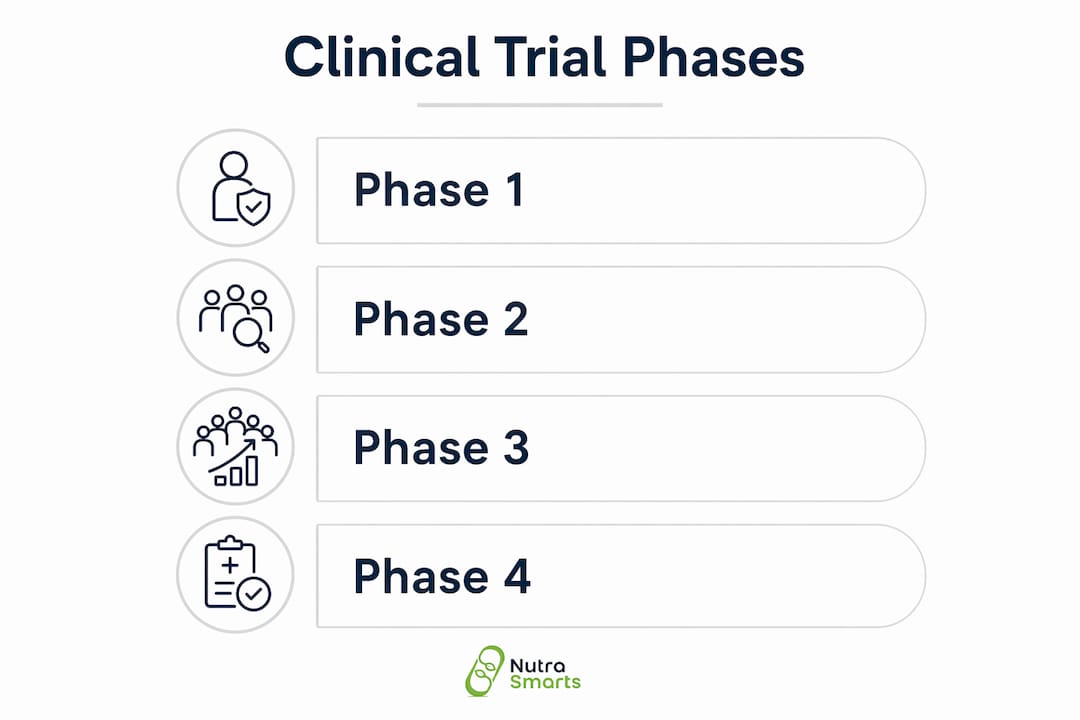
Clinical trial phases for dietary supplements are defined as a four-stage scientific process that evaluates safety, dosage, efficacy, and long-term effects before a supplement reaches widespread use. The standard industry term is "phased clinical development," and understanding it helps you read supplement labels and research claims with real confidence. Each phase increases in scale, starting with 20–80 participants in Phase 1 and expanding to thousands in Phase 4. The FDA, randomized controlled trials (RCTs), and multi-center study designs all shape how this process works for supplements. Knowing the clinical trial phases supplement explained in full gives you a sharper filter for separating credible products from marketing noise.
What happens in Phase 1 clinical trials for supplements?
Phase 1 is the safety phase. Its sole purpose is to determine whether a supplement is safe for human consumption and to identify the right dosage range. Researchers are not yet asking whether the supplement works. They are asking whether it causes harm.

Participant numbers in Phase 1 are deliberately small, typically 20–80 healthy volunteers. Trials run for weeks to a few months, with researchers tracking side effects, how the body absorbs the compound, and how it is metabolized. For supplements, this phase often takes place in a controlled clinical setting where blood markers and organ function are monitored closely.
A typical Phase 1 supplement trial might test three ascending doses of a botanical extract over six weeks. Researchers watch for liver enzyme changes, gastrointestinal distress, and any allergic responses. If no serious adverse events appear, the trial advances to Phase 2.
Key safety endpoints researchers monitor in Phase 1 supplement trials:
- Adverse event rate: Any unexpected reaction, however mild
- Maximum tolerated dose: The highest dose that does not produce unacceptable side effects
- Pharmacokinetics: How the body absorbs, distributes, and clears the supplement
- Organ function markers: Liver and kidney panels, especially for concentrated herbal extracts
- Dropout rate: High early dropout can signal tolerability problems
Pro Tip: When reading a supplement's Phase 1 data, look for the maximum tolerated dose and the dropout rate. A dropout rate above 20% in a small trial is a red flag for tolerability problems, even if the researchers report no serious adverse events.
How do Phase 2 trials assess supplement efficacy and side effects?
Phase 2 is the first time researchers ask whether the supplement actually does something useful. Participant numbers grow to 100–300 people, and this group now includes individuals with the specific condition the supplement targets. Safety monitoring continues, but the primary question shifts to preliminary effectiveness.
Placebo control and randomization become critical at this stage. RCTs eliminate bias by randomly assigning participants to the supplement or a placebo, so neither the researchers nor the participants know who received what. This double-blind design is the reason Phase 2 data carries more weight than anecdotal reports or open-label studies.
A 2026 pilot RCT of krill oil illustrates this phase well. The krill oil trial enrolled 40 participants aged 60 and older in a 12-week double-blind, placebo-controlled study at 4 g per day. The trial showed feasibility and preliminary efficacy for chronic musculoskeletal pain without serious side effects. That result is promising, but 40 participants is still a small sample, and the findings apply specifically to older adults with that condition.
Common limitations in Phase 2 supplement trials:
- Small sample sizes: Trials with fewer than 100 participants are common in herbal research, limiting confidence in the results
- Short duration: Many trials run 8–12 weeks, which may not capture long-term effects
- Narrow population: Results apply only to the tested group, not the general public
- Industry funding: Sponsor-funded trials carry a higher risk of publication bias
- Crossover design risks: Crossover studies can skew results for supplements that accumulate in the body if washout periods are too short
Pro Tip: Check whether a Phase 2 supplement trial used a parallel-group or crossover design. For supplements like collagen or omega-3s that build up in tissue over time, a crossover design with a short washout period can make an ineffective product look effective.
What is the role of Phase 3 clinical trials for supplements?
Phase 3 is the confirmatory stage. Participant numbers jump to 1,000–3,000 or more, and the trial compares the supplement directly against a placebo or an established treatment. This is where researchers determine whether the earlier Phase 2 results hold up at scale and across diverse populations.
Multi-center RCTs are the benchmark for this phase. Large multi-center trials provide the strongest evidence in dietary supplement research, but they remain rare. Running a Phase 3 trial across multiple sites requires significant funding, regulatory coordination, and participant recruitment infrastructure that most supplement companies cannot sustain.
The table below shows how the four phases compare on key design parameters:
| Phase | Participants | Primary goal | Typical design |
|---|---|---|---|
| Phase 1 | 20–80 | Safety and dosage | Open-label or dose-escalation |
| Phase 2 | 100–300 | Preliminary efficacy | Randomized, double-blind, placebo-controlled |
| Phase 3 | 1,000–3,000+ | Confirm efficacy at scale | Multi-center RCT |
| Phase 4 | Thousands (ongoing) | Long-term safety | Observational or registry-based |
A Phase 3 trial for a supplement targeting cardiovascular health, for example, would need to show consistent blood pressure or lipid improvements across different age groups, sexes, and ethnicities. That level of generalizability is what separates a well-supported supplement from one backed only by a single small study.
One critical caveat: supplement clinical trial results cannot be generalized beyond the tested population or conditions due to regulatory and biological variability. A Phase 3 trial conducted in middle-aged men with elevated cholesterol does not automatically prove the same supplement works for young women with normal lipid levels.
- Confirm Phase 2 findings: Phase 3 must replicate the efficacy signal seen in smaller trials before regulators or the market can treat it as established.
- Test across subgroups: Age, sex, ethnicity, and comorbidities all affect how a supplement performs.
- Compare to standard care: Where an existing treatment exists, Phase 3 trials measure whether the supplement performs comparably.
- Identify rare side effects: Low-frequency adverse events that do not appear in 300-person trials often surface when thousands of participants are enrolled.
- Support legal health claims: RCTs provide the scientific and legal basis for supplement health claims, and Phase 3 data is the strongest foundation for those claims.
Pro Tip: When a supplement brand cites a Phase 3 trial, check whether it was multi-center. A single-site trial with 1,000 participants is stronger than a 200-person trial, but a multi-center design with diverse sites is the real gold standard for supplement efficacy evidence.
Why are Phase 4 studies important for supplements?
Phase 4 begins after a supplement is already on the market or in widespread use. These studies monitor thousands of real-world users over months or years, tracking side effects that only emerge with long-term consumption and in populations far more diverse than any controlled trial.
For supplements, Phase 4 data is especially valuable because pre-market trials often run for only weeks or months. A supplement that looks safe over 12 weeks may produce unexpected effects after two years of daily use. Phase 4 catches those signals.
Key functions of Phase 4 supplement studies:
- Long-term safety tracking: Identifies adverse effects that appear only after extended use
- Real-world effectiveness: Measures how the supplement performs outside controlled trial conditions
- Subgroup monitoring: Tracks effects in pregnant women, elderly patients, and people with chronic conditions who are often excluded from earlier phases
- Drug interaction surveillance: Flags interactions with medications that were not apparent in controlled settings
- Regulatory response: Provides the data regulators need to update labeling, restrict dosages, or issue safety warnings
Patients can access ongoing Phase 4 trial data through ClinicalTrials.gov, the U.S. government's public registry of clinical studies. Searching an ingredient name on that platform shows active and completed trials, including Phase 4 observational studies. Nutrasmarts links its ingredient database directly to peer-reviewed studies and clinical trial citations, making it easier to find this evidence without navigating raw research databases.
One important regulatory note: supplements are not drugs. The FDA does not require supplements to complete all four phases before going to market. Phase 4 surveillance is therefore one of the few mechanisms that catches long-term safety problems after a product is already widely used.
Key Takeaways
Understanding clinical trial phases for supplements means recognizing that Phase 1 through Phase 3 build a safety and efficacy case, while Phase 4 monitors real-world outcomes that controlled trials cannot fully capture.
| Point | Details |
|---|---|
| Four-phase structure | Phases 1–4 progress from safety testing in 20–80 people to long-term monitoring in thousands. |
| Phase 2 is preliminary | Efficacy findings from 100–300 participants are promising but not conclusive for the general population. |
| Phase 3 is rare for supplements | Large multi-center RCTs remain uncommon, so most supplement evidence is still preliminary. |
| Generalization is a real risk | Trial results apply only to the specific population, dosage, and condition studied. |
| Phase 4 fills the long-term gap | Post-market studies catch safety signals that short pre-market trials cannot detect. |
The uncomfortable truth about supplement trial evidence
At Nutrasmarts, we review hundreds of clinical citations every year, and the pattern is consistent: most people reading supplement labels overestimate what the trial evidence actually proves. The generalization trap is the most common mistake. A trial conducted in 60-year-old adults with joint pain does not prove a supplement works for a 35-year-old athlete. The biology, the dosage, and the condition are all different.
The second problem is trial size. Small trials with fewer than 30 participants are common in herbal supplement research. Those trials are useful for generating hypotheses, but they are not strong enough to justify confident health claims. When a brand cites a single small study as proof of efficacy, that is a marketing decision, not a scientific one.
What actually moves the needle is a well-designed double-blind supplement trial with a placebo control, a pre-registered protocol, and a participant group that matches your own health profile. Even then, Phase 2 results should be treated as promising, not proven. Phase 3 multi-center RCTs are the threshold where confidence becomes justified, and those are genuinely rare for dietary supplements.
The practical advice: read the participant count, check the trial phase, and ask whether the tested population resembles you. If a supplement has only Phase 1 or Phase 2 data, treat it as early-stage evidence. That does not mean the product is ineffective. It means the science has not yet caught up to the claim.
— Nutrasmarts
How Nutrasmarts connects you to clinical trial evidence
Nutrasmarts was built specifically for patients and health enthusiasts who want to move past marketing claims and read the actual science. The platform covers over 800 ingredients, each linked to peer-reviewed studies and clinical trial citations organized by phase and study design.
If you are trying to match a supplement to a specific health concern, the supplements by symptom tool filters by condition, from joint pain to brain fog, and surfaces only products with clinical backing. For those building or evaluating supplement formulations, the FDA-compliant Supplement Facts Label Creator generates accurate labels without spreadsheet errors. Every ingredient entry connects back to the trial data so you can verify the evidence yourself, not just take a brand's word for it.
FAQ
What are the four phases of a clinical trial for supplements?
Clinical trials progress through four phases: Phase 1 tests safety in 20–80 people, Phase 2 assesses preliminary efficacy in 100–300 participants, Phase 3 confirms results in 1,000–3,000 or more, and Phase 4 monitors long-term effects in real-world populations.
How is a randomized controlled trial different from other supplement studies?
An RCT randomly assigns participants to the supplement or a placebo, eliminating selection bias and isolating the supplement's true effect. This design provides the strongest scientific and legal basis for supplement health claims.
Can I trust a supplement with only Phase 2 trial data?
Phase 2 data is promising but preliminary. Results from 100–300 participants in a specific population should not be generalized to all adults, and Phase 3 confirmation is needed before the evidence is considered strong.
Where can I find clinical trial data for a specific supplement ingredient?
ClinicalTrials.gov lists active and completed trials by ingredient name. Nutrasmarts also provides a searchable ingredient research database that links each ingredient to its clinical citations and study phases.
Why do supplement trials rarely reach Phase 3?
Phase 3 multi-center RCTs require significant funding, regulatory coordination, and large participant pools. Most supplement companies lack the resources to run trials at that scale, which is why large multi-center trials remain rare in dietary supplement research.