

A systematic review is a rigorous, protocol-driven synthesis of all available scientific evidence on a precisely defined supplement question, and it represents the highest standard of evidence for evaluating dietary supplement efficacy and safety. Unlike a narrative review or a brand-sponsored white paper, a systematic review follows a pre-registered protocol, searches multiple databases exhaustively, and applies formal bias assessment to every included study. Tools like PROSPERO for protocol registration, PRISMA reporting guidelines, and the Cochrane RoB2 bias tool define what separates credible evidence from marketing noise. For anyone serious about evaluating supplement claims, understanding how systematic reviews work is the single most useful skill you can develop.
What makes a systematic review of supplements credible?
Credible systematic reviews are defined by upfront planning, not post-hoc cherry-picking. The methodology is locked in before a single study is read, which eliminates the bias that plagues narrative summaries. Here are the six features that distinguish a trustworthy supplement review from a weak one:
- Pre-specified protocol registered in PROSPERO. Registration timestamps the research question, inclusion criteria, and analysis plan before data collection begins. This prevents researchers from shifting goalposts after seeing results.
- Exhaustive multi-database search. High-quality reviews search PubMed, Embase, Cochrane CENTRAL, and often ClinicalTrials.gov. A search limited to one database misses a significant portion of relevant trials.
- Explicit inclusion and exclusion criteria. Every decision about which studies qualify must be stated in advance and applied consistently across all screened records.
- Independent dual screening. Two researchers screen titles, abstracts, and full texts separately. Disagreements are resolved by consensus or a third reviewer, reducing individual bias.
- Formal risk-of-bias assessment. Tools like Cochrane RoB2 evaluate randomization, blinding, and outcome reporting for each included trial. A review that skips this step cannot be trusted.
- PRISMA-compliant reporting. The Preferred Reporting Items for Systematic Reviews and Meta-Analyses checklist covers 27 items. Reviews that report all 27 are far more transparent and reproducible than those that do not.
Pro Tip: When you find a supplement systematic review online, search its title in PROSPERO before reading the conclusions. If it is not registered, treat the findings with extra skepticism.
Meta-analyses within systematic reviews add statistical pooling of results across trials. The I2 statistic quantifies how much variability exists across studies. High I2 values above 75% signal that pooled results should be interpreted cautiously, because the studies may be measuring different things despite sharing a supplement name.
How systematic reviews reveal real supplement benefits and limits
The most counterintuitive lesson from systematic reviews in nutrition is that biological plausibility does not guarantee clinical benefit. Calcium and vitamin D are a perfect example. A 2026 BMJ systematic review of 69 trials involving more than 153,000 adults found that these supplements showed little to no clinically meaningful effect on fracture risk. The biology of bone metabolism clearly involves both nutrients, yet the population-level evidence does not support supplementation as a fracture prevention strategy for most adults. This gap between mechanism and outcome is one of the most important things systematic reviews teach us.

Heterogeneity compounds the problem. A 2026 Frontiers systematic review on supplements for mild cognitive impairment reported an I2 of 96% across included studies. That number means the results varied so dramatically across trials that the pooled average is nearly meaningless for any individual consumer. PUFA supplements showed some benefit in that review, but the uncertainty is high enough that no confident recommendation is possible.
Evidence grading systems exist precisely to communicate this uncertainty. The GRADE framework rates evidence certainty as high, moderate, low, or very low. Most supplement outcomes land in the low or very low category, as confirmed by certainty assessments in turmeric research and across dozens of other ingredient reviews. Low certainty does not mean a supplement is ineffective. It means the current evidence cannot reliably confirm or deny the effect.
"Statistical significance is not the same as clinical meaningfulness. A supplement that moves a biomarker by 2% in a 6-week trial may be statistically significant and completely irrelevant to your long-term health."
Several additional limitations appear repeatedly in supplement systematic reviews:
- Short trial durations. Most supplement trials run 8 to 12 weeks. Chronic conditions like cognitive decline or cardiovascular disease develop over decades, making short-term surrogate endpoints a poor proxy for real outcomes.
- Surrogate endpoints. Trials measuring blood levels or biomarkers rather than clinical events (fractures, hospitalizations, mortality) tell you less than they appear to.
- Underpowered studies. Many supplement trials enroll fewer than 100 participants, which limits the ability to detect modest but real effects.
- Publication bias. Positive results are more likely to be published, which inflates apparent efficacy in pooled analyses.
Does supplement form and purity affect how you read a review?
Systematic reviews pool results across trials, but those trials often use different supplement forms, doses, and delivery mechanisms. Bioactive form, dose, and bioavailability vary enough across formulations that averaging them can obscure true effects entirely. A review of magnesium supplementation, for example, might pool trials using magnesium oxide (poor bioavailability) alongside trials using magnesium glycinate (high bioavailability). The pooled result tells you something about "magnesium" in the abstract, but very little about the specific product you are considering.
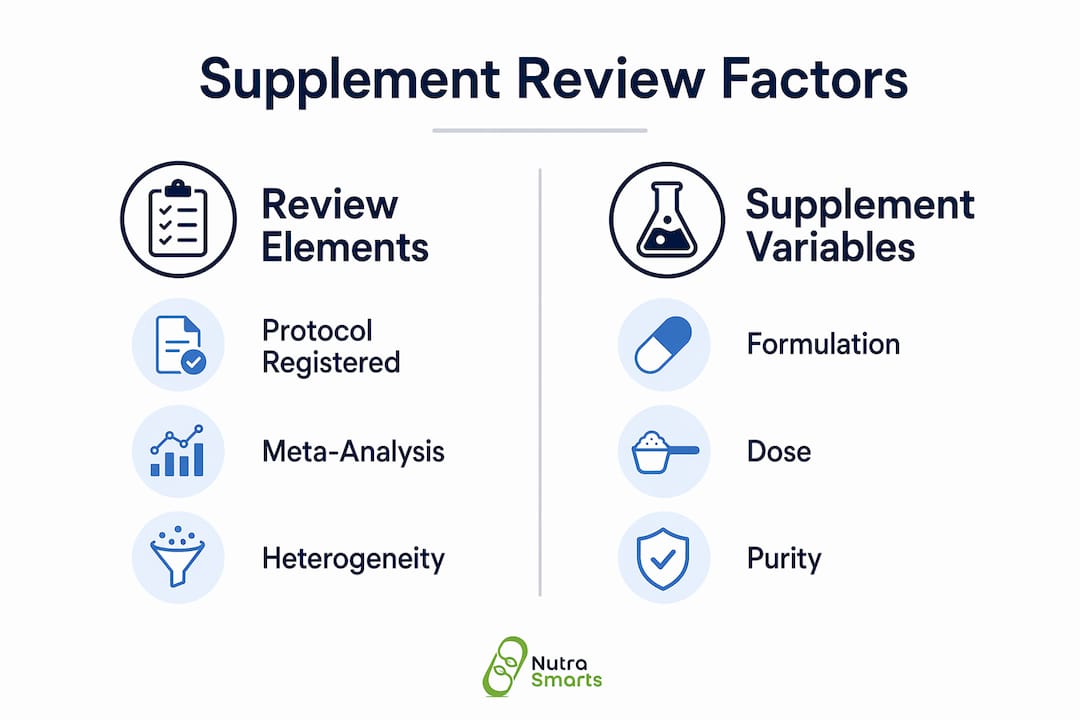
Contamination adds a separate safety dimension that efficacy reviews rarely address. A systematic review of sport supplements found 9 to 15% of tested products contaminated with prohibited or undisclosed substances, with pre-workout, weight-loss, and muscle-building categories carrying the highest risk. This contamination rate is not a fringe concern. It means roughly 1 in 10 products in high-risk categories contains something not listed on the label.
| Factor | What it means for interpreting reviews |
|---|---|
| Formulation differences | Pooled results may not apply to the specific form in your supplement |
| Dose variability | Trials using sub-therapeutic doses underestimate real-world efficacy |
| Contamination risk | 9 to 15% contamination rate in high-risk categories creates safety concerns independent of efficacy |
| Labeling accuracy | Label claims may not match actual ingredient content, as detailed in non-compliant label examples |
Pro Tip: Cross-reference the dose and form used in the systematic review's included trials against the label of the product you are evaluating. If the review used 500 mg of a specific bioactive form and your product uses 100 mg of a different form, the evidence does not directly apply.
Third-party testing programs from organizations like NSF International, USP, and Informed Sport verify that a product contains what the label claims and nothing it does not. These certifications do not guarantee efficacy, but they address the contamination and labeling accuracy gap that systematic reviews cannot close on their own.
How to apply supplement systematic reviews to your own choices
Reading a systematic review critically is a learnable skill. The following checklist covers the most important evaluation steps for any consumer serious about evaluating dietary supplements with real evidence:
- Check PROSPERO registration. A registered protocol signals that the methods were pre-specified, not reverse-engineered from favorable results.
- Scan the search strategy. A credible review lists every database searched and the exact search terms used. Vague descriptions of "a literature search" are a red flag.
- Look at the risk-of-bias table. If most included trials are rated high risk of bias, the pooled conclusions are unreliable regardless of statistical significance.
- Read the GRADE certainty ratings. Low or very low certainty means the true effect could be substantially different from the estimate. High certainty means the evidence is unlikely to change with more research.
- Match the intervention to your product. Confirm that the supplement form, dose, and population studied in the review match your situation. A review in elderly adults with documented deficiency does not apply to a healthy 35-year-old.
- Separate efficacy from safety. A supplement with moderate efficacy evidence but high contamination risk in its category requires a different decision than one with strong evidence and clean third-party testing.
One underappreciated finding: a 2026 umbrella review of resveratrol assessed 45 systematic reviews and found that only a handful of health outcomes reached high-certainty evidence, with blood pressure reduction being one of the few. Umbrella reviews, which synthesize multiple systematic reviews on the same ingredient, represent the top tier of evidence and are worth seeking out when they exist. Most supplement categories do not yet have them, which itself tells you something about the maturity of the evidence base.
Ingredient transparency is another layer worth examining. When a supplement uses a proprietary blend without disclosing individual ingredient amounts, you cannot verify whether the doses match those studied in trials. Resources that explain ingredient transparency for consumers make this verification step much easier.
Key takeaways
Systematic reviews are the most reliable tool for evaluating supplement efficacy, but their conclusions only apply when the review's methods are rigorous, the evidence certainty is high, and the studied formulation matches the product you are considering.
| Point | Details |
|---|---|
| Protocol registration matters | Trust reviews registered in PROSPERO with pre-specified methods over unregistered narrative summaries. |
| Most evidence is low certainty | GRADE ratings of low or very low are common in supplement reviews; statistical significance alone is not enough. |
| Heterogeneity limits pooled results | An I2 above 75% means pooled findings may not apply to your specific situation or supplement form. |
| Contamination is a real risk | Roughly 9 to 15% of high-risk supplement categories contain undisclosed or prohibited substances. |
| Match the review to your product | Confirm that the dose, form, and population in the review align with the supplement you are evaluating. |
What I have learned from years inside supplement evidence
The most common mistake I see is treating a positive systematic review headline as a green light to buy. The headline says "omega-3s linked to cognitive benefit." The fine print says I2 = 96%, evidence certainty is very low, and most trials ran for 12 weeks in populations with existing deficiencies. Those two things are not the same story.
The second mistake is the opposite: dismissing a supplement entirely because one large trial found no effect. The calcium and vitamin D fracture data is genuinely sobering, but it does not mean those nutrients are useless. It means population-wide supplementation for fracture prevention is not supported. Someone with documented deficiency is in a different evidence category entirely.
What I have found actually works is treating systematic reviews as a starting point, not a verdict. You use the review to understand the quality and direction of evidence, then you layer in formulation specifics, contamination risk, and your own health context. A supplement with moderate evidence, a third-party tested product, and a dose matching the trial protocol is a far more defensible choice than one with a glowing headline and no quality verification.
The research base for supplements is evolving faster than most consumers realize. Umbrella reviews are becoming more common, GRADE assessments are more standardized, and contamination surveillance is improving. Staying current with the evidence is not optional if you want your supplement decisions to hold up over time.
— NutraSmarts
Make smarter supplement decisions with NutraSmarts
NutraSmarts was built specifically for the kind of evidence-based thinking this article describes. The platform's database covers more than 800 ingredients, each linked to peer-reviewed studies and clinical trial citations, so you can move from a systematic review finding directly to a verified ingredient profile. The metabolic health supplement reviews integrate efficacy evidence with quality assessments, saving you the manual work of cross-referencing trials and product labels. For consumers who want to verify label accuracy against studied doses, the Supplement Facts Label Creator provides FDA-compliant label generation without the spreadsheet complexity. If you are ready to apply systematic review evidence to a real supplement decision, NutraSmarts gives you the tools to do it with confidence.
FAQ
What is a systematic review in nutrition research?
A systematic review is a pre-registered, protocol-driven synthesis of all available evidence on a specific nutrition or supplement question. It differs from a narrative review by requiring exhaustive database searches, explicit inclusion criteria, and formal bias assessment for every included study.
Why do so many supplement systematic reviews show low certainty evidence?
Most supplement trials are short-term, use surrogate endpoints, and enroll small populations, which limits the strength of conclusions. The GRADE framework rates these limitations honestly, which is why low or very low certainty ratings are common across supplement categories.
What does high heterogeneity mean in a supplement review?
High heterogeneity, measured by an I2 statistic above 75%, means the results varied substantially across included studies. This often reflects differences in supplement form, dose, participant baseline status, or outcome definitions, and it signals that the pooled average may not apply to any specific individual.
How do I know if a systematic review applies to the supplement I am taking?
Check whether the review's included trials used the same supplement form, dose, and population as your situation. A review pooling trials of magnesium oxide does not directly apply to a magnesium glycinate product, even though both are labeled as magnesium supplements.
Is contamination risk addressed in supplement systematic reviews?
Efficacy-focused systematic reviews rarely address contamination directly. A separate body of contamination surveillance research shows 9 to 15% contamination rates in high-risk categories. Consumers should treat efficacy evidence and safety or quality evidence as two separate but equally important inputs into any supplement decision.