

Cofactors are molecules that enzymes require to catalyze the biochemical reactions that convert nutrients into forms your body can actually absorb. Without them, the enzymes responsible for processing iron, zinc, B vitamins, and dozens of other nutrients simply stop working. The role of cofactors in nutrient absorption is not a secondary concern. It sits at the center of why two people eating the same diet can have very different nutritional outcomes. Understanding how cofactors work gives you a direct lever for improving what your body actually gets from food and supplements.
What is the role of cofactors in nutrient absorption?
Cofactors are defined as non-protein chemical compounds that bind to enzymes and are required for their catalytic activity. An enzyme without its cofactor is called an apoenzyme. It has a shape but no function. When the cofactor binds, the complex becomes a holoenzyme, which is the active, working form. This distinction matters because it means nutrient absorption is not just about eating enough of a nutrient. It depends on whether the right cofactors are present to activate the enzymes that process it.
Cofactors provide both catalytic function and structural stability to enzymes, making them indispensable beyond simple helpers. That means a cofactor deficiency does not just slow absorption. It can shut it down entirely. Magnesium, for example, activates over 300 enzyme systems in the body, including those involved in protein synthesis and energy metabolism. Zinc functions as a critical cofactor for up to 300 enzymes important in metabolism. That scale shows why a single mineral deficiency can produce wide-ranging symptoms across multiple body systems.
What types of cofactors are involved in nutrient absorption?
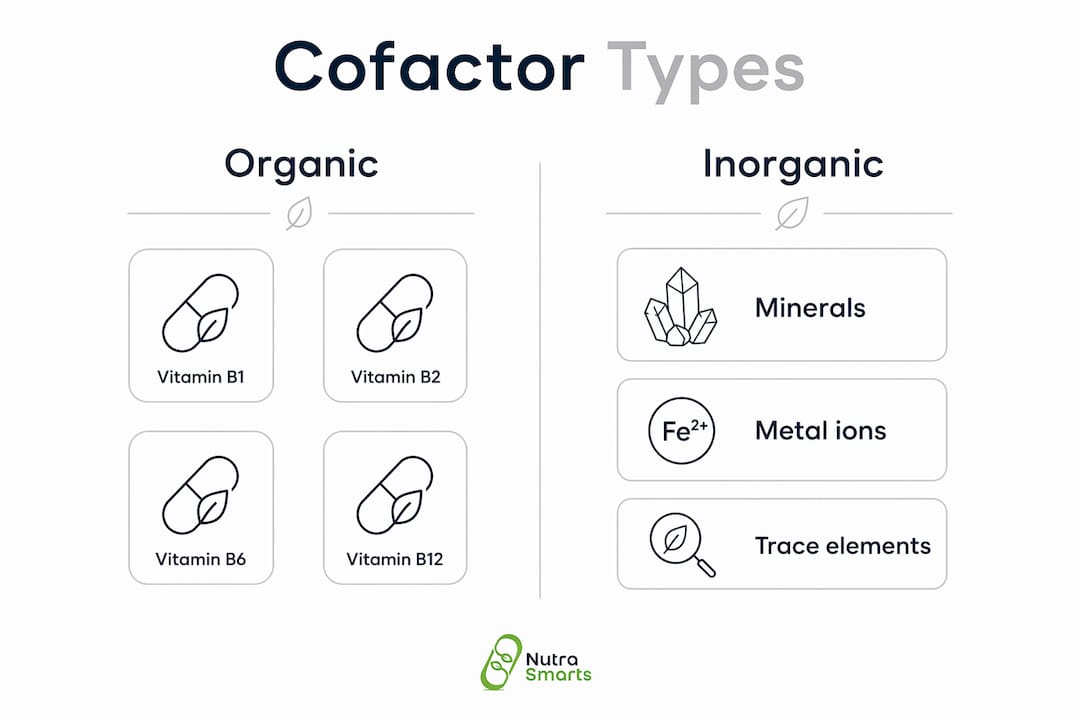
Cofactors split into two main categories: inorganic metal ions and organic coenzymes. Each plays a distinct role in how enzymes process nutrients.
Inorganic metal ion cofactors include minerals that bind directly to enzyme active sites:
- Iron activates enzymes involved in oxygen transport and electron transfer reactions.
- Zinc stabilizes enzyme structure and participates in catalytic reactions across metabolic pathways.
- Magnesium acts as a bridge between enzyme and substrate, particularly in phosphate-transfer reactions.
- Copper supports enzymes involved in iron metabolism and antioxidant defense.
- Manganese activates enzymes critical for carbohydrate metabolism and bone formation.
Organic coenzymes are derived primarily from vitamins and bind either tightly or loosely to their enzymes:
- Prosthetic groups bind permanently to the enzyme. FAD (derived from riboflavin, vitamin B2) is one example. It stays attached and participates in repeated redox cycles.
- Loosely bound coenzymes act more like co-substrates, detaching after each reaction. NAD+ (derived from niacin, vitamin B3) works this way, shuttling electrons between reactions.
Vitamins B1, B2, B6, B12, niacin, and folic acid) all serve as precursors or direct organic cofactors for enzymatic reactions. This is why B vitamin deficiencies produce such broad metabolic effects. They are not just nutrients. They are the raw material for the coenzymes that run nutrient metabolism.
How do cofactors mechanistically enhance the absorption of key nutrients?
The most studied example of cofactor-driven absorption is iron. Non-heme iron from plant foods arrives in the gut as ferric iron (Fe3+). Enterocytes cannot absorb it in that form. Vitamin C reduces Fe3+ to ferrous iron (Fe2+) through the Dcytb reductase enzyme, which sits on the surface of intestinal cells. That chemical reduction is the gateway to absorption. Without vitamin C acting as a cofactor in this process, a significant portion of plant-based iron passes through unabsorbed.
Zinc's mechanism is different but equally dependent on cofactor activity. Approximately 15–40% of consumed zinc is absorbed, and that range reflects how heavily absorption depends on competing dietary factors and enzyme availability. Zinc does not just get absorbed. It also enables the enzymes that regulate how other nutrients are processed once inside the cell.
| Cofactor | Nutrient supported | Mechanism |
|---|---|---|
| Vitamin C | Non-heme iron | Reduces Fe3+ to Fe2+ via Dcytb reductase |
| FAD (from B2) | Energy substrates | Electron transfer in redox reactions |
| NAD+ (from B3) | Carbohydrates, fats | Electron shuttling in metabolic pathways |
| Zinc | Multiple nutrients | Enzyme structural stability and catalysis |
| Dietary fat | Fat-soluble vitamins A, D, E, K | Micelle formation enabling intestinal uptake |
Fat-soluble vitamins illustrate a different cofactor concept entirely. Vitamins A, D, E, and K require dietary fat to form micelles for absorption through intestinal walls. Fat is not a cofactor in the strict enzymatic sense, but it performs the same enabling function. Without it, these vitamins cannot reach the intestinal wall at all.
Absorption is also regulated at the hormonal level. The liver hormone hepcidin controls iron transporter availability, adjusting how much iron enters circulation based on the body's current stores. Even when cofactors are present and enzymes are active, physiological signals can dial absorption up or down. This shows that nutrient absorption is a regulated process, not a passive one.
Enzymes using FAD and NAD+) rely on these molecules for electron transfer critical to nutrient metabolism. These redox reactions are how the body extracts usable energy from carbohydrates, fats, and proteins. A deficiency in riboflavin or niacin does not just affect one pathway. It disrupts the entire electron transport chain that powers cellular metabolism.
Pro Tip: Pair vitamin C-rich foods like bell peppers or citrus with plant-based iron sources at the same meal. The reduction reaction happens in real time during digestion, so timing matters.
What factors influence cofactor availability and effectiveness?
Cofactor availability depends on diet, gut health, and the presence of competing compounds. Each factor can either support or undermine the enzymatic reactions that drive absorption.
Dietary factors:
- A diet low in B vitamins reduces the supply of coenzymes like FAD and NAD+, slowing energy metabolism and nutrient processing.
- Low dietary fat impairs absorption of fat-soluble vitamins regardless of how much you consume.
- Phytates in whole grains and legumes bind zinc and iron, reducing their availability as cofactors before they even reach intestinal enzymes.
Gut health and microbiome:
The gut microbiota plays a direct role in cofactor-dependent absorption. Gut bacteria ferment dietary fiber into short-chain fatty acids, which help absorb calcium and magnesium. Prebiotics can increase colonic calcium absorption from around 10% to approximately 30% of daily total. That is a meaningful difference driven entirely by microbial activity, not dietary calcium intake.
Nutrient competition:
Calcium competes with iron for intestinal transporters. High calcium intake inhibits both heme and non-heme iron absorption. This is why taking a calcium supplement alongside an iron supplement at the same time reduces the effectiveness of both. Cofactor-dependent transporters have limited capacity, and competing minerals reduce throughput.
Deficiency cascades:
A deficiency in one cofactor often impairs the absorption of multiple nutrients simultaneously. Low zinc reduces the activity of enzymes that process vitamin A. Low magnesium impairs over 300 enzyme systems. Identifying the root deficiency, rather than supplementing individual nutrients in isolation, produces better outcomes. Nutrasmarts covers the clinical consequences of these gaps in its deficiency symptom guide.
Pro Tip: If you take iron supplements, avoid pairing them with calcium-rich foods or dairy at the same meal. Separate them by at least two hours to prevent transporter competition.
How can you use cofactor knowledge to improve nutrient absorption?
Applying cofactor science to your diet does not require a biochemistry degree. A few targeted changes produce measurable results.
-
Pair iron with vitamin C at every plant-based meal. Squeeze lemon juice over lentils, add bell peppers to spinach salads, or eat citrus alongside fortified cereals. The reduction of Fe3+ to Fe2+ happens during digestion, so the pairing must be simultaneous.
-
Include healthy fats with fat-soluble vitamins. Add olive oil to salads containing leafy greens rich in vitamin K. Eat avocado with foods high in vitamin E. Without dietary fat, micelle formation fails and these vitamins pass through unabsorbed.
-
Prioritize B vitamin sources to maintain coenzyme supply. Eggs, meat, legumes, and fortified grains supply B1, B2, B6, and B12. These are the raw materials for FAD and NAD+, the coenzymes that power redox reactions across nutrient metabolism.
-
Support gut microbiota to enhance mineral absorption. Prebiotic fiber from garlic, onions, and chicory root feeds the bacteria that produce short-chain fatty acids. Those fatty acids improve calcium and magnesium uptake through the colon wall.
-
Separate competing minerals when supplementing. Take zinc supplements at a different time from copper supplements, and separate iron from calcium. Transporter competition is real and predictable. Timing is the simplest fix.
-
Check supplement formulas for cofactor inclusion. A well-formulated supplement includes the cofactors needed to activate its key ingredients. Vitamin D supplements that include vitamin K2 and magnesium reflect this principle. Magnesium activates the enzymes that convert vitamin D into its active hormonal form. For a deeper look at how bioavailability is built into supplement design, the 2026 bioavailability formulation guide covers the formulation steps in detail.
-
Address deficiencies at the root. If you suspect a cofactor deficiency, identify it specifically rather than adding more of the downstream nutrient. Low iron absorption may reflect low vitamin C intake, not low iron intake.
Key Takeaways
Cofactors are not optional additions to nutrient metabolism. They are the structural and catalytic components that determine whether enzymes can process nutrients at all.
| Point | Details |
|---|---|
| Cofactors activate enzymes | Without cofactors, apoenzymes have no catalytic activity and nutrient processing stops. |
| Vitamin C drives iron absorption | Vitamin C reduces Fe3+ to Fe2+ via Dcytb reductase, enabling non-heme iron uptake. |
| Zinc supports 300+ enzymes | Zinc cofactor activity spans hundreds of metabolic pathways, making deficiency broadly damaging. |
| Gut microbiota affects cofactor uptake | Prebiotic fiber boosts colonic calcium absorption from roughly 10% to 30% of daily total. |
| Nutrient timing reduces competition | Separating calcium and iron by two hours prevents transporter competition and improves both. |
What most nutrition advice gets wrong about cofactors
Most supplement advice focuses on the nutrient itself and ignores the cofactor that makes it work. I have seen this pattern repeatedly when reviewing supplement formulations through Nutrasmarts: a product delivers a high dose of a single nutrient with no attention to the enzymatic context that determines whether the body can use it.
The iron supplement market is a clear example. Many products deliver high-dose ferrous sulfate without vitamin C, despite the fact that the Dcytb reductase pathway requires that reduction step to function. The dose looks impressive on the label. The absorption rate tells a different story.
The same logic applies to vitamin D. Most standalone vitamin D supplements ignore magnesium entirely. Magnesium activates the enzymes that convert vitamin D into its active hormonal form, calcitriol. A person who is magnesium-deficient and takes vitamin D supplements may see little improvement in their vitamin D status, not because the supplement is low quality, but because the cofactor is missing.
The uncomfortable truth is that isolated nutrient supplementation often underperforms not because the nutrient is wrong, but because the enzymatic infrastructure is incomplete. Cofactor-aware formulation is not a marketing angle. It is basic biochemistry that the supplement industry has been slow to apply consistently.
— Nutrasmarts
Nutrasmarts and cofactor-aware supplement research
Nutrasmarts was built around exactly this problem. Choosing a supplement based on a single ingredient dose misses the enzymatic context that determines real-world results.
The Nutrasmarts ingredient database covers over 800 ingredients, each linked to peer-reviewed studies and clinical trial citations. You can search by health concern and filter for ingredients with documented cofactor interactions. For metabolic health specifically, the best metabolic health supplements section reviews 130 products with attention to how their formulas support enzymatic nutrient processing. If you want to understand what is actually in your supplement and why it matters biochemically, Nutrasmarts gives you the research to make that call with confidence.
FAQ
What are cofactors in nutrition?
Cofactors are non-protein molecules that bind to enzymes and are required for their catalytic activity. Without a cofactor, an enzyme (called an apoenzyme) cannot process nutrients.
How do cofactors aid absorption of iron?
Vitamin C acts as a cofactor by reducing ferric iron (Fe3+) to ferrous iron (Fe2+) via the Dcytb reductase enzyme, which is the form enterocytes can absorb.
Why does zinc matter as a cofactor?
Zinc functions as a cofactor for up to 300 enzymes involved in metabolism. Low zinc absorption, which ranges from 15–40% of intake, can impair a wide range of metabolic processes simultaneously.
Can gut health affect cofactor effectiveness?
Yes. Gut microbiota ferment fiber into short-chain fatty acids that improve mineral absorption. Prebiotic intake can raise colonic calcium absorption from around 10% to approximately 30% of daily total.
Should I take iron and calcium supplements together?
No. Calcium competes with iron for intestinal transporters and inhibits both heme and non-heme iron absorption. Separate them by at least two hours for best results.