

Explaining supplement ingredients to clients is defined as the structured process of translating label data, ingredient functions, and safety profiles into clear, evidence-backed guidance that supports informed health decisions. Health professionals who master this skill reduce client confusion, improve adherence, and build the kind of trust that keeps people coming back. The Supplement Facts panel, ingredient forms, third-party certifications, and drug interaction risks are the four pillars every practitioner must understand before walking a client through a single bottle. This guide gives you the clinical framework to do exactly that.
How to explain supplement ingredients to clients using label literacy
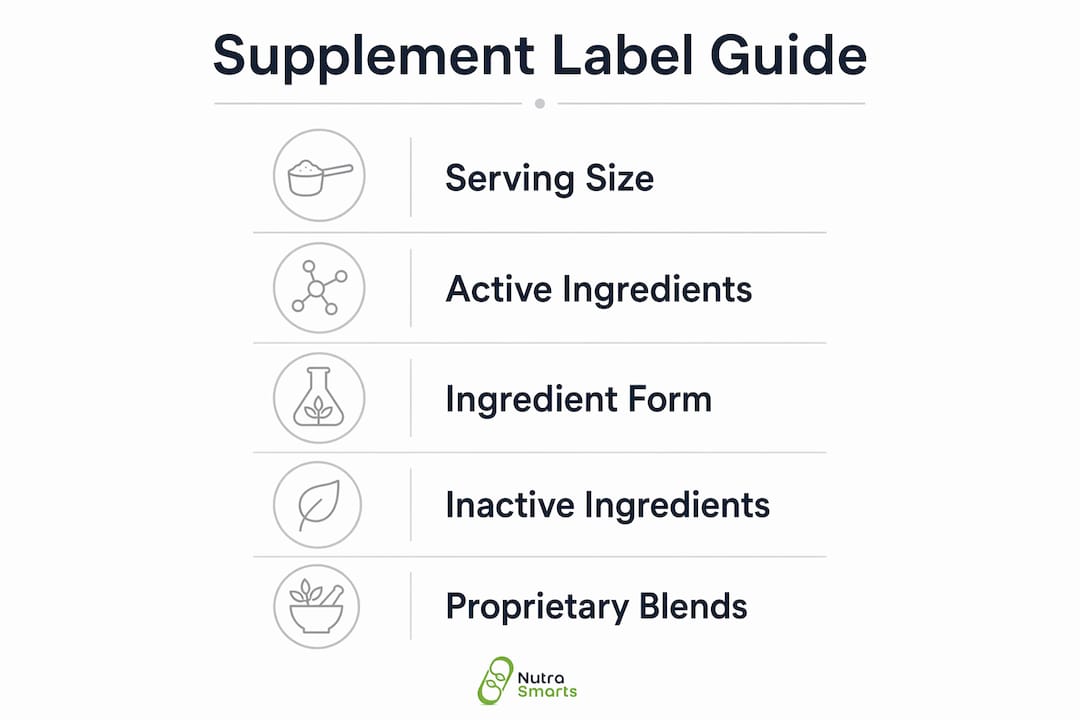
The Supplement Facts panel is the starting point for every ingredient conversation. It lists serving size, active ingredients, amounts per serving, and percent Daily Value (%DV) in a standardized FDA-regulated format. Understanding how each section maps to real-world efficacy is what separates a useful client conversation from a confusing one.
What each label section tells you
| Label section | What to check |
|---|---|
| Serving size | Confirms dose per use; compare to clinical research doses |
| Active ingredients | Verify form, not just name (e.g., methylfolate vs. folic acid) |
| %DV | Useful for vitamins and minerals; absent for many botanicals |
| Other ingredients | Scan for allergens, fillers, and artificial additives |
| Third-party seal | Look for USP, NSF, or Informed Sport marks |
Inactive ingredients are not irrelevant. Binders and fillers influence product stability and can trigger sensitivities in clients with soy, dairy, or corn allergies. Teaching clients to read the "Other Ingredients" section prevents GI distress and allergic reactions that get misattributed to the active compounds.
Proprietary blends are the most common labeling problem you will encounter. They list a blend total weight but not individual ingredient amounts, which means a product could legally contain a subclinical ingredient level of every active compound inside it. This practice is called pixie dusting, and it is widespread in sports nutrition and weight management categories.
Pro Tip: When a client brings in a supplement with a proprietary blend, ask them to look up whether the blend total weight is at or above the clinically studied dose for the primary ingredient. If it is not, the entire blend is likely underdosed.
Red flags to flag for clients when reviewing any label include:
- Proprietary blends with no individual ingredient weights
- Marketing claims like "clinically proven" without a cited study
- Missing lot numbers or expiration dates
- No third-party certification seal
- Allergen-containing fillers buried in "Other Ingredients"
For a deeper breakdown of how Supplement Facts panels differ from Nutrition Facts panels, the label format differences are worth reviewing before your next client session.
Does ingredient form actually change how well a supplement works?
Ingredient form determines bioavailability, and bioavailability determines whether a supplement produces a clinical effect or expensive urine. Different chemical forms of the same nutrient lead to significant variation in absorption and efficacy. This is one of the most under-discussed topics in client supplement education.
Magnesium is the clearest example. Magnesium glycinate is chelated to glycine, which improves intestinal absorption and reduces the laxative effect common with cheaper forms. Magnesium oxide, by contrast, has roughly 4% bioavailability. A client taking 400 mg of magnesium oxide is absorbing far less elemental magnesium than one taking 200 mg of magnesium glycinate. The label dose means nothing without knowing the form.
Folate tells a similar story. Folic acid requires enzymatic conversion to the active form 5-methyltetrahydrofolate (5-MTHF). Clients with the MTHFR gene variant cannot perform this conversion efficiently, making methylfolate the only clinically relevant form for that population. Recommending folic acid to an MTHFR-positive client is not just suboptimal. It may be counterproductive.
For botanical supplements, standardized extracts guarantee a minimum concentration of active compounds, improving potency predictability. A non-standardized ashwagandha powder may contain anywhere from trace to therapeutic levels of withanolides. A standardized extract labeled "5% withanolides" delivers a consistent, measurable dose every time.
Pro Tip: Train clients to look for the form name in parentheses after the ingredient name on the label. "Magnesium (as magnesium glycinate)" is the signal they want. If the form is not listed, the manufacturer is not being transparent about quality.
Additional ingredient form comparisons worth discussing with clients:
- Vitamin D3 (cholecalciferol) vs. D2 (ergocalciferol): D3 raises serum levels more effectively
- Zinc picolinate vs. zinc oxide: picolinate absorbs significantly better
- Curcumin with piperine or phospholipid complex vs. plain curcumin: absorption increases dramatically with delivery system
What safety and interaction information should you discuss about supplement ingredients?
Supplement safety is not a secondary concern. It is the first conversation that builds client trust and protects your professional credibility. The most dangerous assumption clients make is that supplements are inert because they are sold without a prescription.
Green tea extract reduces warfarin efficacy by 30 to 50%, and St. John's Wort lowers digoxin concentration by 26%. These are not theoretical risks. They are documented pharmacokinetic interactions that can result in treatment failure or toxicity. Any client on anticoagulants, cardiac medications, or immunosuppressants needs a full supplement review before adding anything new.
Timing is equally important and frequently missed. Spacing minerals like calcium and magnesium two to four hours apart from thyroid medications or antibiotics prevents absorption interference that reduces both the supplement and the drug's effectiveness. A client taking levothyroxine with a calcium-containing multivitamin at breakfast is likely undermining their thyroid treatment without knowing it.
Safety note: Always ask clients for a complete medication list before recommending any supplement protocol. Even "natural" products carry real pharmacological activity. Red yeast rice, for example, contains monacolin K, which is chemically identical to lovastatin and raises serious risks when combined with statin medications.
Third-party certifications are the most reliable shortcut for verifying label accuracy. USP-certified products show 92% label accuracy compared to 67% for uncertified products, yet only about 18% of brands carry such marks. Recommending certified products is not just a quality preference. It is a risk management decision.
Pro Tip: Keep a reference list of common drug-supplement interactions organized by medication class. Share it with clients who are on multiple prescriptions. The clinical evidence behind interactions is well-documented and easy to summarize in plain language.
Key safety points to cover in every supplement discussion:
- Ask about all current medications before recommending anything
- Check "Other Ingredients" for allergens specific to the client
- Confirm timing of intake relative to medications
- Prioritize third-party certified products when possible
- Flag any supplement with stimulant compounds for clients with cardiovascular conditions
How to communicate supplement information clearly to clients
Clear communication about supplement components starts with anchoring every explanation to the client's specific health goal. "This magnesium glycinate supports your sleep quality because it crosses the blood-brain barrier more effectively than other forms" lands better than "magnesium is good for relaxation." Specificity creates credibility.
Analogies work well for ingredient forms and bioavailability. Comparing bioavailability to a key fitting a lock, where only the right form opens the cellular door, helps clients understand why form matters without requiring a biochemistry background. For proprietary blends, the analogy of a recipe that lists "spices" without amounts captures the transparency problem immediately.
Visual aids accelerate understanding. Photographing a supplement label and annotating it with color-coded callouts for active ingredients, form names, and third-party seals takes five minutes and dramatically improves client recall. Comparison charts showing magnesium glycinate versus oxide absorption rates, or methylfolate versus folic acid conversion, give clients a reference they can return to.

Digital platforms have changed what is possible in client education. Platforms like Fullscript are used by more than 125,000 providers to manage supplement protocols, streamline ordering, and maintain cost transparency. Integrating a platform like this into your practice reduces the friction between recommendation and purchase, which directly improves adherence.
Personalized discussions grounded in lab results are the gold standard. Functional medicine practice emphasizes lab-guided supplementation tailored to individual client needs rather than generic protocols. When a client sees their serum ferritin result alongside your iron supplement recommendation, the connection between ingredient and outcome becomes concrete and motivating.
Pro Tip: Structure every supplement explanation in three parts: what the ingredient is, what form it is in and why that matters, and what the client should expect to notice if it is working. This framework keeps conversations focused and gives clients measurable expectations.
Common client misconceptions about supplement ingredients
The most persistent misconception is that "natural" equals safe. Clients routinely assume that plant-based or whole-food-derived supplements carry no risk, when in reality many contain potent pharmacologically active compounds. Red yeast rice is the clearest example, but kava, comfrey, and high-dose licorice root all carry documented risks that clients rarely anticipate.
Proprietary blend confusion is the second most common issue. Clients often interpret a long ingredient list as a sign of quality, not recognizing that each ingredient may be present in a dose too small to produce any effect. Teaching clients to ask "is this ingredient at the dose used in the research?" reframes their evaluation criteria immediately.
The "more is better" fallacy shows up most often with fat-soluble vitamins and minerals. Vitamin A toxicity, vitamin D hypercalcemia, and iron overload are all real clinical risks from excessive supplementation. Clients need to understand that appropriate dosing is not a conservative recommendation. It is a safety requirement.
Concerns about inactive ingredients are often dismissed too quickly. Clients with IBS, Crohn's disease, or multiple food sensitivities may react to titanium dioxide, carrageenan, or microcrystalline cellulose in ways that get attributed to the active compounds. Taking these concerns seriously and helping clients find cleaner-label alternatives builds significant trust.
Adherence problems tied to ingredient complexity are real. AI-driven tools improve first-fill rates from 46% when cost transparency and automated reminders are built into the protocol. Simplifying the supplement regimen and explaining why each ingredient is included reduces the cognitive load that causes clients to abandon protocols.
Key takeaways
Effective client education about supplement ingredients requires label literacy, ingredient form knowledge, safety awareness, and clear communication grounded in the client's specific health goals.
| Point | Details |
|---|---|
| Read the full label | Check active ingredients, forms, "Other Ingredients," and third-party seals before recommending. |
| Ingredient form determines efficacy | Magnesium glycinate outperforms magnesium oxide; methylfolate outperforms folic acid for MTHFR clients. |
| Safety conversations come first | Drug interactions like warfarin with green tea extract require a full medication review before any new supplement. |
| Proprietary blends obscure dosing | Pixie dusting is common; verify that blend totals meet clinically studied doses for key ingredients. |
| Personalize every explanation | Anchor ingredient discussions to lab results and the client's specific health goal for maximum adherence. |
Why ingredient education is the most undervalued clinical skill
At Nutrasmarts, we have reviewed thousands of supplement labels and spoken with practitioners across functional medicine, sports nutrition, and integrative health. The pattern is consistent: the practitioners whose clients get results are not necessarily the ones with the most advanced supplement knowledge. They are the ones who explain what they know clearly and honestly.
The uncomfortable truth is that most supplement conversations happen in the last two minutes of an appointment, after the "real" clinical work is done. That approach produces clients who nod, buy the supplement, take it inconsistently for three weeks, and report back that "it didn't work." The ingredient explanation is not a formality. It is the mechanism through which the supplement actually works in practice.
We have also seen how transparency about limitations builds more trust than projecting certainty. Telling a client "this form has better research support, but we will check your levels in 90 days to confirm it is working for you" is more credible than a confident recommendation with no follow-up plan. Clients who understand what they are taking and why are the ones who stay on protocols long enough to see results.
The tools available in 2026 make this easier than it has ever been. A database of over 800 ingredients linked to peer-reviewed studies, a label creation tool, and symptom-based search all reduce the time it takes to build a credible, personalized explanation. The clinical judgment is still yours. The infrastructure to support it is now accessible.
— NutraSmarts
How Nutrasmarts helps you educate clients on supplement ingredients
Nutrasmarts is built specifically for health professionals who need credible, research-backed ingredient information at their fingertips. The platform's database covers over 800 ingredients, each linked to peer-reviewed studies and clinical trial citations, so you can walk into any client conversation with evidence behind every recommendation.
The FDA-compliant Supplement Facts Label Creator lets you generate accurate, visual label breakdowns without spreadsheets, making it easier to show clients exactly what they are taking and why. For symptom-specific recommendations, the supplements by symptom tool lets you search by condition, from joint pain to brain fog, and pull up ingredient comparisons grounded in clinical evidence. If you are building personalized protocols and want a faster way to verify ingredient quality, Nutrasmarts gives you the research infrastructure to do it confidently.
FAQ
What is the most important part of a supplement label to review?
The active ingredient section is the most critical, specifically the ingredient form and dose per serving. Comparing these against clinically studied doses tells you whether the product is likely to produce a real effect.
How do proprietary blends affect client supplement recommendations?
Proprietary blends hide individual ingredient amounts, making it impossible to verify that any single ingredient reaches a therapeutic dose. Clients should be advised to choose products that list exact amounts for each active ingredient.
Which drug interactions should every wellness professional know?
St. John's Wort lowers digoxin concentration by 26%, and green tea extract can reduce warfarin efficacy by 30 to 50%. Any client on cardiac, anticoagulant, or immunosuppressant medications requires a full supplement review before starting a new protocol.
How do third-party certifications improve supplement safety?
USP-certified products show 92% label accuracy compared to 67% for uncertified products. Recommending certified supplements from organizations like USP or NSF reduces the risk of contamination, mislabeling, and underdosing.
Why does ingredient form matter more than ingredient name?
The chemical form of an ingredient determines how well the body absorbs and uses it. Magnesium glycinate absorbs significantly better than magnesium oxide, and methylfolate is the only effective form for clients with the MTHFR gene variant.