

Dietary supplement labels are defined by a single-serving Supplement Facts panel, not the dual-column Nutrition Facts format used on food products. Knowing how to handle dual-column supplement nutrition facts correctly prevents both regulatory errors for formulators and accidental overconsumption for consumers. The difference between Supplement Facts and Nutrition Facts runs deeper than layout. It reflects two entirely separate regulatory frameworks under FDA rules, and confusing them creates real compliance and safety risks.
How dual-column supplement nutrition facts rules actually work
The dual-column Nutrition Facts label is a food-specific requirement. FDA mandates dual-column labels specifically for food products containing between 200% and 300% of the Reference Amount Customarily Consumed, known as the RACC, under 21 CFR 101.9(e). That rule exists because a single-serving bag of chips or a large beverage can easily contain two or three times what a person typically eats in one sitting. The dual-column format shows both "per serving" and "per container" values so consumers can see what they are actually consuming.

Dietary supplements operate under an entirely different regulation: 21 CFR 101.36. Supplement Facts panels focus exclusively on ingredient amounts per serving and do not use a dual-column layout. The FDA does not require or encourage dual-column labeling on Supplement Facts panels. This distinction matters because applying food labeling logic to a supplement label is a compliance error, not a formatting preference.
The serving size calculation also differs fundamentally. Food serving sizes are based on standardized RACC values set by the FDA. Supplement serving sizes are manufacturer-defined, based on the recommended dose, whether that is two capsules, one scoop, or three tablets. That flexibility is intentional. It reflects the clinical dosing logic behind supplements rather than typical consumption patterns.
- Identify the product category first. Determine whether the product is regulated as a food or a dietary supplement before applying any labeling rule.
- Apply 21 CFR 101.9(e) only to foods. The dual-column requirement applies when a food product falls between 200% and 300% of its RACC.
- Apply 21 CFR 101.36 to all dietary supplements. Supplement Facts panels use a single-serving format with no per-container column.
- Set serving size by recommended dose for supplements. Manufacturer-defined dosing, not RACC, governs how serving size appears on a Supplement Facts panel.
Pro Tip: If you are unsure whether your product qualifies as a food or a supplement under FDA rules, check the product's intended use and primary marketing claims. A protein powder marketed for muscle recovery is typically a supplement. A protein bar sold as a snack food may fall under food labeling rules.
How to read dual-column nutrition info on borderline products
Some products sit in a gray zone between food and supplement. Protein bars, meal replacement powders, and fortified beverages sometimes carry dual-column Nutrition Facts labels because they are classified as food products, not supplements. Consumers searching for supplement guidance often encounter these labels and misread them.
The two columns on a dual-column food label show values for one serving and for the entire package. Per-container values can encourage accidental overconsumption of fat-soluble vitamins or high-dose minerals if consumers treat the total column as a single dose. Fat-soluble vitamins like A, D, E, and K accumulate in body tissue. Consuming the full-container amount of vitamin D in one sitting, for example, carries real toxicity risk.
- Always read the "per serving" column first. The left column on a dual-column label reflects one serving, not the whole package.
- Check the serving size declaration. It appears at the top of the label and defines exactly how much product equals one serving.
- Watch fat-soluble vitamins and minerals closely. These nutrients carry upper tolerable intake levels set by the National Academies of Sciences, Engineering, and Medicine. Exceeding them consistently causes harm.
- Do not assume the right column is your daily target. The "per container" column shows cumulative totals, not recommended intake.
- Compare the label format to the product type. A dual-column label on a protein bar signals food classification. A single-column Supplement Facts panel signals a dietary supplement.
"The dual-column rule was introduced to reduce calorie misinterpretation in food products with large serving sizes. That rationale does not translate to supplements, which are dosed by clinical recommendation, not by how much a person typically eats in one sitting."
Pro Tip: When reading a label on a fortified food or protein product, check whether the panel header says "Nutrition Facts" or "Supplement Facts." That single label tells you which regulatory framework applies and whether dual-column values are relevant.
Step-by-step guide for formulators: building a compliant Supplement Facts panel
Formulators who understand FDA Supplement Facts label requirements avoid the most common compliance errors before they reach production. The workflow below reflects current FDA expectations under 21 CFR 101.36.
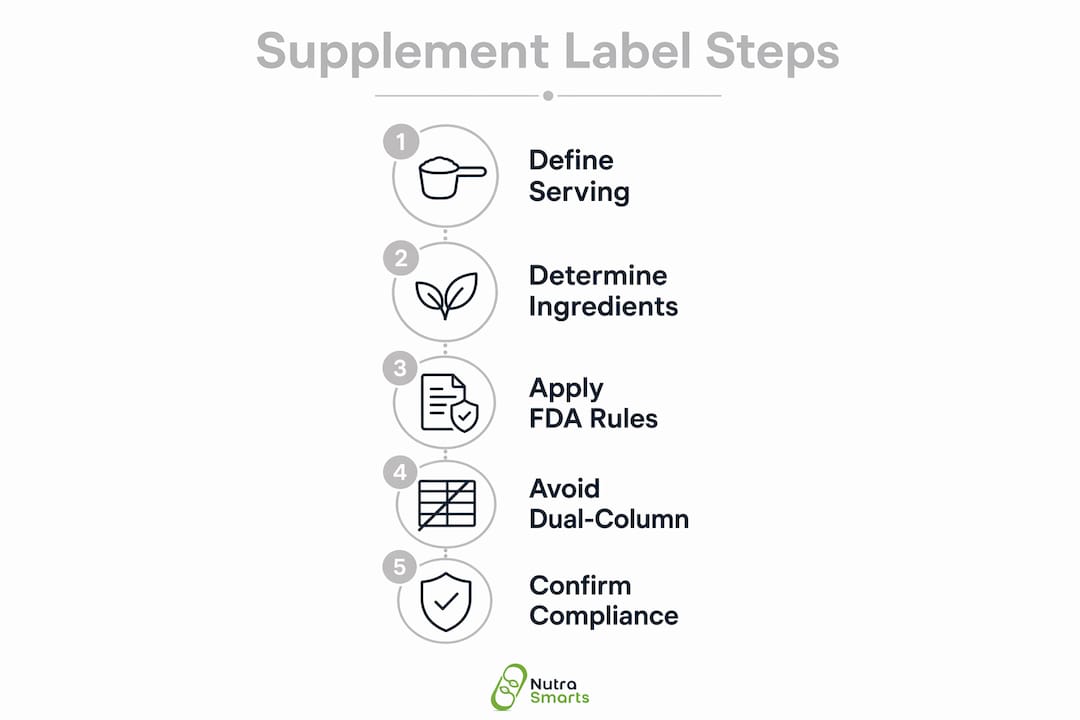
- Define the serving size. Base it on the recommended dose for your product. Two capsules, one scoop, or three softgels each represent a distinct serving size. Document the rationale clearly.
- Calculate ingredient amounts per serving. Every active dietary ingredient must be declared in weight per serving. Use milligrams, micrograms, or grams as appropriate. Verify calculations against your batch records.
- Determine % Daily Value for applicable nutrients. Vitamins and minerals with established Daily Values must show the percentage. Botanicals and novel ingredients without a Daily Value are listed with an asterisk.
- Order ingredients correctly. FDA requires a specific sequence: vitamins and minerals first, then other dietary ingredients. Within each category, list by descending order of predominance by weight.
- Declare proprietary blends accurately. List the blend by its total weight, then name each ingredient within it in descending order. FDA rules permit proprietary blends without disclosing individual ingredient quantities, but the total blend weight must be accurate.
- Review the label against 21 CFR 101.36 before printing. Check font size, column width, and required statements. The Supplement Facts table structure must meet specific formatting standards.
| Label element | FDA requirement |
|---|---|
| Serving size | Manufacturer-defined, based on recommended dose |
| Ingredient declaration | Amount per serving in weight units |
| % Daily Value | Required for nutrients with established DVs; asterisk for others |
| Proprietary blend | Total weight declared; individual amounts not required |
| Column format | Single-column per serving; no dual-column layout |
Applying food dual-column requirements to a Supplement Facts panel is a direct compliance error. Dual-column labeling on supplements can trigger regulatory scrutiny because it signals a misunderstanding of the applicable standard. Keep the panel clean, single-column, and serving-focused.
Common mistakes when reading supplement facts correctly
Misreading supplement labels is more common than most people realize, and the errors carry real consequences. Consumers and formulators both make predictable mistakes that a clear understanding of the regulatory framework prevents.
- Assuming dual-column rules apply to all supplements. They do not. Very few dietary supplements are subject to dual-column or multi-serving labeling mandates. The Supplement Facts format is fundamentally single-serving.
- Treating proprietary blend totals as individual doses. A blend listed as "Herbal Matrix 500 mg" does not mean each herb inside provides 500 mg. The total is shared across all ingredients in the blend.
- Skipping serving size revalidation after reformulation. Any change to product weight or density requires a serving size review. For food products, this could shift a product across the 200% RACC threshold. For supplements, it changes per-serving nutrient declarations and may require a full label update.
- Misreading "per container" values as daily targets. This error is most dangerous with fat-soluble vitamins and minerals that have established upper limits.
- Applying food label reading habits to supplement panels. Food labels and Supplement Facts panels use different nutrient ordering, different column structures, and different regulatory logic.
Pro Tip: After any reformulation, run a full label audit before reprinting. Check that serving size, ingredient weights, and % Daily Values all reflect the updated formula. FDA inspections prioritize serving size accuracy, and an outdated label on a reformulated product is a direct compliance risk.
Consumers who track their intake for health reasons, such as those monitoring bloodwork markers over time, benefit most from reading supplement labels accurately. Knowing exactly what a serving contains helps connect supplement use to measurable health outcomes.
Key Takeaways
Dietary supplements use a single-serving Supplement Facts panel under 21 CFR 101.36, and applying the food-based dual-column format to supplement labels is a compliance error with real regulatory and safety consequences.
| Point | Details |
|---|---|
| Dual-column labels are food-specific | The 200%–300% RACC rule under 21 CFR 101.9(e) applies only to food products, not dietary supplements. |
| Supplement Facts panels are single-column | FDA requires per-serving values only on Supplement Facts; no per-container column is used. |
| Serving size logic differs | Supplement serving sizes are manufacturer-defined by recommended dose, not standardized RACC values. |
| Proprietary blends limit dose visibility | Blend totals are declared, but individual ingredient amounts within a blend are not required. |
| Reformulation triggers a label review | Any change to product weight or density requires revalidating serving size and updating all label declarations. |
Why label clarity matters more than label design
At Nutrasmarts, we have reviewed hundreds of supplement labels, and the most consistent problem is not missing information. It is misplaced information. Formulators sometimes borrow visual conventions from food packaging because food labels look familiar and authoritative. That instinct works against compliance. A dual-column layout on a Supplement Facts panel does not make the product look more professional. It signals to an FDA reviewer that the formulator applied the wrong regulatory standard.
The more interesting problem is on the consumer side. People who read labels carefully, which is exactly the behavior we want to encourage, are the most likely to misinterpret a dual-column format if they encounter it on a borderline product. They see a large number in the right column and assume it represents a single dose. That assumption is wrong, and with fat-soluble vitamins or concentrated minerals, it is also dangerous.
The fix is not complicated. Supplement formulators should treat 21 CFR 101.36 as the only applicable standard and build their panels accordingly. Consumers should check the panel header before reading any values. "Supplement Facts" and "Nutrition Facts" are not interchangeable terms. They represent different rules, different formats, and different safety assumptions. Respecting that distinction is the foundation of label literacy.
— Nutrasmarts
Nutrasmarts tools for accurate supplement label creation
Nutrasmarts builds tools and research resources specifically for people who need to get supplement labels right the first time.

The FDA-compliant label creator generates Supplement Facts panels that meet current 21 CFR 101.36 requirements without spreadsheets or manual formatting. For ingredient research, the supplement ingredient database covers over 800 ingredients, each linked to peer-reviewed studies and clinical trial citations. Consumers looking for products that match their health goals can browse supplements by symptom to find options backed by clinical evidence. Whether you are formulating a new product or reading a label for the first time, Nutrasmarts gives you the regulatory clarity and ingredient data to make informed decisions.
FAQ
What is a dual-column nutrition facts label?
A dual-column Nutrition Facts label shows nutrient values for both one serving and the entire container. The FDA requires this format for food products containing between 200% and 300% of the Reference Amount Customarily Consumed under 21 CFR 101.9(e).
Do dietary supplements need a dual-column label?
No. Dietary supplements use a single-column Supplement Facts panel under 21 CFR 101.36. The dual-column format is a food labeling requirement and does not apply to dietary supplements.
Why do some protein bars show dual-column nutrition info?
Protein bars classified as food products, not dietary supplements, fall under food labeling rules. If a bar contains between 200% and 300% of its RACC, FDA requires the dual-column format to show per-serving and per-container values.
What is the risk of misreading dual-column values on a supplement-adjacent product?
Treating the per-container column as a single dose can lead to overconsumption of fat-soluble vitamins like A, D, E, and K, or high-dose minerals, both of which carry established upper tolerable intake levels. Always read the per-serving column as your reference point.
How should formulators handle serving size after reformulating a supplement?
Any change to product weight or density requires a full serving size review and label update. For supplements, this means recalculating ingredient amounts per serving and verifying that all % Daily Value declarations reflect the updated formula before reprinting.