

Healthy adults generally do best on 250 to 500 mg per day of combined EPA and DHA, according to global guideline reviews. Treating high triglycerides calls for a much higher, clinician-supervised range of 2 to 4 g per day of EPA plus DHA. The FDA caps total EPA and DHA from supplements at no more than 5 g per day, and anyone considering doses above that needs medical guidance first.
TL;DR:
- Most adults should aim for 250 to 500 mg per day of combined EPA and DHA for general health, mostly achievable through two servings of fatty fish weekly.
- Therapeutic doses for high triglycerides range from 2 to 4 grams daily, requiring medical supervision and regular lipid monitoring due to potential LDL cholesterol increases.
- Over-the-counter fish oil capsules often contain less EPA and DHA than labeled, making prescription formulations more reliable for therapeutic needs; up to 11 capsules per day may be necessary to reach high doses OTC.
- Intake of omega-6 fatty acids from processed foods can counteract omega-3 benefits, so increasing omega-3 sources is more practical than obsessing over precise ratios.
- Checking supplement labels for actual EPA and DHA milligrams and using verification tools ensures accurate dosing and better health outcomes.
Table of Contents
- How Much Omega-3 Do Adults Actually Need Per Day?
- Why 250 to 500 Mg a Day Works as a Wellness Baseline
- What Dose Fits Your Specific Health Goal?
- Prescription Omega-3s vs. Over-the-Counter Fish Oil: Does the Difference Matter?
- Is High-Dose Fish Oil Safe? Side Effects and Interactions to Know
- How to Choose and Dose an Omega-3 Supplement, Step by Step
- How NutraSmarts Helps You Verify Dose and Quality Before You Buy
- Getting the Omega-6 to Omega-3 Balance Right
- A Practical, Conservative Dosing Plan Worth Following
- Check Your Omega-3 Dose Before You Buy Another Bottle
- Sources
- FAQ
How Much Omega-3 Do Adults Actually Need Per Day?
There's no official Recommended Dietary Allowance for EPA and DHA in the United States. What exists instead is an Adequate Intake for ALA, the plant-based omega-3 found in flaxseed and walnuts, set at 1.6 g per day for men and 1.1 g per day for women aged 19 and older. That number matters, but it doesn't tell the whole story, because ALA converts to EPA and DHA in the body at a notoriously low rate, often under 10%.
That's why most nutrition scientists talk about EPA and DHA separately from ALA. A 2025 review of global intake recommendations found that 250 mg per day of combined EPA and DHA is the figure cited most often for healthy adults trying to support cardiovascular health. Some guidelines push that up to 500 mg per day, especially for people who eat little or no fish.
The table below lays out the full range, from baseline wellness dosing to therapeutic and regulatory ceilings.
| Purpose | Recommended amount | Source |
|---|---|---|
| ALA Adequate Intake, men | 1.6 g/day | IOM/NAM |
| ALA Adequate Intake, women | 1.1 g/day | IOM/NAM |
| Baseline EPA+DHA for healthy adults | 250–500 mg/day | 2025 global review |
| Therapeutic EPA+DHA for high triglycerides | 2–4 g/day (clinician supervised) | AHA clinical guidance |
| Expected triglyceride reduction at therapeutic dose | Approximately 20% to 50% | AHA clinical guidance |
| FDA upper limit, EPA+DHA from supplements | 5 g/day maximum | NIH/ODS fact sheet |
Common supplement side effects at typical doses stay mild: fishy aftertaste, heartburn, mild nausea, occasional loose stools. They tend to show up more at higher therapeutic doses than at the 250 to 500 mg baseline. Most adults tolerate the lower range without noticing much of anything, which is part of why it works as a default recommendation rather than a strict prescription.
Why 250 to 500 Mg a Day Works as a Wellness Baseline
The 250 mg per day figure isn't arbitrary. It shows up repeatedly across international guideline bodies because it reflects the intake level associated with lower cardiovascular risk in population studies, without requiring the kind of high-dose regimen reserved for people managing a diagnosed lipid disorder.
Here's the biology in plain terms: ALA is considered "essential" because your body cannot make it, so the Institute of Medicine sets a firm intake target for it. EPA and DHA are technically non-essential in the same regulatory sense, since your body can convert some ALA into them. But that conversion is inefficient, often converting less than a tenth of dietary ALA into usable EPA and DHA. That gap is exactly why nutrition researchers created separate EPA+DHA targets instead of just telling people to eat more flaxseed and calling it done.
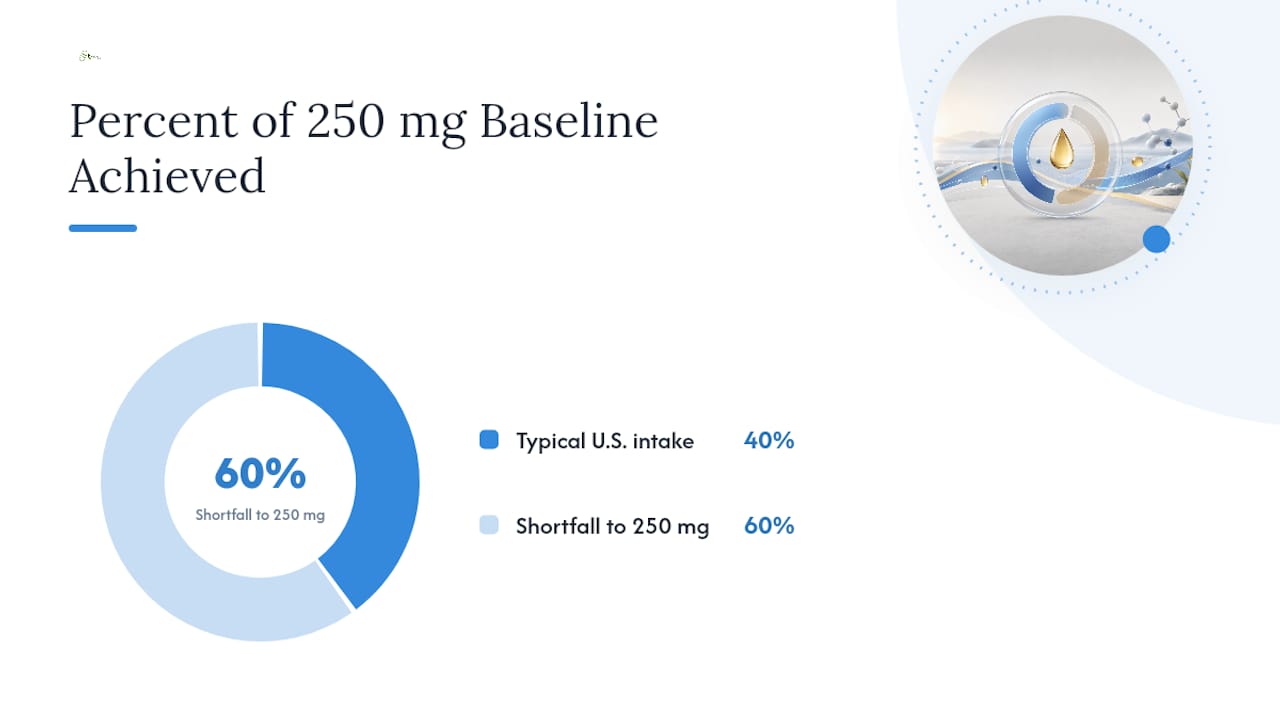
Most Americans fall short of even the modest 250 mg baseline. The American Heart Association notes that typical U.S. adult intake of EPA and DHA hovers around just 0.1 g per day, a fraction of what's recommended. That's not a supplement industry talking point. It reflects how little oily fish actually shows up in the standard American diet.
Pro Tip: Two servings of fatty fish a week, roughly 8 ounces total, gets most adults close to or above the 250 mg per day baseline without touching a supplement bottle.
Dietary patterns that reliably hit the target usually include:
- Salmon, mackerel, sardines, or herring at least twice weekly, matching the Dietary Guidelines for Americans recommendation of about 8 ounces of seafood per week.
- Fortified eggs or omega-3 enriched dairy products as smaller contributors.
- Algal oil supplements for people who don't eat fish, since algae is the original source DHA-rich fish accumulate it from anyway.
- Walnuts, chia, and flax for ALA, which supports the AI target even though it doesn't directly substitute for EPA/DHA.
People who eat fish less than once a week, follow a vegan or vegetarian diet, or simply don't like seafood are the ones most likely to fall meaningfully below baseline. A few groups should loop in a clinician before adding a supplement rather than just picking one off a shelf: anyone with a history of cardiovascular disease already taking other medications, people on blood thinners given omega-3's mild effect on bleeding time, and anyone pregnant or planning to be, since dosing there involves separate DHA-specific guidance covered further down.
What Dose Fits Your Specific Health Goal?
General wellness dosing and condition-specific dosing are two different conversations, and mixing them up is where a lot of people get confused. Someone taking 500 mg a day for general health maintenance is doing something entirely different, physiologically, than someone taking 3 g a day to bring down a triglyceride level of 400 mg/dL. Here's how the numbers break down by goal.
Lowering high triglycerides
This is the condition with the strongest, most consistent dose-response evidence behind it. Clinical guidance from the American Heart Association points to 2 to 4 g per day of combined EPA and DHA, taken under medical supervision, with trials showing triglyceride reductions in the range of 20% to 50% at those doses. The effect is genuinely dose dependent: research summarized in reviews of triglyceride-lowering therapies shows that each additional gram of long-chain omega-3s produces measurably greater triglyceride reduction, and doses below 2 g per day generally don't move the needle much for people who actually need clinical-grade lowering.
This is not a dose range to self-select. Anyone in this bracket needs baseline and follow-up lipid panels, because the response varies by individual and because, as covered below, high-dose EPA+DHA can shift LDL cholesterol in ways worth tracking.
Cardiovascular disease prevention
For people who already have cardiovascular disease and are looking at omega-3s for secondary prevention, some guidelines land on roughly 1 g per day of EPA+DHA as a commonly cited target. This sits in an odd middle zone: higher than the general wellness baseline, lower than triglyceride-therapy dosing. The clinical trial landscape here is genuinely mixed. Some large trials using purified, high-dose EPA formulations found meaningful reductions in cardiovascular events, while trials using lower-dose mixed EPA+DHA formulations showed weaker or null results. The takeaway isn't that omega-3s don't work for heart health. It's that formulation and dose both matter more than a single blanket number can capture, which is exactly why this is a conversation to have with a cardiologist rather than settle with a label.
Mood, depression, and cognitive support
Depression and mood-related trials have tested a wide spread of doses, commonly in the 1 to 2 g per day range, with a lean toward higher EPA-to-DHA ratios showing more consistent signal than DHA-dominant formulas. The evidence here is real but less settled than the triglyceride data. Trial results vary by population, baseline diet, and formulation, so this is an area where "try it and reassess in eight to twelve weeks" is more honest advice than a confident single number. Anyone using omega-3s for mood support alongside a prescribed antidepressant should mention it to their prescriber, mainly because of the mild bleeding-risk interaction with certain other medications, not because omega-3s themselves are dangerous. For more on how EPA and DHA interact with cognitive function specifically, the dosing detail in NutraSmarts' clinical guide to omega-3 and brain function breaks down the trial doses used in that research separately from mood studies.
Pregnancy and lactation
DHA gets special attention during pregnancy because it's a structural component of fetal brain and retinal tissue, accumulating rapidly during the third trimester. Authoritative bodies generally recommend at least 200 to 300 mg of DHA daily during pregnancy and breastfeeding, often met through a combination of low-mercury fish and prenatal supplementation. This is one area where "more seafood" carries a real caveat: pregnant women are also advised to avoid high-mercury species like swordfish and king mackerel, which pushes many toward algal oil or purified fish oil supplements instead. Anyone pregnant or breastfeeding should confirm dosing with an OB or midwife rather than relying on a general wellness label, since prenatal needs shift by trimester.
Prescription Omega-3s vs. Over-the-Counter Fish Oil: Does the Difference Matter?
It matters more than most people assume, especially once you're dosing in the therapeutic range. Prescription omega-3 products are FDA-approved medications for severe hypertriglyceridemia, and they come in two main classes: EPA-only formulations and combined EPA+DHA formulations. A typical prescription regimen delivers around 4 g per day, providing more than 3 g of active EPA and DHA in a single, standardized dose. That consistency is the whole point.
Over-the-counter fish oil doesn't offer that same guarantee. Formulation type changes how well your body actually absorbs what's on the label:
- Ethyl ester forms are the cheapest to produce but tend to be more meal-dependent for absorption and generally show lower bioavailability than other forms.
- Triglyceride-form fish oil absorbs somewhat better than ethyl esters and is common in higher-quality retail products.
- Free fatty acid forms show the strongest absorption profile, with research showing greater bioavailability and less meal dependence compared to ethyl esters, which is one reason some prescription products use this formulation for once-daily dosing.
- Algal oil is the vegan option, sourced from the same algae that fish get their DHA from in the first place, and works well for people avoiding fish-derived products.
Here's the part that surprises most people: hitting a real therapeutic dose using standard OTC capsules is often impractical. One study found that reaching a pharmaceutical-level dose of roughly 3.4 g per day using common over-the-counter fish oil products required a median of 11 capsules per day. That's not a dosing plan most people stick with for more than a few weeks.
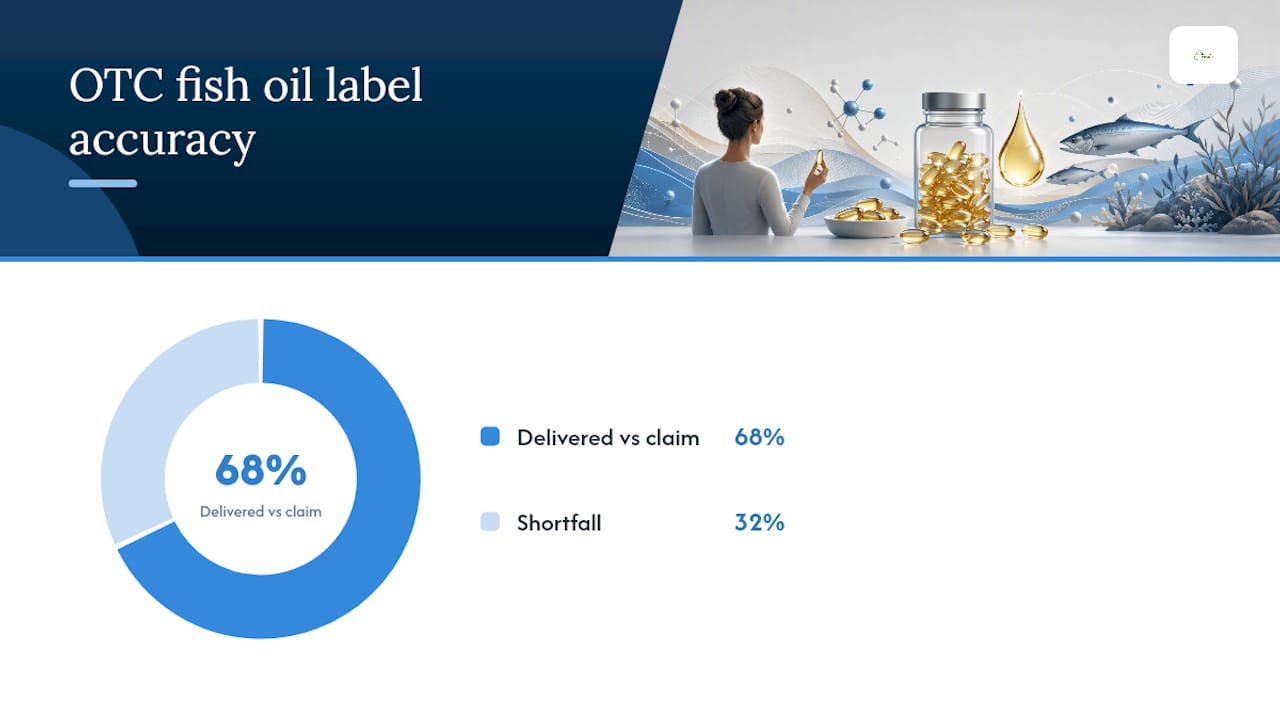
Quality control adds another layer of uncertainty. Analysis of consumer fish oil products found some contained on average only about 68% of their claimed EPA+DHA content, with many exceeding recommended oxidation marker limits. An oxidized fish oil capsule isn't just less effective, it can taste and smell noticeably worse, which is often the first sign something's off with a bottle.
Pro Tip: If a fish oil supplement smells strongly "fishy" or rancid rather than mild, oxidation has likely already reduced its potency, regardless of what the label claims.
Practically speaking, this is why clinicians lean toward prescription formulations for anyone who needs a genuine 2 to 4 g per day therapeutic dose. It's not brand snobbery. It's the difference between a standardized, tested dose and a supplement aisle gamble that might deliver two thirds of what the bottle promises.
Is High-Dose Fish Oil Safe? Side Effects and Interactions to Know
Most people tolerate omega-3 supplementation well at any dose within the FDA's guidance. The common side effects are unglamorous but harmless: a fishy aftertaste, mild heartburn, occasional nausea, and loose stools, especially when starting a new supplement or increasing the dose quickly.
The more clinically relevant risk shows up at higher doses and involves interactions rather than standalone side effects. Omega-3s have a mild blood-thinning effect, which becomes more relevant for people already taking anticoagulants like warfarin or antiplatelet medications like aspirin. That combination isn't automatically dangerous, but it's exactly the kind of thing a prescriber should know about before you start a multi-gram-per-day regimen.
The FDA's official guidance caps combined EPA and DHA from dietary supplements at 5 g per day. That's not a target to aim for, it's a ceiling. Anyone whose doctor recommends going above it for a specific medical reason should do so under direct supervision, with regular monitoring, not by stacking over-the-counter bottles on their own.
Monitoring matters more the higher the dose climbs:
- Anyone using more than 2 g per day should have baseline and periodic fasting lipid panels, not just for triglycerides but to watch LDL cholesterol.
- Research on triglyceride-lowering therapy notes that in some patients, high-dose EPA+DHA can raise LDL-C, while EPA-only prescription formulations have avoided that effect in several trials, a detail worth raising with a prescriber choosing between options.
- Where available, an omega-3 index test gives a more direct read on tissue-level EPA and DHA status than a symptom checklist ever could.
- Product quality issues, oxidation and underdosing among them, mean two people taking "the same" 1,000 mg fish oil dose could be getting meaningfully different amounts of actual EPA and DHA.
That last point circles back to something worth repeating: a supplement label states intent, not always delivered content. Third-party testing seals from organizations like USP or NSF, plus checking manufacturing dates for freshness, meaningfully improve the odds that what's in the capsule matches what's on the label.
How to Choose and Dose an Omega-3 Supplement, Step by Step
Picking a bottle off the shelf without doing this math is how people end up dramatically over or under their target.
- Read the Supplement Facts panel for actual EPA and DHA milligrams, not the total "fish oil" number. A 1,000 mg fish oil capsule might contain only 300 mg of combined EPA and DHA, with the rest being other fatty acids and filler oils. The fish oil ingredient profile on NutraSmarts breaks down exactly what to look for on a typical label.
- Calculate how many servings you need to hit your target dose. If you're aiming for the 500 mg baseline and each capsule delivers 250 mg of EPA+DHA, you need two capsules daily, not one. For therapeutic dosing in the 2 to 4 g range, this math often reveals why a clinician-guided prescription product, rather than a shelf supplement, becomes the more realistic option.
- Start conservative and plan lab work if you're going above 2 g per day. Fasting lipid panels before starting and again at 8 to 12 weeks give you a real read on whether the dose is doing anything measurable, rather than guessing based on how you feel.
Pro Tip: Splitting a higher daily dose into two smaller servings with meals, rather than one large dose, tends to reduce the fishy aftertaste and GI upset that make people quit fish oil in the first place.
A few smaller things make a real difference in practice: taking fish oil with a meal that contains some fat improves absorption for ethyl ester forms specifically, refrigerating capsules after opening slows oxidation, and choosing a product with a visible expiration date rather than a vague "best by" range gives you more confidence in freshness.
How NutraSmarts Helps You Verify Dose and Quality Before You Buy
Reading a fish oil label and doing the milligram math by hand is tedious, and it's exactly the kind of task where mistakes creep in. NutraSmarts built its ingredient database specifically around that problem, linking entries for EPA, DHA, and algal oil directly to the peer-reviewed trials and clinical dosage benchmarks behind them, rather than marketing copy.
The Supplement Facts Tool solves a more specific problem: it lets you calculate exact EPA and DHA milligrams per serving and generate an FDA-compliant label entry without wrestling with a spreadsheet. That matters whether you're a formulator building a product or a consumer trying to figure out how many capsules actually get you to 500 mg.
Side-by-side ingredient comparisons also make it easier to spot which products list verified dosing versus which rely on vague "proprietary blend" language, a red flag worth taking seriously given how often oxidation and underdosing show up in independent testing.
Getting the Omega-6 to Omega-3 Balance Right
Omega-3 dosage doesn't exist in a vacuum. Omega-6 fatty acids, found heavily in vegetable oils like soybean and corn oil, compete with omega-3s for some of the same enzymatic pathways in the body. The modern American diet skews heavily toward omega-6, largely because seed oils are so common in processed and restaurant food, which shifts the overall ratio in a direction most nutrition researchers consider unfavorable for inflammatory balance.
You don't need to eliminate omega-6, and there's no need to obsess over hitting a precise ratio, since the exact "ideal" ratio remains debated among researchers. The more practical approach is additive rather than subtractive: increase omega-3 intake through fish, algal oil, or a supplement rather than trying to strip omega-6 out of your diet entirely, which is difficult to sustain and not clearly necessary for most healthy adults.
Where this becomes more relevant is for anyone managing inflammatory conditions or triglycerides, where a very high omega-6 intake alongside low omega-3 intake may work against the benefits you're trying to get from supplementation. If your diet leans heavily on fried food and packaged snacks, that's a signal to prioritize the fish and omega-3 side of the equation more deliberately, rather than assuming a fish oil capsule alone will offset it.
A Practical, Conservative Dosing Plan Worth Following
If you're healthy and just want a sensible default, 250 to 500 mg of combined EPA and DHA daily covers the baseline most guidelines converge on. Step up to around 1 g per day only if you're managing existing cardiovascular disease and a clinician has recommended it for secondary prevention. The 2 to 4 g per day range belongs strictly to triglyceride management under medical supervision, not a self-directed wellness routine.
What tends to get overlooked is that dose and quality are inseparable questions. A poorly absorbed, partially oxidized capsule at 1,000 mg might deliver less real benefit than a well-formulated 500 mg product. Before adjusting your dose upward, check the label math and talk to a clinician if you're moving past 2 g per day. That combination, modest baseline dosing plus real quality verification, does more for most adults than chasing a bigger number ever will.
— NutraSmarts
Check Your Omega-3 Dose Before You Buy Another Bottle
Most fish oil shopping happens backward: pick a bottle, hope the label math works out, adjust later if something feels off. Nutrasmarts flips that by putting the clinical dosage benchmarks and label math in front of you first, whether you're comparing fish oil against algal oil DHA or trying to figure out how many capsules actually reach 500 mg.

Start with the free Supplement Facts Tool to calculate exact EPA and DHA milligrams per serving before you commit to a product, especially if you're trying to hit a specific therapeutic range with your doctor. If you're weighing options for triglyceride support specifically, the metabolic health supplement guide walks through vetted choices without the guesswork of reading a dozen labels side by side. And if you want to compare two products head to head, including their EPA/DHA content and formulation type, the side-by-side comparison tool does that math for you. Run your current bottle through it before your next refill.
This article is general information, not a substitute for advice from a qualified doctor. Consult a qualified healthcare professional about your own circumstances before acting on anything here.
FAQ
How much omega-3 should a healthy adult take daily?
Most guideline reviews point to 250 to 500 mg per day of combined EPA and DHA as a reasonable baseline for healthy adults. People who eat fatty fish at least twice a week may already meet that target through diet alone.
What is the maximum safe dose of omega-3 supplements?
The FDA advises keeping combined EPA and DHA from supplements to no more than 5 g per day. Doses above that, or any dose in the 2 to 4 g therapeutic range, should be taken under a clinician's supervision.
How much fish oil lowers triglycerides?
Clinical guidance uses 2 to 4 g per day of combined EPA and DHA for triglyceride management, with trials showing reductions of roughly 20% to 50% at that dose. This range requires medical supervision and regular lipid panel monitoring, not self-directed dosing.
Is prescription fish oil different from over-the-counter supplements?
Yes. Prescription omega-3 products deliver standardized, tested doses, often over 3 g of active EPA and DHA, while over-the-counter supplements can vary significantly in actual content, with some analyses finding products delivering only about 68% of their claimed amount. That variability is a major reason clinicians prefer prescription formulations for therapeutic dosing.
How do I know how much EPA and DHA is in my supplement?
Check the Supplement Facts panel specifically for milligrams of EPA and DHA, not the total "fish oil" or "marine lipid concentrate" amount. Tools like the NutraSmarts Supplement Facts Tool can help calculate exact per-serving amounts if the label math feels unclear.