

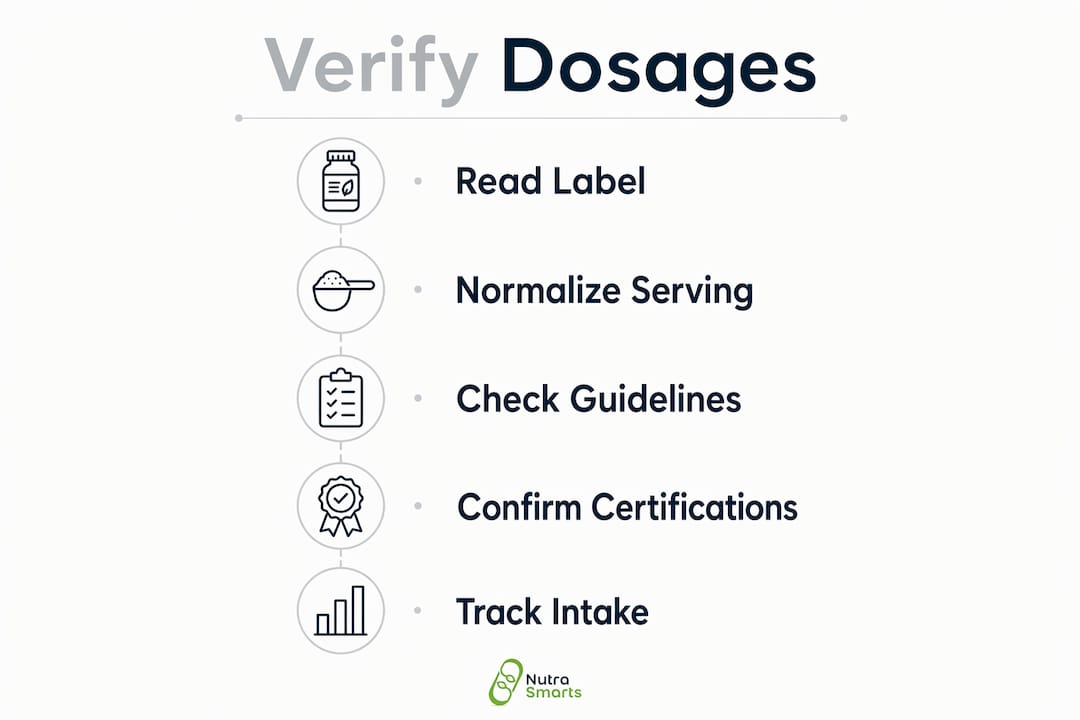
Verifying supplement ingredient dosages is defined as the process of confirming that a product's declared ingredient amounts are accurate, appropriate for your health goals, and safe based on your total daily intake. The supplement industry operates under a regulatory gap: dietary supplements in the US are not FDA-approved before sale, meaning the label alone cannot guarantee what is actually inside the bottle. The most reliable approach to supplement dosage verification combines three steps: reading the Supplement Facts panel accurately, confirming actual content through independent testing or a Certificate of Analysis, and comparing doses against clinical safety benchmarks. This guide walks you through each step with the precision your health decisions deserve.
How to verify supplement ingredient dosages from the label
The Supplement Facts panel is the starting point for any dosage check. According to FDA labeling requirements, the panel must declare serving size, servings per container, amount per serving, and percent Daily Value for each ingredient. These four data points are the only numbers that matter for dosage verification. Marketing claims on the front of the bottle, such as "extra strength" or "maximum dose," carry no regulatory weight and should be ignored entirely.
When you read the label, focus on these elements:
- Serving size: The quantity you must take to receive the declared amounts. This could be one capsule, two tablets, or one scoop.
- Servings per container: Tells you how many doses the product actually contains, which affects cost-per-dose comparisons.
- Amount per serving: The actual milligrams, micrograms, or international units of each ingredient. This is the number to verify.
- % Daily Value: A reference point based on population averages. It is useful context but does not reflect your personal needs or clinical targets.
The panel also separates "dietary ingredients" from "other ingredients." Dietary ingredients are the active compounds with declared amounts. Other ingredients are fillers, binders, and coatings that have no therapeutic dose relevance. Confusing the two is a common source of misreading labels.
Pro Tip: If a product lists a "proprietary blend," the total blend weight is declared but individual ingredient amounts are not. You cannot verify ingredient dosage accuracy from a proprietary blend label. Treat these products as unverifiable until a COA is provided.

How do you normalize serving sizes to compare doses fairly?
Normalization is the step most people skip, and it is the one that causes the most confusion. Two magnesium supplements may both claim "500 mg per serving," but if one serving is two capsules and the other is one, the per-capsule dose is completely different. Normalizing ingredient amounts to a common unit basis, such as per capsule or per gram, is the only way to compare products fairly.
Follow these steps to normalize any supplement dose:
- Identify the serving size unit. Note whether the serving is expressed in capsules, tablets, scoops, or milliliters.
- Divide the ingredient amount by the number of units in a serving. If a serving is three capsules containing 900 mg of vitamin C, each capsule contains 300 mg.
- Convert units to a consistent standard. Vitamin D is often listed in IU and micrograms on different products. One microgram of vitamin D equals 40 IU. Probiotic strains are measured in CFU (colony-forming units), which cannot be converted to milligrams and must be compared directly.
- Recalculate for your actual intake. If you take one capsule instead of the recommended three, your real dose is one-third of the declared amount per serving.
- Use a reference database to cross-check. The NIH Office of Dietary Supplements publishes ingredient-specific fact sheets with standard units that make cross-product comparison straightforward.
Unit mismatches and ignored serving sizes are the most frequent causes of miscalculated intake. A consumer who sees "1000 mg" on a label and assumes that is a single-capsule dose, when the serving is actually four capsules, is taking 250 mg per dose. That gap between perceived and actual intake has real consequences for both efficacy and safety.
Pro Tip: Build a simple spreadsheet with columns for product name, serving size, units per serving, ingredient amount per serving, and calculated amount per single unit. Updating it each time you add a supplement takes under two minutes and prevents cumulative dosing errors.
What third-party certifications actually confirm about your supplement
The FDA does not verify supplement label claims before a product reaches store shelves. This means a label can state any ingredient amount without pre-market proof. Dose verification requires combining label reading with third-party testing or a Certificate of Analysis review to confirm what is actually in the product.
Third-party certifications to look for include:
- USP Verified: The U.S. Pharmacopeia tests for ingredient identity, potency, and purity. A USP Verified mark means the declared dose was confirmed in an independent lab.
- NSF Certified for Sport: NSF International tests for label accuracy and screens for banned substances. Useful for athletes and anyone concerned about contamination.
- Informed Sport: A UK-based certification widely recognized in the US that batch-tests finished products for label accuracy and contaminants.
A Certificate of Analysis (COA) goes one level deeper. A COA is a lab document issued by the manufacturer or an independent testing lab that lists actual measured values for each ingredient in a specific production lot. To validate a COA, check for three things: a lot number that matches the product you hold, the name and accreditation of the testing laboratory, and test methods that are recognized standards such as HPLC or ICP-MS.
Certificates of Analysis are only as reliable as their linkage to specific lot numbers and the credibility of the testing lab and methods used. A COA without a lot number or from an unaccredited lab provides no meaningful verification.
Warning signs of unreliable certification include undated COAs, certificates that cover an entire product line rather than a specific batch, and labs that are not ISO 17025 accredited. You can verify lab testing credibility by searching the lab name in the A2LA or ILAC directories. Reputable brands make batch-specific COAs available on their websites or upon request.
How to assess whether your supplement dose is actually safe
Confirming that a label is accurate is not the same as confirming that the dose is safe for you. Safety assessment requires comparing your total daily intake of each ingredient against established tolerable upper intake levels (ULs). Safety ceilings apply to combined intake from food and supplements together, not to supplement doses in isolation.
Use this framework to assess safety:
- Identify all sources of each ingredient. A multivitamin, a B-complex, and a standalone B12 supplement may all contribute to your total B12 intake. Sum every source.
- Look up the tolerable upper limit. The NIH Office of Dietary Supplements publishes ULs for most nutrients. For example, the UL for vitamin A from preformed sources is 3,000 mcg RAE per day for adults.
- Note which ULs apply only to supplemental sources. The UL for folate applies only to synthetic folic acid, not naturally occurring food folate. This distinction matters when calculating risk.
- Use a reference calculator. Tools like the Calcipedia supplement comparison calculator allow you to input multiple products and check cumulative doses against safety thresholds.
- Consult a clinician for personalized limits. Population-based ULs do not account for individual factors like kidney function, medication interactions, or genetic variation in nutrient metabolism.
| Nutrient | Common UL (adults) | Key consideration |
|---|---|---|
| Vitamin D | 4,000 IU/day | Fat-soluble; accumulates with excess intake |
| Vitamin A (preformed) | 3,000 mcg RAE/day | Teratogenic at high doses; check retinol vs. beta-carotene |
| Iron | 45 mg/day | UL applies to supplemental iron; food iron is lower risk |
| Zinc | 40 mg/day | High doses deplete copper; check multi-ingredient stacks |
| Niacin (folic acid) | 35 mg/day (niacin) | Flush and liver effects at doses above UL |
Clinical dosing guidelines vary by health goal, not just safety. A therapeutic dose of vitamin D for deficiency correction is different from a maintenance dose. Matching your dose to a clinical target, not just staying below the UL, is what makes supplementation effective.
Tools and best practices for tracking a multi-supplement stack
Managing dosage verification across multiple products requires a system. Relying on memory or checking labels one at a time each morning leads to the exact ingredient overlaps that create safety risks. Multi-supplement stacks require summing all doses of overlapping nutrients and adjusting for different forms or bioavailability before any safety or efficacy judgment is valid.
Practical tools and habits that make ongoing verification manageable:
- Supplement tracking apps with label recognition: Apps like HerClarity use AI to extract ingredient data from label photos, log your stack automatically, and flag overlapping ingredients. This removes manual data entry as a source of error.
- Side-by-side comparison tools: Nutrasmarts offers a supplement comparison guide that normalizes ingredient amounts across products so you can evaluate your stack without building your own spreadsheet.
- Ingredient overlap detection: When two products both contain zinc, magnesium, or vitamin B6, a tracker that sums these automatically prevents the cumulative overdose that neither label alone would reveal.
- Periodic stack audits: Review your full supplement list every 90 days. Ingredients added for a short-term goal, such as iron during pregnancy, may no longer be appropriate at the same dose.
Pro Tip: Print or screenshot your current supplement stack and bring it to every healthcare appointment. Clinicians cannot assess drug-nutrient interactions or adjust prescriptions accurately without knowing your full supplement intake.
Key takeaways
Reliable supplement dosage verification requires three sequential steps: accurate label reading, independent content confirmation via COA or third-party certification, and safety assessment against total daily intake benchmarks.
| Point | Details |
|---|---|
| Read the label precisely | Focus on "amount per serving" and serving size, not front-of-label marketing claims. |
| Normalize before comparing | Divide ingredient amounts by units per serving to get a true per-capsule or per-gram dose. |
| Confirm content independently | Look for USP Verified, NSF Certified, or batch-specific COAs from accredited labs. |
| Assess total daily intake | Sum all sources of each ingredient and compare against NIH tolerable upper limits. |
| Track your stack systematically | Use a tracking app or spreadsheet to detect overlaps and keep records for clinical consultations. |
The part of dosage verification most people never do
At Nutrasmarts, the pattern we see most often is not that people skip label reading. Most health-conscious consumers do read labels. The step that gets skipped is normalization combined with independent content verification. Someone will spend 20 minutes researching which magnesium form to buy, then purchase a product with a four-capsule serving size and take one capsule, never realizing they are getting 25% of the dose they think they are taking.
The second blind spot is treating third-party certification as binary. A product either "has a certification" or it does not, and consumers stop there. The more useful question is whether the certification covers the specific lot you purchased and whether the testing lab is independently accredited. A certification logo on a website does not guarantee the bottle in your hand was tested.
What we have found through building Nutrasmarts' ingredient database across more than 800 compounds is that the gap between labeled dose and clinically effective dose is often the real problem, not contamination or fraud. A product can be exactly what it says it is and still deliver a dose too low to produce the outcome you are looking for. That is why supplement dosage and outcomes must be evaluated together, not separately.
The most empowering shift you can make is to treat your supplement stack the way you would treat a medication list: with documentation, periodic review, and professional input when doses change.
— Nutrasmarts
Verify your stack with Nutrasmarts tools
Nutrasmarts gives you the infrastructure to verify supplement ingredient safety data without guesswork. The Supplement Facts Label Creator generates FDA-compliant labels with accurate declared amounts, so you can cross-check any product's label format against regulatory standards. For comparing products side by side, the supplement comparison tool normalizes ingredient amounts across serving sizes automatically. If you are starting from a health concern rather than a specific product, the symptom-based supplement finder matches you to ingredients backed by peer-reviewed clinical evidence. Every ingredient in the Nutrasmarts database links directly to the studies behind the dose, so you are never relying on a label claim alone.
FAQ
What does it mean to verify supplement ingredient dosages?
Verifying supplement ingredient dosages means confirming that the amounts declared on a product label are accurate, appropriate for your health goal, and safe given your total daily intake from all sources. The process combines label analysis, third-party certification review, and comparison against clinical and safety benchmarks.
How do I check if a supplement's dose matches clinical guidelines?
Compare the declared amount per serving against evidence-based references such as NIH Office of Dietary Supplements fact sheets or peer-reviewed clinical trial data. Nutrasmarts links each of its 800-plus ingredients directly to clinical dosing evidence so you can see whether a product's dose falls within a studied range.
What is a Certificate of Analysis and why does it matter?
A Certificate of Analysis is a lab document that reports the actual measured content of each ingredient in a specific production lot. It matters because COA credibility depends on lot-specific data and an accredited testing lab. Without both, the document does not confirm what is in the product you purchased.
Can I trust a supplement with a proprietary blend?
No, not for dosage verification purposes. Proprietary blends declare only the total blend weight, not individual ingredient amounts. You cannot validate ingredient dosage accuracy from a proprietary blend label without a batch-specific COA that breaks out each component.
How do I avoid taking too much of an ingredient across multiple supplements?
Sum the amount of each ingredient across every product you take daily, including your multivitamin, and compare the total against the NIH tolerable upper limit for that nutrient. Ingredient overlaps in stacks are a leading cause of unintentional excess intake, particularly for fat-soluble vitamins and minerals like zinc and iron.