

Several supplements have genuine research backing for depressive symptoms, with omega-3 EPA-rich formulas, SAMe, methylfolate, vitamin D, St. John's wort, saffron, curcumin, NAC, zinc, and probiotics earning the strongest support from guidelines and meta-analyses. Magnesium and B-vitamin complex are also commonly considered. Before you start any of them, one rule applies without exception: talk to a clinician first, because these compounds can interact with medications, may trigger mania in people with bipolar disorder, and work best as adjuncts to standard care rather than replacements for it.
- Strongest guideline support (adjunctive use): Omega-3 EPA, SAMe, methylfolate, vitamin D, probiotics, zinc
- Supportive phytoceutical evidence: St. John's wort, saffron, curcumin, lavender
- Commonly considered, emerging evidence: Magnesium, B-vitamin complex/folate, NAC
Next steps: Discuss your current medications and any history of mania with your prescriber before starting anything. Then check product quality — third-party tested, standardized extracts for herbs, EPA-major formulas for omega-3.
Pro Tip: If you have been diagnosed with bipolar disorder, skip St. John's wort and any serotonergic supplement entirely until you have spoken with a psychiatrist. The mania risk is real and documented.
Key Takeaways
The supplements with the strongest guideline-level support for depression are EPA-rich omega-3, SAMe, methylfolate, vitamin D, probiotics, and zinc, all used as adjuncts to standard care rather than replacements for it.
| Point | Details |
|---|---|
| Best-evidence supplements | Omega-3 EPA, SAMe, methylfolate, vitamin D, probiotics, and zinc have WFSBP/CANMAT guideline support as adjuncts. |
| Safety first | St. John's wort interacts with dozens of medications; SAMe and serotonergic supplements raise serotonin syndrome risk with SSRIs. |
| Give it enough time | Most supplements require 8–12 weeks of consistent use before benefit is measurable; the ISNPR sets 8 weeks as the minimum for omega-3. |
| Check product quality | Look for USP, NSF, or ConsumerLab seals; verify that EPA content (not total fish oil) meets the studied dose for omega-3. |
| Use Nutrasmarts to verify | The Nutrasmarts ingredient database links each supplement to clinical trial citations and evidence ratings before you buy. |
Table of Contents
- How strong is the evidence for supplements in depression?
- 1. Omega-3 fatty acids (EPA/DHA)
- 2. SAMe (S-adenosylmethionine)
- 3. Methylfolate (L-methylfolate)
- 4. Vitamin D
- 5. St. John's wort (Hypericum perforatum)
- 6. Saffron (Crocus sativus)
- 7. Curcumin (turmeric extract)
- 8. NAC (N-acetylcysteine)
- 9. Zinc
- 10. Probiotics
- 11. Magnesium
- 12. B-vitamin complex and folate
- Safety rules, drug interactions, and who needs extra caution
- How to pick a high-quality supplement in the U.S.
- How long to try a supplement and what to track
- How Nutrasmarts tools help you research before you buy
- The evidence-first approach to recommending supplements for mood
- Research your supplements before you commit
- Sources
How strong is the evidence for supplements in depression?
The honest answer: promising but imperfect. The WFSBP/CANMAT taskforce reviewed nutraceuticals and phytoceuticals for psychiatric disorders and issued graded recommendations supporting adjunctive omega-3 (EPA), vitamin D, probiotics, zinc, methylfolate, and SAMe for unipolar depression, alongside supportive evidence for St. John's wort, saffron, curcumin, and lavender. That is a meaningful signal from a rigorous international body.
Effect sizes across trials tend to be modest. A network meta-analysis in Psychological Medicine found statistically significant benefits for several nutraceuticals versus placebo, but heterogeneity across trials was high. Individual response varies considerably, and no supplement reliably outperforms antidepressants in moderate-to-severe depression. A PMC systematic review covering folate, vitamin D, vitamin C, and herbal extracts reached a similar conclusion: potential benefit exists, but trial variability demands caution before drawing firm conclusions.
The consistent theme across guidelines is adjunctive, not alternative. Cleveland Clinic notes that lifestyle foundations — exercise, sleep, diet — often produce larger effects than any single supplement, and that supplements are most useful layered on top of those foundations and standard care.
1. Omega-3 fatty acids (EPA/DHA)
Evidence level: Strong (adjunctive)
EPA-major omega-3 formulas have the most consistent meta-analytic support of any supplement in this category. The key is the EPA:DHA ratio. Research published in Translational Psychiatry shows that DHA-predominant formulas are consistently ineffective in trial meta-analyses; the antidepressant signal comes from EPA. The ISNPR practice guideline recommends at least 1 g/day net EPA, with an EPA:DHA ratio greater than 2:1, and a minimum 8-week trial for major depressive disorder.
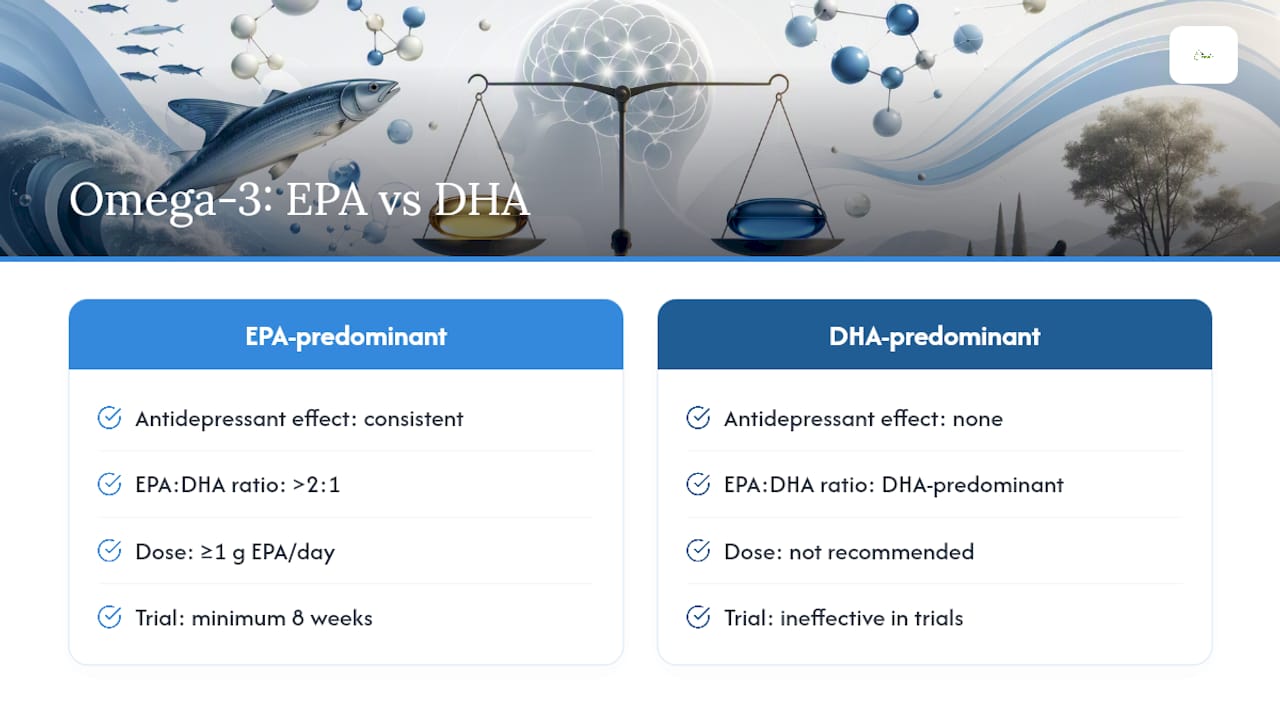
Trial dose range: omega-3 EPA doses commonly start at around 1 gram per day, often used adjunctively with antidepressants. Safety notes: High doses can thin the blood; discuss with your prescriber if you take warfarin or other anticoagulants. Fish-sourced products may cause GI upset — take with food. Algae-based omega-3 is an option for vegetarians. For a deeper look at mechanisms and clinical dosing, see Nutrasmarts' omega-3 and brain function guide.
2. SAMe (S-adenosylmethionine)
Evidence level: Moderate (adjunctive and monotherapy in mild cases)
SAMe is a methyl donor involved in neurotransmitter synthesis. The network meta-analysis places SAMe among the better-performing nutraceuticals versus placebo.
Trial dose range: 400–1,600 mg/day, with trials typically running several weeks to a few months. Safety notes: SAMe can have serotonergic activity — combining it with SSRIs or St. John's wort raises serotonin syndrome risk. Avoid in bipolar disorder without psychiatric supervision. It is also unstable; look for enteric-coated or blister-packed products stored away from heat.
3. Methylfolate (L-methylfolate)
Evidence level: Moderate (adjunctive)
L-methylfolate is the bioactive form of folate that crosses the blood-brain barrier and supports monoamine synthesis. It is particularly relevant for people with MTHFR gene variants who cannot efficiently convert dietary folate. The WFSBP/CANMAT taskforce includes methylfolate in its graded recommendations, and Harvard Health lists it among the supplements with the most clinical attention.
Trial dose range: L-methylfolate doses studied include moderate therapeutic amounts, often in the range of several milligrams daily Safety notes: Generally well tolerated. High-dose folate can mask B12 deficiency — check B12 levels before starting. Not the same as standard folic acid; look for "L-methylfolate" on the label.
4. Vitamin D
Evidence level: Moderate (adjunctive, especially in deficiency)
Low vitamin D levels are common in people with depression, and supplementation in deficient individuals shows the clearest benefit. The WFSBP/CANMAT taskforce includes vitamin D in its graded recommendations. The PMC review also highlights vitamin D among ingredients with potential mood benefit.
Trial dose range: vitamin D doses vary widely, with many studies using moderate daily intakes adjusted to baseline levels Safety notes: Get a 25-OH vitamin D blood test before supplementing — dosing without knowing your baseline is guesswork. Toxicity is possible at very high doses (generally above 10,000 IU/day long-term). Vitamin D3 (cholecalciferol) is better absorbed than D2.
5. St. John's wort (Hypericum perforatum)
Evidence level: Moderate (mild-to-moderate depression; NOT for severe depression)
St. John's wort has more randomized trial data than almost any other herbal supplement for depression. The WFSBP/CANMAT taskforce includes it among phytoceuticals with supportive evidence. However, it is a potent inducer of CYP3A4 and P-glycoprotein enzymes, which means it can reduce the blood levels of dozens of common medications.
Safety notes: Mayo Clinic flags interactions with oral contraceptives, anticoagulants, antivirals (including HIV medications), cyclosporine, and antidepressants. Combining it with SSRIs risks serotonin syndrome. Photosensitivity is a known side effect. Do not use in bipolar disorder.
6. Saffron (Crocus sativus)
Evidence level: Moderate (mild-to-moderate depression)
Saffron has a growing body of saffron depression studies behind it, with several small-to-medium RCTs showing antidepressant effects comparable to low-dose SSRIs in mild-to-moderate depression. The WFSBP/CANMAT taskforce includes it among phytoceuticals with supportive evidence, and the network meta-analysis finds a meaningful signal. Sample sizes in most trials remain small, so interpret the results with appropriate caution.
Trial dose range: 30 mg/day of standardized saffron extract, typically for 6–8 weeks. Safety notes: Generally well tolerated at studied doses. Very high doses (grams, not milligrams) can be toxic — stick to standardized extracts. Avoid in pregnancy.
7. Curcumin (turmeric extract)
Evidence level: Moderate (mild-to-moderate depression, adjunctive)
Curcumin, the active polyphenol in turmeric, has shown antidepressant signals in several RCTs and meta-analyses. The meta-analytic review notes promising signals alongside the usual caveat about heterogeneity and small samples. Bioavailability is the main practical challenge — standard curcumin is poorly absorbed, so trials typically use enhanced-bioavailability forms (piperine-combined, phospholipid complexes, or nanoparticle formulations).
Trial dose range: 500–1,000 mg/day of a bioavailability-enhanced extract, for 8–12 weeks. Safety notes: Generally safe at studied doses. May have mild blood-thinning effects; use caution with anticoagulants. High doses can cause GI upset.
8. NAC (N-acetylcysteine)
Evidence level: Moderate (adjunctive; promising signal)
NAC is a precursor to glutathione and modulates glutamate signaling, which has drawn interest in mood disorders. Meta-analyses flag a promising signal, though the review in PubMed notes that larger RCTs are still needed. Harvard Health lists NAC among the supplements receiving clinical attention for depression.
Trial dose range: NAC doses usually range between about 1,000 and 2,400 mg daily, used for several weeks to months Safety notes: Generally well tolerated. Can cause GI side effects, particularly nausea. Rare risk of bronchospasm in people with reactive airway disease. Start at a lower dose and titrate up.
9. Zinc
Evidence level: Moderate (adjunctive)
Zinc deficiency is associated with depressive symptoms, and supplementation as an adjunct to antidepressants has shown benefit in several trials. The WFSBP/CANMAT taskforce includes zinc in its graded recommendations. It is one of the more accessible and affordable options in this list.
Trial dose range: 25–30 mg/day elemental zinc, for 8–12 weeks as an adjunct. Safety notes: Long-term high-dose zinc can deplete copper — if supplementing beyond 12 weeks, consider a zinc-copper balanced formula. Take with food to reduce nausea.
10. Probiotics
Evidence level: Moderate (adjunctive; gut-brain axis)
The gut-brain axis has moved from hypothesis to active research area. The WFSBP/CANMAT taskforce includes probiotics in its graded recommendations for depression, and several trials show mood benefit from multi-strain formulas. The mechanism likely involves modulation of inflammatory pathways and neurotransmitter precursor availability.
Trial dose range: Multi-strain formulas at 1–10 billion CFU/day, for 8–12 weeks. Safety notes: Generally safe for healthy adults. Use caution in severely immunocompromised individuals. Refrigerated products or those with guaranteed-at-expiry CFU counts are preferable.
11. Magnesium
Evidence level: Limited to Moderate (emerging evidence)
Magnesium deficiency is common in Western diets, and low levels have been linked to depressive symptoms. Small RCTs suggest benefit, though large-scale trial data is still limited. It is often considered for people with both depression and sleep disturbance, given its role in sleep regulation.
Trial dose range: 125–300 mg/day elemental magnesium (as glycinate or malate for better tolerance), for 6–8 weeks. Safety notes: High doses cause diarrhea. Avoid in severe kidney disease. Magnesium oxide is poorly absorbed — choose glycinate, malate, or citrate forms.
12. B-vitamin complex and folate
Evidence level: Limited to Moderate (adjunctive, especially in deficiency)
B vitamins — particularly B6, B12, and folate — are involved in methylation and monoamine synthesis. Deficiency in any of them can worsen mood. The PMC review includes folate among ingredients with potential mood benefit. A B-complex is often recommended when deficiency is suspected rather than as a standalone antidepressant strategy.
Trial dose range: Varies by formulation; most trials use B-complex doses providing RDA-level or slightly above for B6 and B12, with 400–800 mcg folate. Safety notes: High-dose B6 (above 100 mg/day long-term) can cause peripheral neuropathy. B12 is generally safe. Check for deficiency before high-dose supplementation.
Safety rules, drug interactions, and who needs extra caution
High-priority interaction pairs
- St. John's wort interacts with oral contraceptives (reduced efficacy), warfarin, antivirals including HIV medications, cyclosporine, and most antidepressants. This is the single most interaction-prone supplement on this list.
- Serotonergic combinations: SAMe, 5-HTP, and St. John's wort each have serotonergic activity. Combining any of them with SSRIs, SNRIs, or MAOIs raises serotonin syndrome risk.
- Omega-3 and anticoagulants: At doses above 3 g/day total omega-3, bleeding risk increases. Discuss with your prescriber if you take warfarin, heparin, or antiplatelet drugs.
- Curcumin and blood thinners: Mild antiplatelet effect; same caution applies.
- Zinc and antibiotics: Zinc can reduce absorption of certain antibiotics (tetracyclines, fluoroquinolones). Separate doses by at least two hours.
Special population cautions
Bipolar disorder: St. John's wort, SAMe, and high-dose omega-3 have all been associated with mania induction in susceptible individuals. No supplement in this article should be started without psychiatric supervision if you have a bipolar diagnosis.
Pregnancy and breastfeeding: Avoid St. John's wort, saffron at high doses, and most herbal extracts during pregnancy — safety data is insufficient. Omega-3 DHA is generally considered safe and is often recommended for fetal brain development, but discuss dose with your OB. Check the Nutrasmarts deficiency risk guide by group for pregnancy-specific nutrient considerations.
Older adults: Polypharmacy is the main concern. Older adults often take multiple medications, and any supplement with CYP enzyme activity (St. John's wort especially) can disrupt drug levels unpredictably. Start low, go slow, and loop in the prescribing physician.
Chronic illness and immunocompromised individuals: Probiotic use requires extra caution in people with compromised immune systems. Anyone with kidney disease should avoid high-dose magnesium and zinc without medical supervision.
Urgent red flags — stop and contact a clinician immediately
- Worsening depression or new suicidal thoughts
- Sudden mood elevation, decreased need for sleep, racing thoughts (possible mania)
- Severe GI symptoms, rash, or signs of allergic reaction
- Confusion, agitation, rapid heart rate, or sweating (possible serotonin syndrome)
- Any new symptom that began within days of starting a supplement
What to tell your prescriber before starting
- Every medication and supplement you currently take (including OTC and herbal)
- Pregnancy status or plans to become pregnant
- Any personal or family history of bipolar disorder or mania
- Recent lab results (vitamin D, B12, folate, zinc) if available
- The specific supplement, dose, and brand you are considering
Pro Tip: Bring the product label to your appointment, not just the supplement name. Doses and forms vary widely between brands, and your prescriber needs the exact formulation to assess interaction risk accurately.
How to pick a high-quality supplement in the U.S.
The FDA does not evaluate supplements for efficacy or safety before they reach store shelves. That makes third-party testing the most reliable proxy for quality.
Third-party seals to look for
- USP Verified: Tests for identity, potency, purity, and manufacturing quality. One of the most rigorous seals available.
- NSF Certified for Sport: Particularly relevant if you want assurance against undisclosed ingredients; also tests for potency and purity.
- ConsumerLab: An independent testing organization that publishes pass/fail results for specific products — worth checking their database before buying.
Label-reading checklist
- Serving size and number of servings per container (easy to miss)
- Active ingredient amount per serving in mg or mcg — not just "proprietary blend"
- Form of the ingredient (EPA vs. total omega-3; L-methylfolate vs. folic acid; D3 vs. D2)
- Standardized extract percentage for herbal products (e.g., "standardized to 0.3% hypericin" for St. John's wort, "standardized to 3.5% crocins" for saffron)
- Presence of allergens, fillers, or artificial additives you want to avoid
Quick product vetting checklist
- Does the label list the exact amount of each active ingredient? (If it says "proprietary blend," skip it.)
- Is there a third-party seal from USP, NSF, or ConsumerLab?
- For omega-3: does the label show EPA and DHA separately, with EPA higher than DHA?
- For herbal extracts: is the standardization percentage listed?
- Is the manufacturer's contact information and lot number on the label?
Pro Tip: For omega-3 specifically, the fish oil depression dosage that matters is the EPA content, not the total fish oil amount. A 1,000 mg fish oil capsule might contain only 180 mg EPA. Read the EPA line, not the headline number.
How long to try a supplement and what to track
Most people expect supplements to work like medications — within days. They rarely do. Cleveland Clinic notes that supplements typically require consistent daily use for several weeks to months before measurable changes appear. The ISNPR guideline sets a minimum 8-week trial for omega-3 in major depressive disorder, and most RCTs run several weeks to a few months. NAC trials have run as long as 24 weeks.
What to monitor
- Mood: Use the PHQ-9 (a validated 9-question depression scale available free online) at baseline and every 4 weeks. A drop of 5 or more points is clinically meaningful.
- Sleep quality and duration: Note changes weekly.
- Energy and motivation: Simple 1–10 daily rating in a journal or app.
- Appetite and weight: Track any significant changes.
- Side effects: Log any new symptoms with the date started and the supplement dose.
Check in with your clinician at the 4-week mark to share your tracking data, then again at 8–12 weeks to decide whether to continue, adjust dose, or stop. A supplement that produces no measurable change after a full 8–12 week trial at an evidence-based dose is unlikely to help you. Stopping is a valid clinical decision, not a failure.
For guidance on translating trial doses to consumer products, Nutrasmarts' supplement dosage assessment guide walks through the methodology researchers use.
How Nutrasmarts tools help you research before you buy
Before spending money on a supplement, you can verify the evidence behind it in minutes using Nutrasmarts' free research tools.
- Search by ingredient. Go to the Nutrasmarts ingredient database and type in any supplement from this article. Each profile shows an evidence rating, linked clinical trial citations, and the dose ranges studied.
- Check the evidence rating. Each ingredient profile includes a graded evidence summary tied to peer-reviewed studies — not marketing copy. You can see at a glance whether the evidence is from a single small trial or a meta-analysis.
- Review typical doses. The profile lists the dose ranges used in trials, which you can compare against the label of any product you are considering.
- Search by symptom. If you are not sure which supplement to start with, the symptom-to-supplement search tool lets you filter by health concern — including mood-related symptoms — and returns evidence-rated ingredient options.
- Check for deficiencies first. The deficiency symptom tool helps you cross-reference your symptoms with potential nutrient deficiencies, which is worth doing before you add a supplement.
- For supplement formulators or anyone who wants to verify exact ingredient amounts in a product, the free Supplement Facts label creator generates FDA-compliant labels and makes it easy to confirm that a product's label math adds up.
Pro Tip: Cross-reference the dose on any product you are considering against the trial dose listed in the Nutrasmarts ingredient profile. If the product dose is a fraction of what trials used, it is unlikely to replicate the studied effect.
The evidence-first approach to recommending supplements for mood
The most common mistake in this space is treating supplements as a category where enthusiasm substitutes for evidence. NutraSmarts' editorial position is the opposite: start with what the guidelines actually say, be honest about effect sizes, and never frame a supplement as a replacement for care that has stronger evidence behind it.
What the research consistently shows is that the best-supported supplements work as adjuncts, not alternatives. Omega-3 EPA, methylfolate, and SAMe have the most credible mechanistic rationale and the most consistent trial data. St. John's wort has real efficacy in mild-to-moderate depression but a drug interaction profile that makes it genuinely risky for many people. Saffron is more interesting than most clinicians realize, but the trials are still small. Curcumin and NAC have promising signals that deserve larger RCTs.
The supplements with the weakest evidence tend to be the ones marketed most aggressively. That gap between marketing intensity and research quality is exactly why checking a source like the WFSBP/CANMAT taskforce output matters before you spend money. Supplements can be a meaningful part of a depression management plan. They are rarely the whole plan, and they are never a reason to delay or discontinue evidence-based treatment.
Research your supplements before you commit
Nutrasmarts gives you the research infrastructure to make an informed decision without wading through academic databases yourself.
The ingredient database covers over 800 ingredients, each linked to peer-reviewed studies and graded for evidence quality. For mood-related research specifically, you can filter by symptom, compare ingredients side by side, and see the exact trial doses that produced results. If you suspect a nutrient deficiency is contributing to your symptoms, the deficiency guide maps symptoms to potential gaps and identifies which groups are at highest risk. And if you are evaluating a specific product, the free Supplement Facts label creator lets you verify that the ingredient amounts on a label are accurate and FDA-compliant. Start with the ingredient search and compare what you find against the product you are considering.
Sources
- Clinician guidelines for the treatment of psychiatric disorders with nutraceuticals and phytoceuticals: The World Federation of Societies of Biological Psychiatry (WFSBP) and Canadian Network for Mood and Anxiety Treatments (CANMAT) Taskforce
- Natural Antidepressants: What They Are & Effectiveness
- Can a dietary supplement help ease your depression?
- Dietary Supplementations and Depression - PMC
This article is general information, not a substitute for advice from a qualified doctor. Consult a qualified healthcare professional about your own circumstances before acting on anything here.