

To cite a peer-reviewed supplement study correctly, capture these fields: author(s), publication year, article title, journal name, volume(issue):pages, DOI (via CrossRef), PMID or PMCID (from PubMed), any trial registration number (NCT ID from ClinicalTrials.gov), and supplement-specific metadata including ingredient name, dose, formulation, and manufacturer. Every one of those identifiers serves a different verification purpose, and missing even one can make a citation unresolvable in a systematic review.
Here is a copyable AMA-format example for an RCT:
Moinard C, Nicolis I, Neveux N, et al. Dose-ranging effects of citrulline administration on plasma amino acids and hormonal patterns in healthy subjects. Br J Nutr. 2008;99(4):855–862. doi:10.1017/S0007114507841110. PMID: 17953785. NCT ID: [if registered]. Supplement details: L-citrulline, 2–15 g/day oral, powder form, single-center crossover.
TL;DR checklist before you finalize any supplement study citation:
- DOI (CrossRef-verified, resolves to canonical record)
- PMID and/or PMCID (PubMed/PMC indexed)
- NCT ID (if a registered trial)
- Ingredient name, dose (mg or IU), formulation, and manufacturer
- Study design (RCT, meta-analysis, cohort) and blinding status
Nutrasmarts' supplement ingredient database links each of its 1,300+ ingredient profiles directly to peer-reviewed citations, giving you a fast starting point for locating and cross-referencing supplement research citations before you build your reference list.
Table of Contents
- Where can you find peer-reviewed supplement studies?
- How do you assess peer-review status and study quality before citing?
- What citation formats work for supplement studies?
- Which citation managers handle supplement study exports best?
- What supplement-specific details must you capture when citing a study?
- How do you verify peer-review status and access the full text?
- Nutrasmarts evidence-tier checklist for citation-ready records
- Should you cite preprints or non-peer-reviewed supplement research?
- How do you keep citations current for living reviews and dynamic datasets?
- Key Takeaways
- Why reproducible citation practice matters more than most researchers admit
- Nutrasmarts gives researchers a faster path to citation-ready evidence
- Useful sources and resources
Where can you find peer-reviewed supplement studies?
The right database depends on what you need: indexed journal articles, open full text, trial protocols, or DOI resolution. Each platform below fills a distinct role in the supplement research citation workflow.
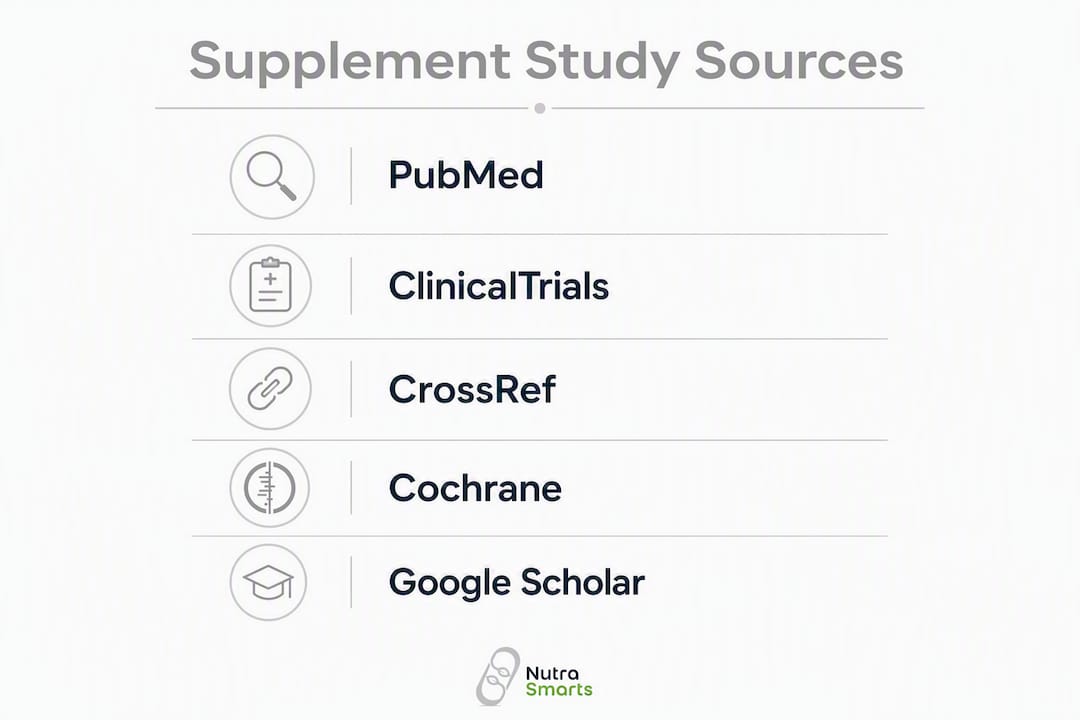
PubMed / PubMed Central (PMC) is the primary source for indexed biomedical literature. PubMed assigns every indexed article a PMID; when the full text is deposited in PMC, it also receives a PMCID. Use PubMed for RCTs, systematic reviews, and meta-analyses on specific supplement ingredients. PMC is the place to go when you need the open-access full text to extract exact dosing and outcome data.
ClinicalTrials.gov is the U.S. registry for interventional and observational studies. Every registered trial receives an NCT ID, which you include in the citation and use to pull the pre-specified protocol for endpoint comparison. The NIH's Office of Dietary Supplements (ODS) also maintains evidence-based review summaries that link back to registered trials.
CrossRef / DOI system resolves DOIs to canonical publisher records. When a PMID is unavailable (for example, a newer article not yet indexed), CrossRef's DOI lookup at doi.org confirms the article exists and links to the authoritative version.
Cochrane Library hosts systematic reviews and meta-analyses with explicit risk-of-bias assessments. For supplement efficacy questions, a Cochrane review is often the single most citable source because its methodology is transparent and reproducible.
Google Scholar is useful for broad discovery and for locating author manuscripts when a paper sits behind a paywall, but it does not assign persistent identifiers and indexes preprints alongside peer-reviewed articles. Use it to find, not to verify.
| Resource | What it provides | Persistent identifiers / export formats |
|---|---|---|
| PubMed | Indexed biomedical literature, abstracts, MeSH terms | PMID, PMCID; RIS, NBIB, XML |
| PubMed Central (PMC) | Open-access full text | PMCID; PDF, XML |
| ClinicalTrials.gov | Trial protocols, pre-specified endpoints, results | NCT ID; XML, JSON |
| CrossRef | DOI lookup, metadata API | DOI; JSON, XML |
| Cochrane Library | Systematic reviews, meta-analyses | DOI; RIS, BibTeX |
| Google Scholar | Broad discovery, author manuscripts | None native; BibTeX via Cite button |
| ODS Evidence Reviews | Supplement-specific evidence summaries | Links to PubMed records |
Pro Tip: When searching PubMed for supplement RCTs, combine MeSH terms with free-text: for example, "magnesium"[MeSH] AND "randomized controlled trial"[pt]. Then cross-reference any promising result with the Nutrasmarts ingredient profile for that ingredient to find additional linked citations you may have missed.
How do you assess peer-review status and study quality before citing?
Not every indexed article deserves equal weight in a reference list. The evidence hierarchy below tells you where a study sits; the risk-of-bias checklist tells you whether it belongs in your citation at all.

The evidence hierarchy for supplement research
Supplement research should be tiered by evidence quality: meta-analyses and Cochrane systematic reviews sit at the top, followed by well-powered, double-blind, placebo-controlled RCTs, then prospective cohorts, case-control studies, and finally mechanistic or animal studies. Cohort and mechanistic studies generate hypotheses; they rarely justify definitive efficacy claims on their own. A BMJ systematic review of vitamin and mineral supplementation found that accumulated RCT evidence frequently contradicts earlier observational signals, sometimes showing harm where observational data suggested benefit. That gap is exactly why tiering matters when you decide which studies to cite for a specific claim.
For clinical trial designs specifically, a double-blind, placebo-controlled, multi-center RCT with a pre-registered protocol is the citation standard for efficacy claims.
Risk-of-bias appraisal checklist
Work through these steps in order before deciding a study is citation-worthy for a definitive claim:
- Pre-specified primary endpoints — Do the reported primary outcomes match what was registered on ClinicalTrials.gov or another registry?
Common red flags specific to supplement research include unregistered trials, changed primary outcomes between registration and publication, small single-center trials that fail replication in larger cohorts, and industry-funded studies without transparent COI statements. A recent L-citrulline crossover RCT reporting null results on time to exhaustion is a useful model: it pre-registered its endpoints, reported blinding procedures, and disclosed funding, which makes it citation-worthy even though the result was negative.
Pro Tip: Pull the ClinicalTrials.gov record for any trial you plan to cite and compare the registered primary endpoints with the outcomes the paper actually reports. Outcome switching — quietly demoting a null primary endpoint and promoting a positive secondary one — is more common in supplement literature than in pharmaceutical trials.
What citation formats work for supplement studies?
Three formats cover the vast majority of U.S. research and clinical publishing: APA (social and health sciences), AMA (medical journals), and Vancouver/ICMJE (biomedical and clinical journals). The table below maps each to its mandatory fields for the three most common supplement study types.
| Citation type | APA template | AMA template | Vancouver/ICMJE template | Mandatory fields |
|---|---|---|---|---|
| RCT journal article | Author(s). (Year). Title. Journal, Vol(Issue), pages. https://doi.org/xxx | Author(s). Title. Journal Abbrev. Year;Vol(Issue):pages. doi:xxx. PMID: xxx. | Author(s). Title. Journal Abbrev. Year;Vol(Issue):pages. doi:xxx. PMID: xxx. | Authors, year, title, journal, vol(issue):pages, DOI, PMID/PMCID |
| Systematic review / meta-analysis | Same as RCT; add "Systematic review and meta-analysis" in brackets after title if not in title | Same as RCT; note pooled effect size and I² in annotation | Same as RCT | Above + pooled effect, I², included trial IDs |
| ClinicalTrials.gov registry entry | Principal Investigator. (Year). Study title (NCT ID). ClinicalTrials.gov. https://clinicaltrials.gov/study/NCTxxxxxxxx | Principal Investigator. Study title. ClinicalTrials.gov. NCT ID: NCTxxxxxxxx. Accessed Month Day, Year. | Principal Investigator. Study title [Internet]. ClinicalTrials.gov; Year [cited Year Mon Day]. Available from: URL. NCT ID: NCTxxxxxxxx. | PI name, title, NCT ID, registry URL, access date |
Three copyable examples
RCT with DOI and PMID (AMA format): Pérez-Guisado J, Jakeman PM. Citrulline malate enhances athletic anaerobic performance and relieves muscle soreness. J Strength Cond Res. 2010;24(5):1215–1222. doi:10.1519/JSC.0b013e3181cb28e0. PMID: 20386132. Supplement: citrulline malate, 8 g oral, single dose, pre-exercise.
Systematic review / meta-analysis (Vancouver format): Gröber U, Schmidt J, Kisters K. Magnesium in prevention and therapy. Nutrients. 2015;7(9):8199–8226. doi:10.3390/nu7095388. PMID: 26404370. [Systematic review; pooled analysis of 22 RCTs; I² reported per outcome.]
ClinicalTrials.gov registry entry (APA format): Smith, J. A. (2023). Effects of vitamin D3 supplementation on inflammatory markers in adults with metabolic syndrome (NCT05123456). ClinicalTrials.gov. https://clinicaltrials.gov/study/NCT05123456. Accessed January 15, 2026.
Some journals, particularly those following ICMJE recommendations, require the NCT ID at the end of the abstract as a condition of publication. When submitting to those journals, include the NCT ID in both the abstract and the reference entry.
Which citation managers handle supplement study exports best?
Zotero, EndNote, and Mendeley each cover the core workflow, but they differ in ways that matter for supplement research specifically.
Zotero (free, open source) captures metadata directly from PubMed, CrossRef, and ClinicalTrials.gov via browser extension, and it stores PMID and DOI automatically. Its custom fields and tags let you annotate records with supplement metadata (ingredient, dose, formulation) without leaving the application.

EndNote (subscription) offers the largest library of journal output styles, which matters when you need to reformat a reference list for a different target journal. It imports RIS and EndNote XML natively and handles large reference libraries without performance issues.
Mendeley (free tier available) combines PDF management with reference organization. Its PDF reader lets you annotate the full text and sync highlights across devices, which is useful when extracting dosing and outcome data from supplement trials.
Step-by-step import workflow
- Locate the DOI or PMID for the study in PubMed or CrossRef.
- In PubMed, click Cite → select PubMed format or RIS → download the file.
- Import the RIS file into your citation manager (File → Import in Zotero or EndNote; drag-and-drop in Mendeley).
- Attach the full-text PDF: if available in PMC, download directly; if behind a paywall, attach via institutional access or interlibrary loan.
- Add custom tags for supplement metadata: ingredient (chemical name and INCI), dose (mg or IU per serving), formulation (salt, ester, standardization %), route, frequency, and brand/manufacturer if reported.
- Add the NCT ID and PMCID to the record's extra or custom fields so they export with the citation.
- Save a PDF or archived URL of the ClinicalTrials.gov registry page and attach it to the same record with the capture date noted.
Export formats by use case:
- RIS — universal; imports into Zotero, EndNote, Mendeley, and most manuscript submission systems
- BibTeX — required for LaTeX manuscripts; export from Zotero or Google Scholar
- EndNote XML — best for batch imports between EndNote libraries or when sharing a project reference set
Pro Tip: Tag each Zotero record with the corresponding Nutrasmarts ingredient profile URL (from the ingredient database) in the "Extra" field. When you revisit a record months later, that link takes you directly to the evidence summary and any additional citations Nutrasmarts has indexed for that ingredient.
What supplement-specific details must you capture when citing a study?
A standard bibliographic citation tells a reader where to find the paper. For supplement research, it does not tell them what was actually tested. Reviewers and replication researchers need the product-level details to judge whether two studies tested the same thing.
Capture and report these fields for every supplement study you cite:
- Ingredient identity — chemical name (e.g., magnesium glycinate), INCI name if applicable, and any standardization (e.g., 95% curcuminoids)
- Dose — mg, IU, or g per dose; total daily dose; and duration of supplementation
- Formulation — salt or ester form (e.g., magnesium citrate vs. magnesium oxide), delivery vehicle (capsule, powder, liquid), and bioavailability modifier if reported
- Route and frequency — oral, sublingual, topical; once daily, twice daily, with meals
- Brand and manufacturer — if disclosed in the paper; lot number if a safety study
- Supplement Facts reference — cite the label or attach a copy if the study provides one; if not, note "label not reported"
- Comparator or placebo composition — what the control group received (matched placebo, active comparator, or open-label control)
A short annotated citation note might look like this: "Supplement: magnesium bisglycinate chelate, 300 mg elemental magnesium/day, oral capsule, 8 weeks; manufacturer: [name as reported]; placebo: matched cellulose capsule." That note sits in your data extraction table, not necessarily in the published reference, but it belongs in any systematic review protocol or methods supplement.
On copyright: reproducing a Supplement Facts panel from a published paper requires the journal's or publisher's permission. Prefer linking directly to the journal figure or citing the paper's supplementary materials. The Nutrasmarts Supplement Facts label creator lets you reconstruct a label for annotation purposes without reproducing a copyrighted image.
Pro Tip: When a paper does not disclose the brand or lot number, note that explicitly in your extraction table ("brand not reported"). Reviewers will ask, and "not reported" is a legitimate and honest answer that protects your methods section.
How do you verify peer-review status and access the full text?
Peer-review status is not self-reported reliably. A journal's own website, its indexing status, and the article's publication type in PubMed are the three fastest verification points.
Verification checklist
- Check whether the journal is indexed in MEDLINE/PubMed. Indexed journals meet NLM's peer-review criteria.
- Confirm the article has a DOI. Preprints on bioRxiv or medRxiv also carry DOIs, so DOI alone is not sufficient.
- Check the article's publication type in PubMed (e.g., "Randomized Controlled Trial," "Review," "Preprint"). A "Preprint" tag means it has not completed peer review.
- Visit the journal's author instructions page and confirm it states peer review is conducted.
- Confirm the presence of a PMID (indexed in PubMed) and, for open-access articles, a PMCID (deposited in PMC).
Full-text access routes
- PubMed Central — free full text for NIH-funded research and voluntary deposits; search by PMCID
Validating trial registration
Find the NCT ID in the abstract or methods section of the paper, then open the corresponding record on ClinicalTrials.gov and compare the registered primary endpoints with what the paper reports. ICMJE guidance requires that the registration number appear at the end of the abstract; its absence is itself a flag worth noting in your risk-of-bias assessment.
One practical distinction: a PMID confirms PubMed indexing; a PMCID confirms the full text is in PMC. A paper can have a PMID without a PMCID if the publisher has not deposited the full text. When a DOI resolves to a preprint server rather than a journal page, the paper has not completed peer review regardless of what the authors claim.
Nutrasmarts evidence-tier checklist for citation-ready records
The fields below cover everything a systematic review protocol or manuscript methods section will ask for. Copy this into your data extraction template.
| Field | Purpose | Example value |
|---|---|---|
| Authors | Attribution and search reproducibility | Smith JA, Jones B, et al. |
| Title | Record identification | "Effects of magnesium on sleep quality…" |
| Journal, Vol(Issue):Pages | Bibliographic completeness | — |
| DOI | Canonical persistent link | — |
| PMID / PMCID | PubMed indexing / PMC full text | — |
| Study design | Evidence tiering | Double-blind, placebo-controlled RCT |
| Sample size | Power and generalizability | — |
| Primary endpoints | Outcome pre-specification check | Sleep efficiency (% via actigraphy) |
| Trial registration (NCT) | Registry crosscheck | — |
| Funding and COI | Bias assessment | Industry-funded; COI disclosed |
| Ingredient / dose / formulation | Supplement-specific replication | Magnesium glycinate, 300 mg/day, 8 weeks |
| Brand / manufacturer | Product identity | [Name as reported] or "not reported" |
| Effect size and CI | Quantitative synthesis | — |
| p-value | Statistical significance | — |
| Data availability | Reproducibility | Raw data available on OSF |
| Registry snapshot (URL + date) | Version control | ClinicalTrials.gov/study/—, accessed March 10, 2026 |
Capturing effect sizes and confidence intervals is particularly important for supplement safety outcomes: Phase 3 trials routinely report both efficacy and adverse event data with precise CIs, and a citation that omits those metrics cannot be used in a meta-analysis without going back to the original paper.
Pro Tip: Archive the ClinicalTrials.gov registry page as a PDF (or use the Wayback Machine to create a permanent URL) and attach it to your citation manager record with the access date. Living systematic reviews update their included studies over time, and a dated registry snapshot is the only way to prove what the protocol said at the time you extracted data.
Should you cite preprints or non-peer-reviewed supplement research?
The short answer: cite them only when you are explicitly discussing preliminary evidence, and always label them as such.
Preprints on medRxiv or bioRxiv carry DOIs and are increasingly cited in supplement literature, particularly during rapid evidence cycles. They have not completed peer review, and their findings frequently change between preprint and final publication. When you must cite a preprint, include the server name, the posted date, and the DOI, and add a note such as "[Preprint; not peer-reviewed]" immediately after the citation. Never use a preprint as the sole citation for a definitive efficacy or safety claim.
Non-peer-reviewed sources — manufacturer white papers, conference abstracts, and press releases — should not appear in a reference list for a research manuscript or systematic review. Conference abstracts occasionally contain useful preliminary data, but they lack the methodological transparency required for quality appraisal. If you need to reference a conference abstract, cite it as such and note that full peer-reviewed publication is pending or unavailable.
Gray literature (government reports, regulatory agency documents, NIH ODS fact sheets) occupies a different category. These are not peer-reviewed in the journal sense, but they are authoritative and citable for regulatory context, prevalence data, or policy statements. Cite them with the issuing agency, publication date, and URL, and distinguish them clearly from primary research citations in your methods section.
How do you keep citations current for living reviews and dynamic datasets?
Living systematic reviews update continuously as new trials are published, which means citation management is an ongoing process, not a one-time task.
Set a search update schedule at the outset: quarterly for fast-moving supplement categories (e.g., GLP-1-adjacent metabolic supplements), semi-annually for more stable areas. Document the search date in your methods section every time you run it, and store the search string alongside the results file in your citation manager or project folder.
For each new study you add to a living review, run the full checklist from the previous section before including it. A study that passes peer-review verification today may have a correction or retraction notice by the time the review is updated. PubMed flags retracted articles with a "Retraction of Publication" notice, and CrossRef's metadata API returns retraction status when queried. Check both before finalizing an update.
Version control for the citation file itself matters as much as the individual records. Export a dated snapshot of your full reference library (RIS or BibTeX) at each update cycle and store it in a version-controlled folder or repository (GitHub, OSF, or your institution's data repository). That snapshot lets collaborators or peer reviewers reconstruct exactly which version of a study you cited at each review stage.
When a journal publishes a correction or an erratum that changes a reported outcome or dose, update the citation record immediately and note the correction date in the record's annotation field. A corrected paper is still citable; an uncorrected citation to a paper with a known erratum is not.
Key Takeaways
Correctly citing peer-reviewed supplement studies requires capturing persistent identifiers (DOI, PMID, PMCID, NCT ID), verifying peer-review status and trial registration, tiering evidence by study design, and recording supplement-specific metadata including ingredient, dose, formulation, and manufacturer.
| Point | Details |
|---|---|
| Capture all persistent identifiers | Record DOI, PMID, PMCID, and NCT ID for every study to ensure citations resolve and remain verifiable. |
| Cross-check registry vs. manuscript | Compare ClinicalTrials.gov pre-specified endpoints with reported outcomes to detect outcome switching before citing. |
| Prioritize high-tier evidence | Meta-analyses and well-powered double-blind RCTs are the citation standard; cohort and mechanistic studies support hypotheses, not definitive claims. |
| Record supplement-specific metadata | Ingredient name, dose, formulation, brand, and comparator composition are required for replication and systematic review extraction. |
| Use Nutrasmarts for ingredient-level evidence | Nutrasmarts's ingredient database links 1,300+ profiles to peer-reviewed citations, speeding the locate-and-tag workflow for supplement research. |
Do not cite preprints or non-peer-reviewed sources for definitive efficacy or safety claims; reserve them for preliminary or contextual discussion and label them explicitly.
Why reproducible citation practice matters more than most researchers admit
The supplement literature has a specific problem that pharmaceutical research handles better: outcome switching. A trial registers one primary endpoint, finds a null result, and the published paper leads with a positive secondary outcome. Without the registry crosscheck, that paper looks like positive evidence. With it, the citation becomes a cautionary example instead.
The checklist approach in this article is not bureaucratic overhead. It is the difference between a reference list that holds up under peer review and one that collapses when a reviewer pulls the ClinicalTrials.gov record. Researchers who skip the registry comparison step are not just cutting corners; they are potentially propagating a misleading evidence base that influences clinical practice and consumer decisions.
The other underappreciated issue is supplement metadata. Two studies on "magnesium" may have tested magnesium oxide and magnesium glycinate at different doses, in different populations, with different primary endpoints. Citing both as equivalent evidence for "magnesium supplementation" is a methodological error, not just a citation style issue. The dosage assessment guidance and ingredient-level profiles available through Nutrasmarts exist precisely to surface those distinctions before they become errors in a manuscript.
Nutrasmarts gives researchers a faster path to citation-ready evidence
Locating, verifying, and tagging supplement citations is time-consuming when you are working across PubMed, ClinicalTrials.gov, CrossRef, and individual journal pages simultaneously. Nutrasmarts consolidates a significant part of that workflow.
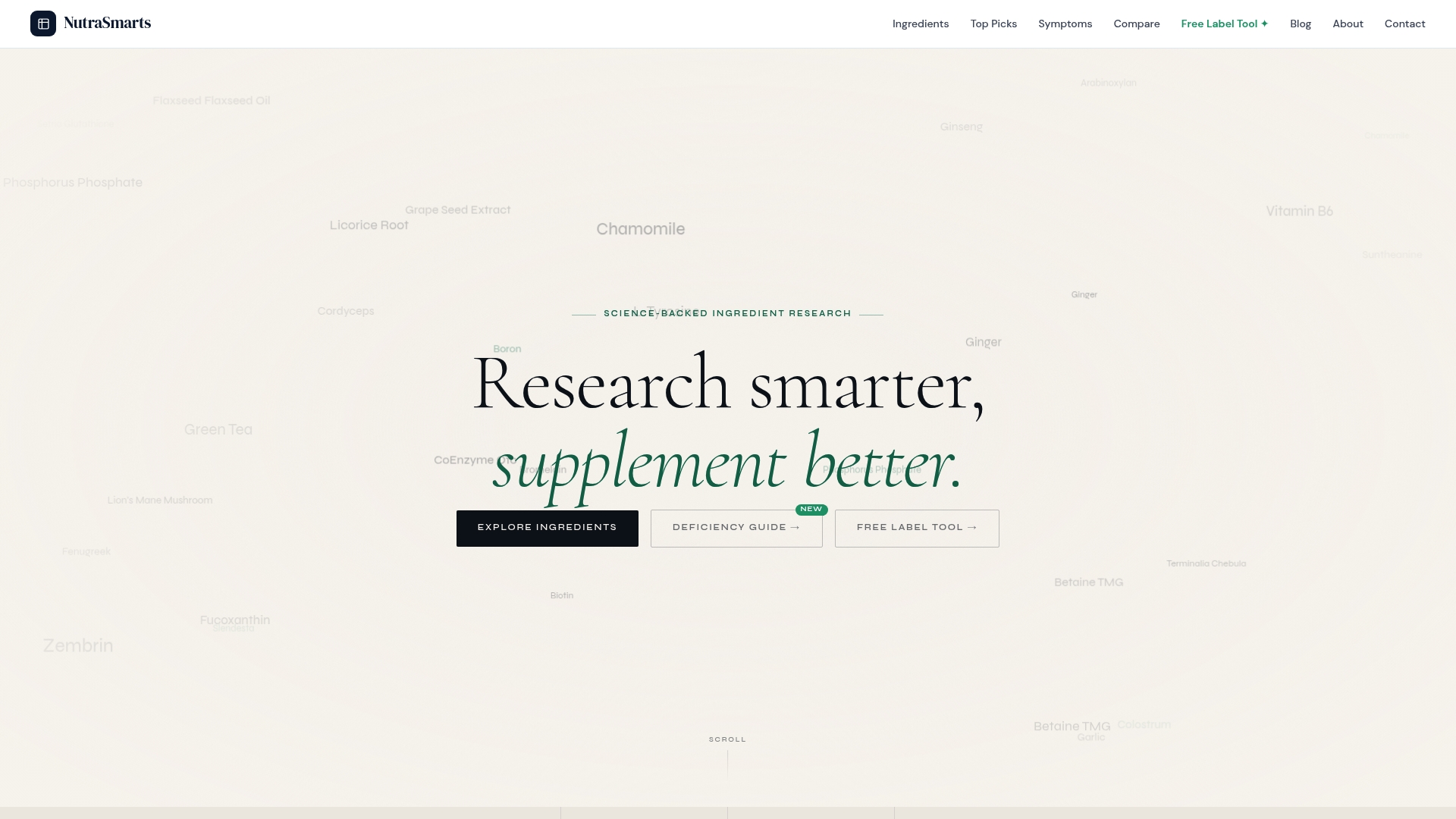
The ingredient database covers 1,300+ ingredient profiles, each linked directly to peer-reviewed studies and clinical trial citations. Instead of running a PubMed search from scratch for every ingredient, you start with a pre-curated evidence set and follow the DOI or PMID links to the canonical records. The side-by-side comparison tool lets you document comparator formulations when a study uses an active control, which is exactly the kind of detail systematic review protocols require. For researchers documenting study interventions, the free Supplement Facts label creator lets you reconstruct a label for annotation without reproducing a copyrighted journal figure.
A practical Zotero workflow: open the Nutrasmarts ingredient profile for the ingredient you are researching, copy the linked citation DOI into Zotero's "Add by identifier" field, then paste the Nutrasmarts profile URL into the record's Extra field as a tag. That gives you the bibliographic record, the full-text link, and the evidence summary in one place. Browse supplements by symptom to find the ingredient categories most relevant to your research question.
Useful sources and resources
These are the primary databases, registries, and guidance documents to keep bookmarked when preparing supplement study citations.
| Resource | What to capture | Quick tip |
|---|---|---|
| PubMed / PMC | PMID, PMCID, RIS export | Use MeSH terms + "[pt]" publication type filter for RCTs |
| ClinicalTrials.gov | NCT ID, protocol PDF, results | Save registry page as PDF with access date |
| CrossRef DOI resolver | DOI, canonical publisher URL | Paste DOI to confirm it resolves before citing |
| Cochrane Library | DOI, review protocol, I² | Check inclusion criteria and heterogeneity tables |
| ICMJE trial registration guidance | Registration requirements, NCT placement | Confirms NCT ID must appear at end of abstract |
| ODS Evidence-Based Reviews | Supplement-specific evidence summaries | Links to PubMed records for each reviewed ingredient |
| BMJ supplement review | RCT vs. observational signal comparison | Use to contextualize null RCT results against prior observational claims |
| Nutrasmarts ingredient database | Linked peer-reviewed citations, ingredient profiles | Tag Zotero records with profile URL for fast retrieval |
Workflow reminders:
- Export a dated RIS or BibTeX snapshot of your reference library at each review update cycle.
- Attach the ClinicalTrials.gov registry PDF to every trial record in your citation manager, with the access date in the annotation field.
- Flag any citation where the brand or lot number was not reported in the paper; reviewers will ask.
- For living systematic reviews, document your search string and run date in the methods section every time you update.