

To evaluate supplement clinical evidence, apply this five-item triage checklist: (1) Is there at least one registered human RCT? (2) Are results replicated or summarized in a meta-analysis? (3) Does the tested dose and formulation match the product you'd buy? (4) Is the product quality verified by USP or a third party? (5) Are there safety signals, conflicts of interest, or unregistered trials? Check ClinicalTrials.gov for trial registration, the USP Dietary Supplements Compendium (USP DSC) for quality standards, and the FDA/DSHEA framework for regulatory context. Accept when all five pass. Investigate further when evidence is mixed or formulations don't match. Avoid when no human trials exist, safety concerns appear, or undeclared drugs are suspected.
Under the Dietary Supplement Health and Education Act (DSHEA), manufacturers are not required to prove efficacy before selling a product. As Harvard Health notes, "natural" labeling and historical use are not substitutes for clinical evidence.
Table of Contents
- How to evaluate supplement clinical evidence fast: a triage checklist
- What kinds of studies count, and how much weight do they carry?
- How do you critically appraise a single clinical trial?
- How do you assess the totality of evidence across multiple studies?
- Safety, product quality, and the US regulatory context
- A step-by-step workflow for evaluating any supplement
- How do you translate evidence into an actual decision?
- Key Takeaways
- Why evidence-first is the only defensible approach
- Nutrasmarts makes the appraisal workflow faster
- Authoritative resources for your next search
How to evaluate supplement clinical evidence fast: a triage checklist
Work through these five questions in order. Stop and flag the supplement if any answer is "no" or "unknown."
- Registered human RCT? — Search ClinicalTrials.gov by ingredient name. Confirm the trial has an NCT identifier, a defined primary outcome, and a status of "Completed" or "Active."
Decision tiers:
| Tier | Criteria |
|---|---|
| Accept | Solid RCT + replication + matched formulation + USP/third-party verification + no safety signals |
| Investigate | Mixed evidence, unmatched formulation, or single-site trial with no replication |
| Avoid | No human trials, safety/adulteration concerns, undeclared drugs, or unregistered trials |
Pro Tip: A "proprietary blend" with no individual dosages listed is a near-automatic red flag. You cannot confirm dose match, and neither can anyone else.
What kinds of studies count, and how much weight do they carry?
Not all supplement research studies are equal. The hierarchy matters.
Randomized controlled trials (RCTs) are the gold standard for efficacy. A well-designed RCT randomly assigns participants to a supplement or placebo, controls for confounders, and measures pre-specified outcomes. A 24-week double-blind, placebo-controlled RCT of Curcuma longa extract reported improvements in orientation and attention in middle-aged adults with subtle cognitive weaknesses — a useful example of what a robust design looks like and what it can and cannot prove.

Systematic reviews and meta-analyses pool data across multiple RCTs. They reduce the influence of any single underpowered study and are the strongest signal that an effect is real and replicable. NIH guidance is explicit: credible safety or efficacy conclusions require synthesis across study types and populations, not a single positive trial.
Observational studies (cohort, case-control) are useful for long-term safety signals and population-level associations. They cannot establish causation on their own.
Case reports and adverse event surveillance are critical for detecting rare harms that RCTs are too small to catch. The FDA's MedWatch system and published case series are the primary sources here.
Preclinical data (in vitro, animal) generates hypotheses. It does not confirm human benefit. Many ingredients with impressive cell-culture results fail in human trials.
Common supplement-specific patterns to watch for: small underpowered RCTs, short durations that can't capture clinically meaningful endpoints, and variable formulations across trials. An RCT of a butyrate-polyphenol formulation enrolled 124 subjects over just 14 days measuring microbiome markers and symptom questionnaires — useful for a preliminary signal, but not sufficient to draw firm clinical conclusions.
How do you critically appraise a single clinical trial?
Use this sequence every time.
- Verify trial registration — Find the NCT ID on ClinicalTrials.gov and confirm the primary outcome listed there matches what the paper reports. Outcome switching after data collection is a serious validity concern.
- Evaluate population relevance — Does the study population match your situation or your patient's? Age, sex, health status, and ethnicity all affect how well results transfer.
Study capture table (copy for your own use):
| Field | What to record |
|---|---|
| Study ID / NCT | e.g., NCT06748989 |
| Design | RCT, double-blind, placebo-controlled |
| Sample size (n) | e.g., 70 |
| Primary outcome | e.g., cognitive domain score |
| Dose / formulation | e.g., standardized extract, twice daily |
| Main result | e.g., improved orientation at week 6 |
| Risk-of-bias notes | e.g., small n, single site, industry-funded |
Pro Tip: A p-value below 0.05 does not tell you whether the effect matters clinically. Look at the effect size and confidence interval. A narrow CI around a small effect is still a small effect.
How do you assess the totality of evidence across multiple studies?
Single trials rarely settle a question. Here's what to look for when building a fuller picture.
- Preregistration: — Check ClinicalTrials.gov for completed trials with no published result. A "Completed" status and no linked publication is a meaningful red flag for selective non-publication.
A strong example of what good totality looks like: a multicenter RCT of Totum-63 published in Nature Communications found statistically significant reductions in fasting plasma glucose in prediabetes patients over six months — a clinically meaningful endpoint, a multicenter design, and a high-impact peer-reviewed venue.
Pro Tip: In PubMed, use the "Cited by" function on a key trial to find replication attempts and systematic reviews. Running a backward citation search on the original paper's reference list often surfaces earlier trials you'd otherwise miss.
Safety, product quality, and the US regulatory context
Under DSHEA, the FDA does not evaluate supplement safety or efficacy before a product reaches market. Manufacturers must follow Current Good Manufacturing Practices (CGMPs), but compliance is not uniform. The FDA's role is post-market: it can act on adulteration, mislabeling, or safety reports after products are already sold.
Practical quality checks:
- USP Dietary Supplements Compendium (USP DSC): Contains admission evaluations and monographs summarizing health and safety profiles for ingredients. The AMA Journal of Ethics recommends clinicians use USP DSC and third-party verification programs as primary quality references.
| Quality signal | What it means in practice |
|---|---|
| USP monograph / DSC admission evaluation | Ingredient meets documentary quality standards; health profile reviewed |
| Third-party verified (USP/NSF) | Independent testing confirmed identity, potency, and purity for that product |
| CGMP compliance only | Manufacturing process meets minimum standards; product content not independently verified |
| No verification | No independent confirmation of what's in the bottle |
Pro Tip: Drug-supplement interactions are underreported. Clinicians should ask patients about supplements at every medication review. St. John's Wort, for example, is a well-documented CYP3A4 inducer that reduces the effectiveness of several prescription drugs.
A step-by-step workflow for evaluating any supplement
- Search ClinicalTrials.gov — by ingredient name. Note NCT IDs, trial status, enrollment, design, and primary outcomes. Flag any "Completed" trials with no linked publication.
For speed, the Nutrasmarts ingredient database links each ingredient directly to clinical trial citations and evidence ratings, cutting the time needed to locate NCT IDs and assess study designs. The symptom-based search tool lets you filter by health concern and see which ingredients have the strongest trial support, so you can prioritize which trials to pull on ClinicalTrials.gov.
For deeper reading on clinical trial designs for supplements and how to assess supplement dosage in clinical research, the Nutrasmarts blog covers both in detail.
How do you translate evidence into an actual decision?
For consumers: Prioritize safety and verified quality first. Accept a supplement only when clinical trials show a meaningful benefit at a dose that matches the product, the product is third-party verified, and no significant safety signals exist. A biomarker change in a 6-week trial of 70 people is not a strong basis for long-term use.
For clinicians: Weigh patient-specific context. Ask:
- Does the study population resemble your patient in age, sex, health status, and relevant comorbidities?
- Is the tested formulation identical to what the patient would actually take?
- How large and clinically meaningful is the effect, and does it outweigh any safety risk or drug interaction?
- Are there completed but unpublished trials that might change the picture?
Population generalizability is a real limit. A trial showing nitric oxide and immune marker changes in elite rowers does not translate to general cardiovascular recommendations. A 180-day RCT on native type-II collagen showing KOOS subscale improvements in healthy adults also demonstrated substantial placebo effects — a reminder that non-diseased populations often respond strongly to placebo, which inflates apparent benefit in unblinded or poorly controlled trials.
Pro Tip: Document your counseling conversation and any monitoring plan in the patient record. If you recommend a supplement, note the evidence basis, the product verified, and what you'll track. That record protects both the patient and the clinician.
Key Takeaways
Evaluating supplement clinical evidence requires checking study type, replication, dose match, product quality, and safety signals before accepting any efficacy claim.
| Point | Details |
|---|---|
| Five-item triage checklist | Check study type, replication, dose/formulation match, third-party verification, and safety signals in that order. |
| Totality over single trials | NIH guidance and multicenter RCT evidence both confirm that patterns across multiple high-quality studies outweigh any single positive result. |
| Dose and formulation must match | A trial on a standardized extract does not validate a generic product; confirm concentration, form, and delivery route. |
| Quality verification matters | USP DSC, USP verification, and NSF certification are the most reliable US quality signals; no verification means no confirmed potency or purity. |
| Nutrasmarts speeds appraisal | The Nutrasmarts ingredient database links ingredients to trial citations and evidence ratings, reducing lookup time across ClinicalTrials.gov and PubMed. |
Why evidence-first is the only defensible approach
The supplement market's core problem is not a shortage of studies. It's a shortage of honest interpretation. Thousands of trials exist, but the gap between a registered RCT and a product label claim is where most consumers and clinicians get misled. A trial on a pharmaceutical-grade extract in a specific population, at a specific dose, for a specific duration, does not validate the $29 bottle on a retail shelf with a vague "supports cognitive health" claim.
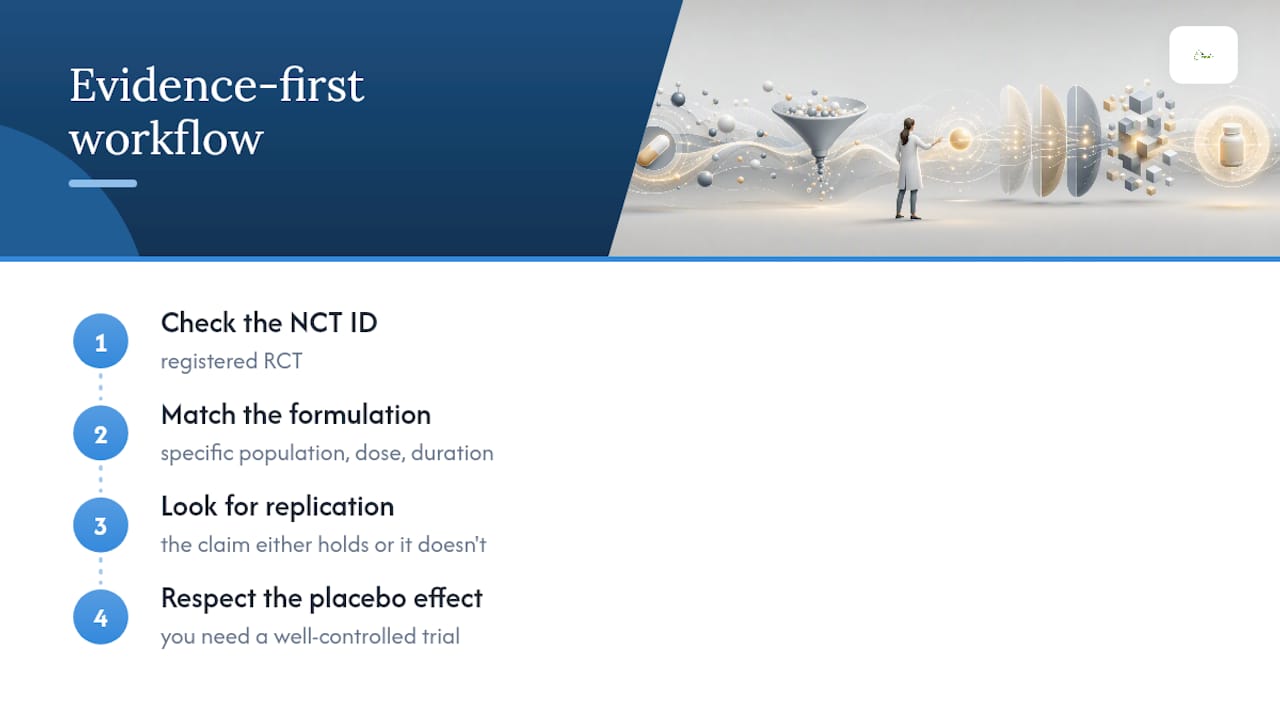
What the evidence-first workflow does is force that gap into the open. When you check the NCT ID, match the formulation, and look for replication, the claim either holds or it doesn't. Most of the time, the honest answer is "promising but not proven" or "proven in a narrow population at a dose this product doesn't match." That's not a reason to dismiss supplements wholesale. It's a reason to be specific about which ones, at what dose, for whom.
The placebo effect deserves more respect than it usually gets in these conversations. In healthy, non-diseased populations, placebo response rates in supplement trials can be substantial. That doesn't mean a supplement isn't working. It means you need a well-controlled trial to know whether it's the ingredient or the expectation doing the work.
Nutrasmarts makes the appraisal workflow faster
Pulling trial data across ClinicalTrials.gov, PubMed, and USP DSC manually takes time most people don't have. Nutrasmarts is built to compress that process. The ingredient database covers 1,300+ evidence-rated profiles, each linked to clinical trial citations so you can jump directly to the NCT ID or PubMed abstract without starting from scratch.
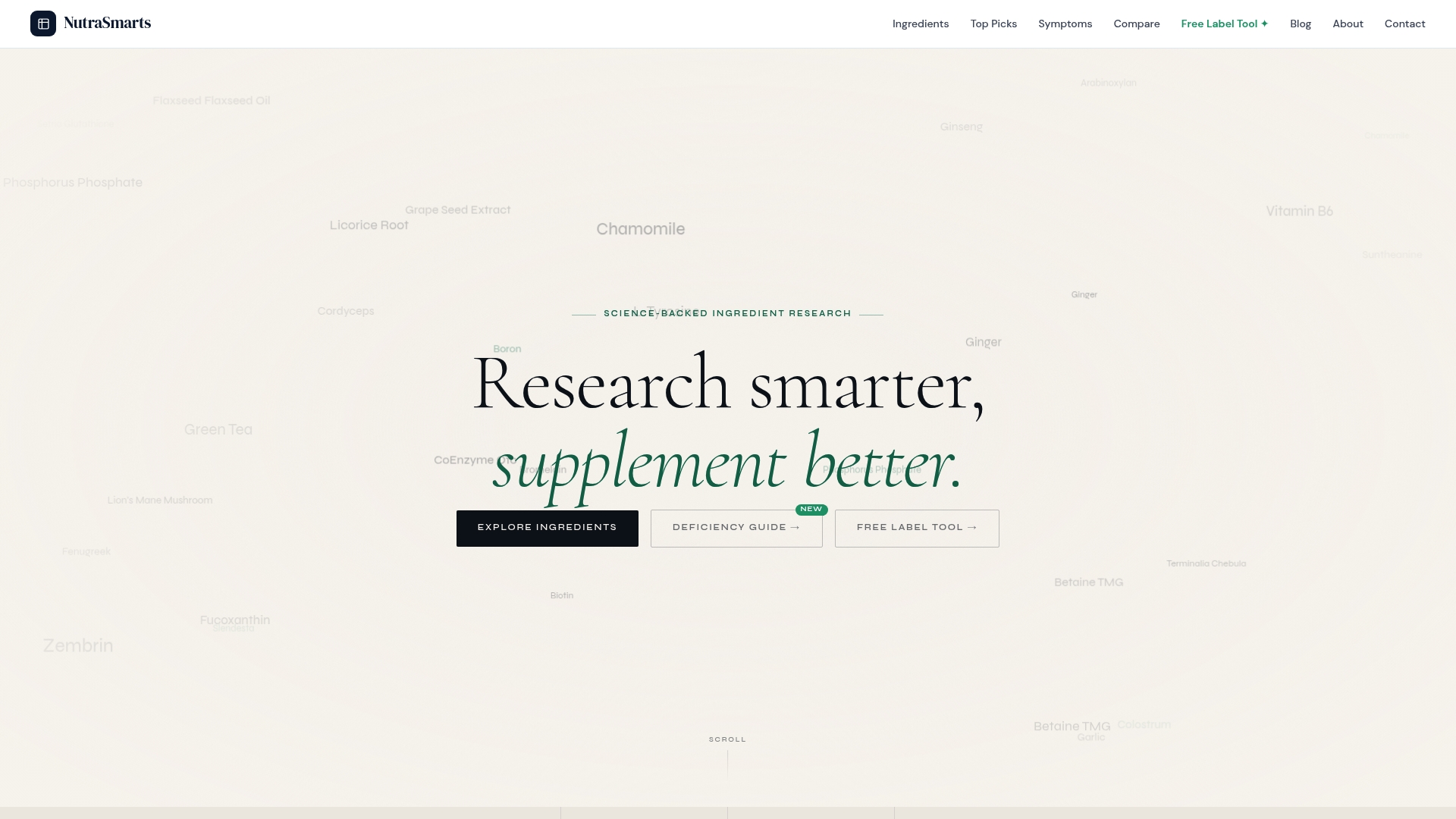
The symptom-based search lets you filter by health concern and surface the ingredients with the strongest trial support in seconds. The side-by-side comparison tool helps you check dose and formulation differences between products without building a spreadsheet. For formulators, the free FDA-compliant Supplement Facts label creator confirms label accuracy against your ingredient inputs.
Start with the ingredient you're researching at nutrasmarts.com/ingredients.html and follow the trial citations from there.
Authoritative resources for your next search
- Lutein, Zeaxathin, and Fish Oil Supplementation
- 4 Categories of Scientific Evidence—Human Information and Data
- Supplements: A scorecard - Harvard Health
- What Should Clinicians Know About Dietary Supplement Quality? | Journal of Ethics | American Medical Association
- Effect of a Specially Formulated Dietary Supplement With Pyrroloquinoline Quinone, γ-aminobutyric Acid, Caffeine and B-vitamins on Cognitive Function in Healthy Postmenopausal Women
- A Study to Evaluate the Effects of a Butyrate-Polyphenol Formulation on Gut Health and Associated Symptoms
- Effects of Curcuma longa extract on cognitive function in healthy participants with subtle cognitive weaknesses within the normal range: a randomized, double-blind, placebo-controlled trial
- Totum-63, a plant-based polyphenol-rich extract, in prediabetes or early-stage type 2 diabetes: an international, multicenter, randomized controlled trial | Nature Communications
Searching tips:
- Use NCT IDs for exact trial lookups; add author names or date ranges to narrow PubMed results.
- Search ClinicalTrials.gov for "Completed" trials with no results posted — those gaps are as informative as published findings.
- When evidence is complex or you're managing a patient with multiple medications, consult a registered dietitian or clinical pharmacist before making a recommendation.
For deeper reading: How to Read Supplement Research Studies and What Is Supplement Efficacy Evidence? on the Nutrasmarts blog.
This article is general educational information, not medical or clinical advice. Confirm current regulatory standards and product-specific evidence with a qualified healthcare professional or primary source before making clinical decisions.