

The quickest reliable way to judge a supplement study is to check the abstract for study type and primary endpoint first. If the result comes from a human RCT or a systematic review of RCTs, keep reading. If it comes from animal models, cell cultures, or a single small pilot trial, treat it as hypothesis-generating at best.
Quick triage checklist — scan these before reading further:
- Was the study conducted in humans? (Animal and cell data don't transfer reliably to personal decisions.)
- Is the primary endpoint a clinical outcome, not just a biomarker?
- Was the sample size large enough to detect a meaningful effect?
- Does the dose and formulation match what's actually sold?
- Who funded the study, and do the authors have financial ties to the product?
If any answer is "no" or "unclear," your confidence in the claim should drop accordingly.
Table of Contents
- 1. Which study types actually count as reliable evidence?
- 2. How to read a single supplement study step by step
- 3. How to interpret systematic reviews and meta-analyses correctly
- 4. Where can you find trustworthy supplement studies?
- 5. Common red flags that make weak evidence look persuasive
- 6. How to translate study findings into a personal decision
- 7. A 5-minute checklist before you believe any supplement claim
- 8. How Nutrasmarts speeds up trustworthy supplement research
- Key Takeaways
- The gap between "promising" and "proven" is wider than most people think
- Nutrasmarts makes evidence-based supplement research faster
- Useful sources for reading supplement research
1. Which study types actually count as reliable evidence?
Not all studies are created equal, and the gap between the top and bottom of the evidence hierarchy is enormous. Systematic reviews and meta-analyses of human RCTs sit at the top because they pool results across multiple controlled trials, reducing the chance that one lucky (or unlucky) result drives the conclusion. Individual RCTs come next: they randomly assign participants to treatment or placebo, which controls for confounding variables in a way no observational design can match.
Below RCTs, the reliability drops fast. Prospective cohort studies track people over time without intervention, so they can show association but not causation. Case-control and cross-sectional studies are weaker still. Animal and in-vitro (cell culture) studies are useful for understanding mechanisms, but they are low-reliability for personal health decisions. A compound that kills cancer cells in a petri dish has a long road before it becomes a supplement worth taking.
| Study Type | Reliability for Personal Decisions | Typical Use |
|---|---|---|
| Systematic review / meta-analysis of RCTs | Highest | Treatment or prevention decisions |
| Individual RCT | High | Evaluating a specific intervention |
| Prospective cohort | Moderate | Identifying associations, long-term risk |
| Case-control / cross-sectional | Low–moderate | Generating hypotheses |
| Animal study | Low | Mechanism research only |
| In-vitro (cell study) | Very low | Early-stage hypothesis |
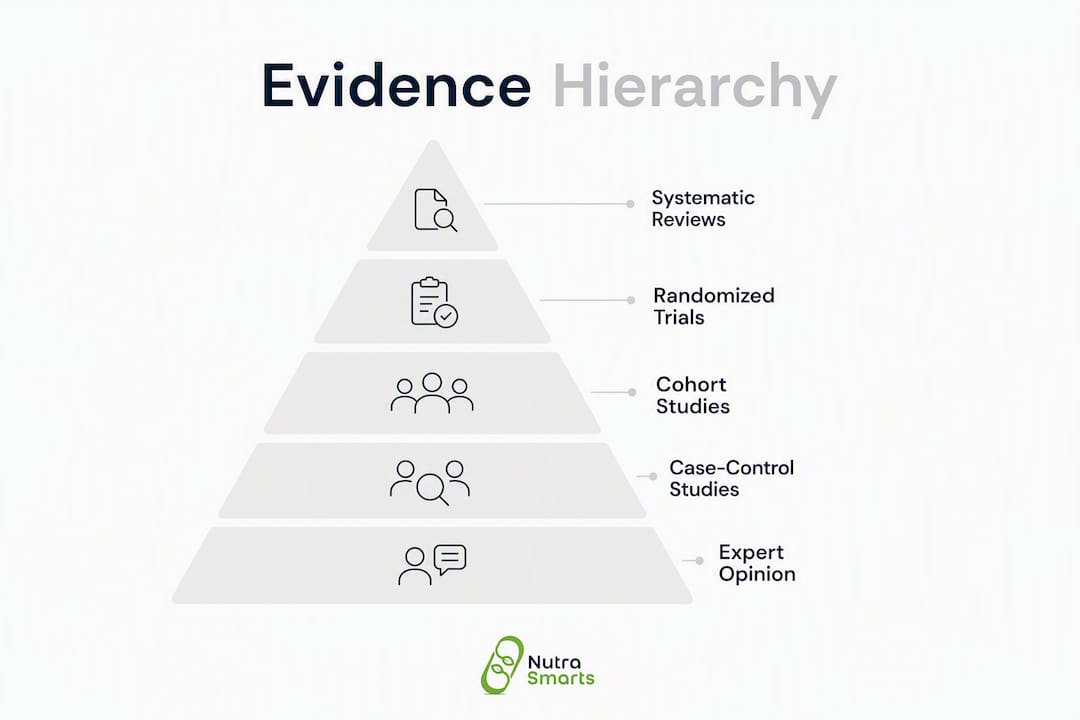
One nuance worth knowing: a large, well-run cohort study with decades of follow-up (think the Nurses' Health Study) can be more informative than a small, poorly designed RCT. Quality matters as much as study type. A scoping review of vitamin and mineral supplements found limited preventive benefits for healthy adults, partly because most trials were underpowered or short-term.
Pro Tip: A single small RCT rarely settles a question that matters for lifespan, disease risk, or sustained function. Look for replication across at least two or three independent trials before treating a finding as actionable.
2. How to read a single supplement study step by step
Most people open a paper and start reading from the top. That's the slowest way to extract signal. A faster approach is to triage in layers, spending the most time where the information density is highest.
- Read the title and abstract. Identify the study type, the supplement, the population, and the primary outcome. If the abstract doesn't state a primary endpoint clearly, that's a yellow flag.
- Check trial registration. Search ClinicalTrials.gov for the trial ID (usually listed in the methods). Compare the registered primary endpoint to what the paper actually reports. Outcome switching — reporting a secondary measure as if it were the main finding — is more common than most readers realize.
- Examine the methods: design, randomization, and blinding. Was it double-blind? Parallel-group or crossover? See clinical trial designs for how these choices affect result reliability.
- Look at the participants. How many were enrolled? What were their ages, health status, and baseline nutrient levels? A study in deficient elderly adults may not apply to a healthy 35-year-old.
- Check the intervention details. Dose, form (e.g., magnesium glycinate vs. magnesium oxide), timing, and duration. The dosage and formulation used in a trial often differs from what's on a product label.
- Assess the outcomes. Clinical endpoints (blood pressure, fracture rate, cognitive test score) are more meaningful than surrogate endpoints (a blood biomarker that correlates with disease but doesn't confirm it).
- Read the statistical results. Note the effect size and confidence interval, not just the p-value. A statistically significant result with a tiny effect size may be clinically irrelevant.
- Check funding and conflicts of interest. Industry-funded trials aren't automatically wrong, but they warrant extra scrutiny.
- Compare the authors' conclusions to the actual data. Authors sometimes overstate findings in the abstract. Read the results section yourself.
Red flags that justify walking away: sample size under 30 for a complex outcome, duration under four weeks for a long-term claim, surrogate-only endpoints presented as proof of clinical benefit, and manufacturer funding without independent replication.
Pro Tip: Before trusting a trial's headline result, pull up the ClinicalTrials.gov registration and confirm the pre-specified primary endpoint matches what the paper reports as its main finding.

3. How to interpret systematic reviews and meta-analyses correctly
A meta-analysis pools data from multiple studies to produce a single, more precise estimate of an effect. Done well, it's the most powerful tool for answering "does this supplement work?" Done poorly, it can give false confidence by combining studies that asked fundamentally different questions.

The first number to check is I², the heterogeneity statistic. An I² above 75% means the included studies are producing very different results, which makes the pooled estimate unreliable. When heterogeneity is high, the review may still be useful for identifying why results differ (dose, population, formulation), but the headline effect size should be treated cautiously.
Next, look at the GRADE rating or risk-of-bias assessment. Cochrane reviews use a standardized risk-of-bias tool; other reviews use GRADE to rate the overall certainty of evidence from "high" to "very low." A meta-analysis rated "low certainty" is not the same as a definitive answer, even if the pooled effect is statistically significant.
Effect size in practice: A 2026 systematic review and meta-analysis of 31 randomized trials (n = 1,168) found that a single 200 mg dose of L-theanine improved attention with a standardized mean difference (SMD) of 0.51 (95% CI 0.25–0.77), measured 30–60 minutes after dosing. An SMD of 0.51 is a moderate effect. The 95% CI doesn't cross zero, which means the result is unlikely to be a statistical fluke. But the review also found mixed effects on anxiety and stress, a reminder that a supplement can show a real benefit on one outcome while doing little on others.
Forest plots visualize this: each horizontal line represents one trial's result, and the diamond at the bottom shows the pooled estimate. When most lines overlap and the diamond is narrow, confidence is higher. When lines scatter widely, heterogeneity is the story.
4. Where can you find trustworthy supplement studies?
The best sources for supplement research are free, well-indexed, and don't require a university login.
- PubMed / PubMed Central: The primary free database for biomedical literature. Use the filters on the left sidebar to narrow results to "Randomized Controlled Trial" or "Systematic Review," then add a publication date range. PubMed's search filters make it practical for non-researchers to find high-quality studies without special credentials.
- ClinicalTrials.gov: Lists registered trials, including their pre-specified endpoints and status. Useful for checking whether a trial was registered before it started and for finding ongoing research.
- Cochrane Library: Publishes rigorous systematic reviews with standardized risk-of-bias assessments. Cochrane reviews on supplements are often the most reliable single source for a given ingredient.
- NIH Office of Dietary Supplements (ODS): Publishes evidence-based fact sheets on individual supplements, written for both consumers and health professionals. The ODS fact sheets summarize the current state of research clearly and are updated regularly.
- NCCIH: The National Center for Complementary and Integrative Health publishes consumer guidance that flags which supplements have evidence and which don't.
- Nutrasmarts: The evidence-rated ingredient database links directly to peer-reviewed trials and meta-analyses for over 800 ingredients, so you can skip the PubMed search and go straight to the highest-quality human studies for a given compound.
Pro search tip for PubMed: Type your ingredient name, add "AND (systematic review[pt] OR randomized controlled trial[pt])", then filter by "Free full text" to get papers you can actually read without a paywall.
5. Common red flags that make weak evidence look persuasive
Marketing copy is designed to make the weakest study sound like a landmark trial. Knowing the patterns makes them easy to spot.
The most common pitfalls:
- Animal or cell data presented as human evidence. A compound that reduces inflammation in mice has not been shown to reduce inflammation in you.
- Cherry-picked secondary outcomes. A trial that found no effect on its primary endpoint but found a positive result on one of fifteen secondary measures is not a positive trial. That secondary finding needs independent replication.
- Small exploratory trials framed as conclusive. A 20-person pilot study is designed to check feasibility and estimate effect size for a future trial, not to prove efficacy.
- Surrogate endpoints only. Lowering homocysteine is not the same as reducing stroke risk. Improving a biomarker doesn't guarantee a clinical benefit.
- Industry funding without independent replication. NCCIH guidance consistently notes that many popular supplements lack large-scale human trial support, particularly for cancer, cardiovascular disease, and cognitive decline in healthy populations.
- Publication bias. Positive results are more likely to be published than null results, which inflates the apparent evidence base for a supplement.
6. How to translate study findings into a personal decision
Reading a study well is only half the job. The other half is deciding whether the findings apply to you.
- Does the study population match you? Age, sex, health status, and baseline nutrient levels all affect how a supplement performs. A trial in iron-deficient women doesn't tell you much about iron supplementation in a man with normal ferritin.
- Does the dose match the product? The dose used in a trial is often different from what's on a product label. A study using 600 mg of a compound doesn't validate a product containing 50 mg.
- Is the effect size clinically meaningful? Statistical significance is not clinical significance. Ask whether the observed change would actually improve your daily function, reduce your disease risk, or matter to your doctor.
- Check safety and interactions. Some supplements have caused emergency room visits and documented drug interactions. Check for contraindications with any medications you take.
- Look for third-party testing. USP, NSF International, and ConsumerLab verify that a product contains what the label claims and isn't adulterated. Adulteration with undisclosed pharmaceuticals is a documented risk in some supplement categories.
- Consult a clinician for anything that affects a diagnosed condition. Evidence-based self-experimentation is reasonable for low-risk supplements with solid human trial data; it's not appropriate for managing a chronic disease without medical supervision.
Pro Tip: When trying a new supplement with solid evidence behind it, set a measurable personal outcome before you start (a sleep score, a cognitive test, a lab value) and reassess after the trial duration used in the research. Subjective "I feel better" is hard to separate from placebo.
7. A 5-minute checklist before you believe any supplement claim
Use this when you see a supplement ad, a social media post citing a "study," or a product page with a clinical reference.
- Was it a human RCT or systematic review? If no, the claim is preliminary at best.
- Was the primary endpoint a clinical outcome? Biomarker improvements alone don't confirm real-world benefit.
- Was the sample size reasonable? Under 50 participants for a complex outcome is a red flag for a definitive claim.
- Did the dose and formulation match what's being sold? A mismatch means the trial doesn't validate the product.
- Are there obvious conflicts of interest? Manufacturer-funded studies with no independent replication deserve extra skepticism.
This checklist works on social media posts, product pages, and news headlines. Screenshot it, print it, or save it as a note. The goal isn't to dismiss every supplement claim — it's to spend your reading time on the studies that actually deserve it.
8. How Nutrasmarts speeds up trustworthy supplement research
Reading supplement research well takes time. Nutrasmarts is built to compress that time without cutting corners on evidence quality.
- Evidence-rated ingredient profiles: Over 1,300 ingredient pages, each linked to peer-reviewed trials and meta-analyses. The evidence rating tells you at a glance whether the support comes from RCTs, cohort data, or animal studies.
- Symptom-to-supplement search: Search by health concern (joint pain, brain fog, sleep quality) and get a filtered list of ingredients with human trial support, not just mechanistic plausibility.
- Side-by-side ingredient comparison: The compare tool lets you place two ingredients next to each other with their linked citations, so you can evaluate competing evidence signals without switching between tabs.
- Deficiency guide: The deficiency symptom tool helps you assess whether a supplement is addressing a genuine nutrient gap or simply adding to an already-adequate intake.
- Free FDA-compliant label creator: For formulators, the Supplement Facts tool generates accurate labels without spreadsheets, grounded in the same evidence database.
The practical benefit is direct access to the highest-quality human RCTs and meta-analyses for an ingredient, without running a PubMed search from scratch every time.
Key Takeaways
Prioritizing human RCTs and systematic reviews, checking endpoints and dose, and verifying third-party testing are the three habits that separate evidence-based supplement decisions from marketing-driven ones.
| Point | Details |
|---|---|
| Start with study type | Systematic reviews and meta-analyses of human RCTs carry the highest confidence for personal health decisions. |
| Check endpoints and dose | Confirm the primary endpoint is clinical, not just a biomarker, and that the trial dose matches the product you'd take. |
| Watch for red flags | Animal data, surrogate endpoints, small exploratory trials, and industry-only funding all reduce confidence in a claim. |
| Verify safety and interactions | Third-party testing (USP, NSF) and a clinician review matter before adding any supplement to a health regimen. |
| Use Nutrasmarts | The evidence-rated ingredient database links directly to peer-reviewed trials, cutting research time without sacrificing rigor. |
The gap between "promising" and "proven" is wider than most people think
Most supplement marketing is built on a real finding — a genuine mechanism, a plausible pathway, sometimes even a small positive RCT. The problem is the distance between that finding and the claim on the label. A compound that raises a biomarker in a 12-week trial in 40 people has not been shown to prevent disease, extend healthspan, or outperform a dietary change. That gap is where most of the supplement industry lives.
What frustrates me about how people read supplement research isn't that they're credulous — it's that they're applying the wrong standard. They ask "is there a study?" when the real question is "does the body of evidence, in humans, at this dose, for this outcome, hold up?" Those are very different questions. The first is almost always yes. The second is often no, or "we don't know yet."
The NIH ODS fact sheets are genuinely underused. They're not exciting, but they represent the most honest summary of where the evidence actually stands for dozens of common supplements. Pair them with a PubMed filter for systematic reviews and you have a research workflow that takes 10 minutes and beats 90% of what supplement brands publish.
The 5-minute checklist in this guide isn't meant to make you cynical about supplements. Some have real, replicated, clinically meaningful evidence. The goal is to help you spend your attention on those, and skip the rest.
Nutrasmarts makes evidence-based supplement research faster
Reading the research yourself is the right instinct. The problem is that pulling up PubMed, filtering for RCTs, checking trial registrations, and cross-referencing doses takes time most people don't have on a Tuesday night.
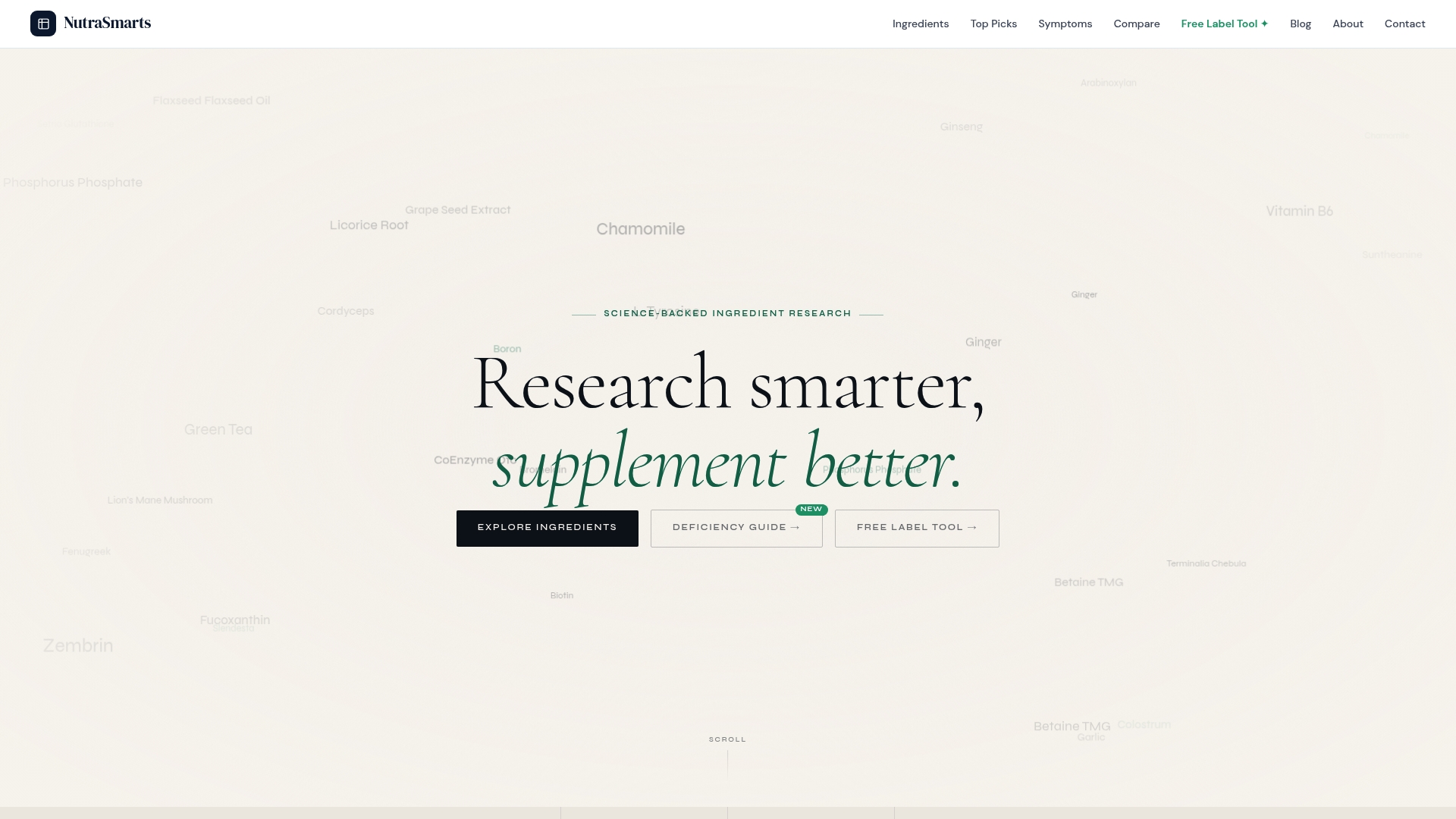
Nutrasmarts cuts that process down. The free ingredient database covers supplements by symptom with direct links to the peer-reviewed trials that matter most, evidence ratings that tell you whether support comes from meta-analyses or animal studies, and a side-by-side comparison tool for when you're deciding between two options. For supplement formulators, the free FDA-compliant label creator generates accurate Supplement Facts panels grounded in the same evidence database. No spreadsheets, no guesswork about compliance. Start with the ingredient database and see which supplements in your current stack actually have human trial support.
Useful sources for reading supplement research
| Source | What it offers | Best for |
|---|---|---|
| PubMed / PubMed Central | Full biomedical literature database with RCT and systematic review filters | Finding original trials and reviews |
| ClinicalTrials.gov | Registered trial database with pre-specified endpoints | Checking outcome switching and trial status |
| Cochrane Library | Rigorous systematic reviews with standardized bias assessment | Highest-quality evidence summaries |
| NIH Office of Dietary Supplements | Evidence-based fact sheets on individual supplements | Quick, authoritative ingredient overviews |
| NCCIH — Using Supplements Wisely | Consumer guidance on evidence and safety | Understanding which claims have real support |
| Nutrasmarts ingredient database | Evidence-rated profiles with linked trial citations for 1,300+ ingredients | Fast, filtered access to human RCT evidence |
Exemplar papers worth studying as practice:
- The 2026 L-theanine systematic review and meta-analysis (31 RCTs, n = 1,168) is a well-structured example of how to read a pooled analysis: clear PICO question, I² reported, effect sizes with confidence intervals, and honest discussion of heterogeneity across outcomes.
- The scoping review on vitamin and mineral supplements in healthy adults is a useful counterpoint to optimistic marketing, showing where the evidence for prevention genuinely falls short.
This article is general information, not medical or professional advice. Confirm current evidence and safety for your specific situation with a qualified clinician or the primary sources listed above.