

Matching supplements to health goals is defined as selecting clinically validated ingredients based on a specific, measurable health outcome rather than broad wellness claims. Most people buy supplements based on marketing, not evidence. That approach wastes money and produces results that are impossible to measure. This guide walks you through a stepwise process: define your primary goal, research the evidence, build a timed protocol, and account for personal factors like medications and age. Nutrasmarts supports each step with a database of over 800 peer-reviewed ingredients, so every decision you make is grounded in science.
How to match supplements to health goals: start with a clear objective
The most critical step in any supplement protocol is defining a specific outcome rather than buying based on broad marketing claims. "I want more energy" is not a goal. "I want to reduce daytime fatigue during workday hours" is. That specificity determines which ingredients are relevant and which are noise.
Goal clarity also protects you from a common trap called goal stacking. Trying to optimize multiple goals simultaneously without isolating effects leads to stagnant progress. Practitioners recommend focusing on one primary goal for 8–12 weeks to get clear results. If you chase muscle recovery, sleep quality, and cognitive performance at the same time, you cannot tell which supplement is working or failing.

Your personal profile shapes which goal deserves priority. Age, sex, existing medications, and lifestyle all affect which nutrients your body actually needs. A 55-year-old woman managing blood pressure has different baseline needs than a 28-year-old male athlete. Supplements tailored to goals must account for that gap.
Common primary goals and their supplement categories:
- Muscle recovery: Creatine monohydrate, leucine-rich protein, magnesium glycinate
- Sleep quality: Magnesium glycinate, L-theanine, ashwagandha
- Cognitive performance: Bacopa monnieri, lion's mane, phosphatidylserine
- Joint health: Collagen peptides, glucosamine sulfate, boswellia serrata
- Immune support: Vitamin D3, zinc, elderberry extract
Pro Tip: Write your goal as a single sentence with a measurable outcome and a time frame. Example: "Improve sleep onset within four weeks." That sentence becomes your filter for every supplement decision.
How do you research and select evidence-based supplements?
Peer-reviewed clinical research is the only reliable standard for supplement efficacy. A supplement that lacks human clinical trial data is a hypothesis, not a solution. The role of clinical trials in confirming safe dosing and real-world effectiveness cannot be replaced by testimonials or influencer endorsements.
Third-party testing adds a second layer of verification. Organizations like USP, NSF International, and Informed Choice test supplements for ingredient accuracy, contamination, and label honesty. Third-party testing confirms ingredient accuracy and safety, but it does not assess efficacy or personalized suitability. That distinction matters. A certified product can still be the wrong choice for your goal.
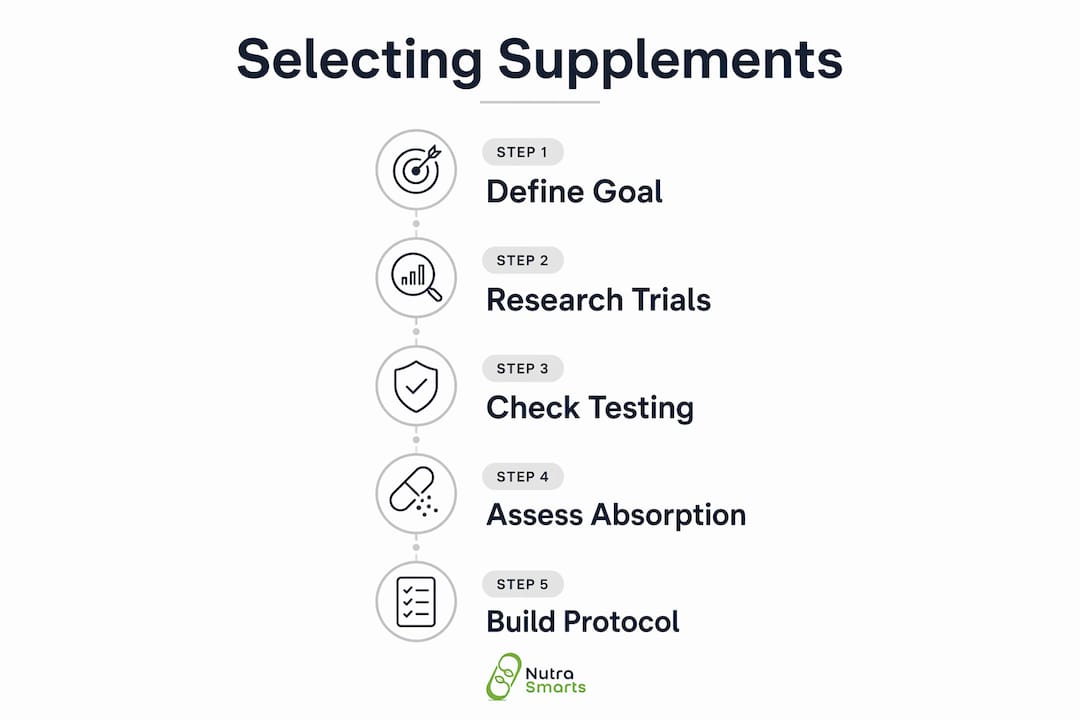
Bioavailability determines how much of an ingredient your body actually absorbs. Magnesium oxide, for example, has poor absorption compared to magnesium glycinate. Vitamin K2 as MK-7 stays active in the body far longer than MK-4. Choosing the right ingredient form is as important as choosing the right ingredient. The Nutrasmarts ingredient database lists bioavailability data alongside clinical citations for over 800 compounds, so you can compare forms directly.
Marketing doses are frequently below clinical doses. A product may list ashwagandha on the label but contain 100 mg per serving when clinical studies use 300–600 mg. Always verify ingredient dosages against the amounts used in published research before purchasing.
A four-step selection process:
- Identify the ingredient with the strongest clinical evidence for your specific goal.
- Confirm the ingredient form matches what was used in trials (e.g., creatine monohydrate, not creatine ethyl ester).
- Check the label dose against the clinical dose range.
- Verify the product carries a third-party certification from USP, NSF, or Informed Choice.
Pro Tip: Single-nutrient thinking misses biological synergies. Calcium requires vitamin D3 for effective absorption. Joint health supplements need consistent months-long use to show results. Build your selection around nutrient relationships, not isolated ingredients.
How to build a personalized supplement protocol
A well-built supplement protocol functions like a team. Each component must have a defined role that complements your nutrition and training, and periodic adjustments are necessary as your goals evolve. Beginners should start with 2–3 essential supplements to capture the majority of benefits while keeping costs and complexity low. Advanced users typically maintain 5–7 supplement protocols, with costs varying significantly by goal.
Timing is not optional. Fat-soluble vitamins including D3, omega-3 fatty acids, and CoQ10 require a fat-containing meal for proper absorption. Magnesium works best taken before bed, which also supports sleep quality. Iron and calcium compete for the same absorption pathway, so they must be spaced at least two hours apart. Getting timing right for absorption is one of the most overlooked factors in supplement effectiveness.
| Supplement | Best timing | Take with |
|---|---|---|
| Vitamin D3 | Morning or midday | Fat-containing meal |
| Omega-3 fatty acids | With any meal | Dietary fat |
| Magnesium glycinate | 30–60 min before bed | Water or light snack |
| Iron | Morning, away from calcium | Vitamin C source |
| Creatine monohydrate | Post-workout or any time | Water |
| CoQ10 | Morning | Fat-containing meal |
Synergistic stacking adds another layer of effectiveness. Vitamin D3 pairs with vitamin K2 to direct calcium into bones rather than arteries. Zinc and magnesium support testosterone and sleep together. For a deeper look at current synergistic supplement combinations, the evidence base in 2026 is stronger than it has ever been.
Protocol adjustment rules:
- Reassess your protocol every 8–12 weeks against your original measurable goal.
- Add one new supplement at a time so you can isolate its effect.
- Remove any supplement that shows no measurable benefit after a full trial period.
- Adjust doses seasonally, especially for vitamin D3 in winter months.
How do medications, age, and deficiencies affect your supplement choices?
Medications create nutrient depletions that most supplement protocols ignore entirely. Medication-induced depletions include statins lowering CoQ10, metformin reducing B12, and proton pump inhibitors depleting magnesium, B12, iron, calcium, and vitamin C. Failing to address these depletions first means other supplements work against a deficit you have not corrected. That is the most common reason a protocol underperforms.
Age and sex shift baseline nutrient needs in measurable ways. Women over 50 need more calcium and vitamin D3 to counter bone density loss. Men over 40 often benefit from zinc and magnesium as natural testosterone support declines. Pregnant women require folate, iron, and DHA at levels that general wellness supplements rarely provide. The Nutrasmarts deficiency risk guide breaks these needs down by demographic group with clinical references.
Lab work removes the guesswork. A serum 25(OH)D test tells you whether you are deficient in vitamin D before you spend money on a dose that may be too low or unnecessary. Ferritin levels reveal iron status more accurately than symptoms alone. If you have not had bloodwork in the past year, that is the most cost-effective supplement investment you can make.
"Many people fail to address medication-induced nutrient depletions first, which hinders the effectiveness of every other supplement in their protocol. Correcting depletions is not optional. It is the foundation."
Consulting a healthcare provider before starting any new protocol is the standard recommendation, especially if you take prescription medications. A registered dietitian or functional medicine physician can interpret your labs and flag interactions that a label cannot warn you about.
Key individual factors to assess before building your stack:
- Current prescription medications and their known nutrient depletions
- Recent bloodwork results, especially vitamin D, B12, iron, and magnesium
- Age and sex-specific nutrient requirements
- Dietary patterns that may create baseline gaps (e.g., vegan diets and B12, omega-3)
- Existing diagnosed conditions that affect absorption (e.g., Crohn's disease, celiac disease)
What are the most common mistakes when aligning supplements with health goals?
The most damaging mistake is buying supplements based on marketing claims without checking clinical evidence. A product labeled "advanced cognitive support" may contain ingredients at doses too low to produce any measurable effect. Starting backward from goals and evidence-validated ingredients prevents wasting money on products that produce nothing but expensive urine.
Overloading a protocol with too many supplements at once is the second most common error. When you take eight supplements simultaneously and feel better, you have no idea which one worked. When you feel worse, you cannot identify the problem. Isolation is the only method that produces usable data about your own body.
Mistakes that stall progress:
- Ignoring timing and absorption guidelines (e.g., taking iron with calcium)
- Failing to re-evaluate the protocol after 8–12 weeks
- Choosing a supplement based on price or brand recognition alone
- Skipping third-party certification checks
- Neglecting to account for medications or existing health conditions
Neglecting to re-evaluate is a slow-moving problem. Goals change. A muscle recovery focus in January may shift to joint support by June. A protocol built for one goal rarely serves a different one well. The top supplement stacks for 2026 reflect this reality by organizing recommendations around specific, time-bound objectives rather than general wellness categories.
Pro Tip: Keep a simple supplement log. Record what you take, when you take it, and one measurable outcome each week. After 8 weeks, the data tells you what to keep and what to cut.
Key Takeaways
Effective supplement selection requires a specific goal, clinical evidence, correct dosing, and an honest accounting of your personal health factors before any product enters your protocol.
| Point | Details |
|---|---|
| Define one measurable goal | Focus on a single outcome for 8–12 weeks before adding or changing supplements. |
| Verify clinical doses | Check that label doses match the amounts used in peer-reviewed human trials. |
| Use third-party certified products | USP, NSF, and Informed Choice certifications confirm purity but not efficacy. |
| Address medication depletions first | Statins, metformin, and PPIs create nutrient gaps that undermine every other supplement. |
| Time supplements for absorption | Fat-soluble vitamins need dietary fat; iron and calcium must be spaced two hours apart. |
What Nutrasmarts has learned from evidence-based supplement matching
The supplement industry has a volume problem. More products, more claims, and more confusion do not produce better health outcomes. They produce paralysis and wasted spending. After working with a database of over 800 clinically referenced ingredients, the pattern is consistent: the people who get results are the ones who started with a single, specific goal and worked backward to the evidence.
The conventional wisdom says to start with a "foundational stack" of multivitamins and fish oil. That advice is not wrong, but it is incomplete. A multivitamin does not correct a metformin-induced B12 deficiency at a therapeutic dose. Fish oil at 500 mg per serving does not reach the 2–4 g EPA/DHA range studied for cardiovascular benefit. Generic foundations often create a false sense of coverage while leaving real gaps unaddressed.
The approach that actually works is uncomfortable in its simplicity. Pick one goal. Find the two or three ingredients with the strongest clinical evidence for that goal. Confirm the dose, the form, and the certification. Take them consistently for 8–12 weeks and measure the outcome you defined at the start. Then adjust. That cycle, repeated over time, produces compounding results that a shopping cart full of trending supplements never will.
Nutrasmarts was built specifically for this process. The ingredient database links every compound to its peer-reviewed studies. The supplement facts tool lets you analyze formulas before you buy. The deficiency guide connects symptoms to likely nutrient gaps. These are not marketing features. They are the infrastructure for making decisions that hold up under scrutiny.
— Nutrasmarts
Nutrasmarts resources for building your supplement protocol
Choosing the right supplements is faster and more reliable when you have clinical data at your fingertips rather than label copy written by a marketing team.
Nutrasmarts offers a symptom-based supplement search that connects specific health concerns, from joint pain to brain fog, to ingredients backed by peer-reviewed research. The ingredient database covers over 800 compounds with clinical citations, bioavailability data, and dosing ranges. For anyone building or auditing a formula, the Supplement Facts Label Creator generates FDA-compliant labels with accurate ingredient data. If you suspect a nutrient gap, the deficiency symptom tool maps your symptoms to likely causes with clinical references. Every resource is free and built for people who want evidence, not guesswork.
FAQ
What does it mean to match supplements to health goals?
Matching supplements to health goals means selecting clinically validated ingredients based on a specific, measurable outcome rather than general wellness claims. The process starts with defining one primary goal, then identifying ingredients with peer-reviewed evidence for that exact outcome.
How many supplements should a beginner take?
Beginners should start with 2–3 essential supplements to capture the majority of benefits while keeping complexity low. Adding too many at once makes it impossible to identify which supplement is producing results.
Why does supplement timing matter?
Timing affects how much of an ingredient your body absorbs. Fat-soluble vitamins like D3 and CoQ10 require dietary fat for absorption, magnesium works best before bed, and iron must be taken at least two hours apart from calcium to avoid absorption interference.
How do medications affect supplement choices?
Common medications deplete specific nutrients. Statins lower CoQ10, metformin reduces B12, and proton pump inhibitors deplete magnesium, B12, iron, calcium, and vitamin C. Correcting these depletions before adding other supplements is the most important step for people on prescription medications.
How long should I follow a supplement protocol before evaluating results?
Focus on one primary goal for 8–12 weeks before making changes. That time frame is long enough to see measurable effects from most supplements and short enough to adjust if something is not working.