

Serum biomarkers are defined as measurable biological indicators in blood that objectively reflect physiological responses to dietary supplements, making them the gold standard for evaluating supplement efficacy. The role of serum biomarkers in supplement studies has grown significantly as researchers move away from subjective endpoints toward quantifiable, reproducible data. Markers like C-reactive protein (CRP), malondialdehyde (MDA), and EPA/DHA serum levels now anchor clinical trials across antioxidant, omega-3, and vitamin research. In 2026, the field is shifting toward multi-biomarker panels and hybrid study designs that combine biochemical indicators with functional outcomes. Nutrasmarts tracks this evolution across its database of over 800 ingredients, each linked to peer-reviewed clinical citations.
How are serum biomarkers selected and validated for supplement efficacy studies?
Biomarker selection is the most consequential decision in supplement trial design. A poorly chosen marker can produce a false negative even when a supplement is genuinely effective. Researchers classify nutritional serum indicators into three main categories: inflammatory markers (CRP, interleukin-6), oxidative stress markers (MDA, total antioxidant capacity), and nutrient status markers (selenoprotein P, 25-hydroxyvitamin D, EPA/DHA levels).
Validation requires four properties: specificity (the marker reflects the targeted pathway), sensitivity (it detects small changes), reproducibility (results are consistent across labs and time points), and biological plausibility (the supplement's mechanism logically connects to the marker). Regulatory guidance from bodies like the FDA and EMA reinforces these criteria for clinical endpoint qualification.
Common challenges include pre-analytical variability (fasting status, sample handling), intra-individual fluctuation, and assay standardization across sites. A biomarker that performs well in a single-center pilot may show high variance in a multicenter trial if collection protocols differ.
- Inflammatory markers: CRP and IL-6 respond to immune modulation and are relevant for anti-inflammatory supplement claims.
- Oxidative stress markers: MDA measures lipid peroxidation; T-AOC reflects total antioxidant defense capacity.
- Nutrient status markers: Selenoprotein P for selenium, 3cB12 for vitamin B12, and EPA/DHA ratios for omega-3 adequacy.
- Functional biomarkers: VO2 max and grip strength complement serum data in performance supplement trials.
Pro Tip: Run a pilot assay on 10–15% of your planned sample size before committing to a primary biomarker. Coefficient of variation above 15% signals a measurement problem, not a supplement effect.
What are the advantages and limitations of serum biomarkers vs. other endpoints?
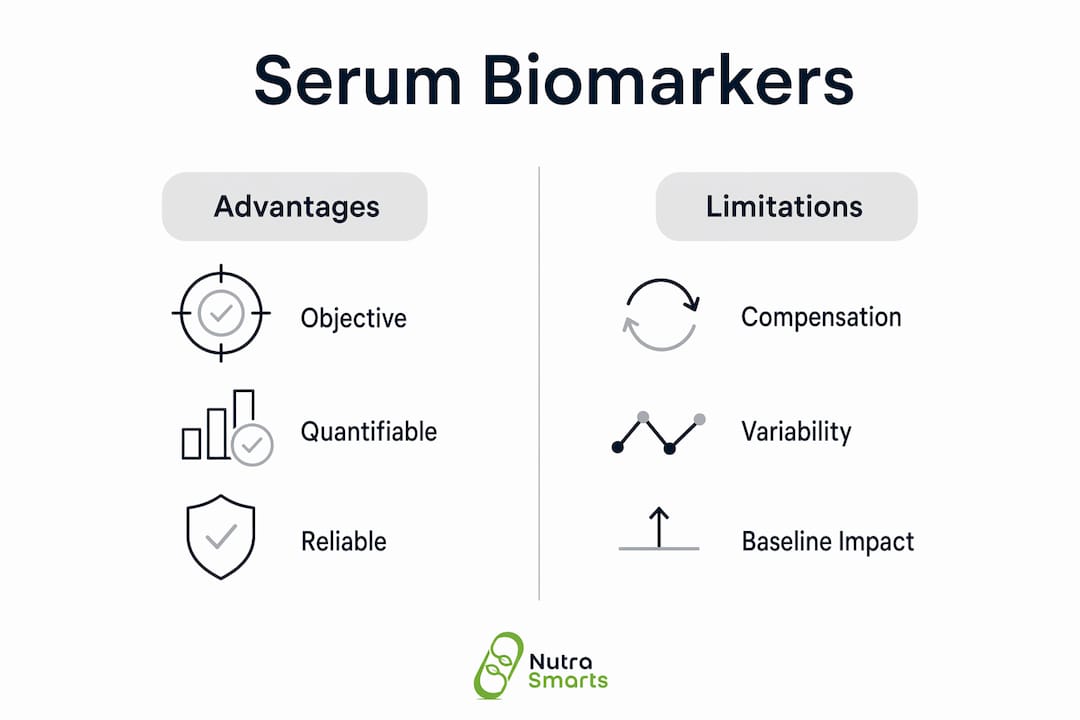
Serum biomarkers offer one clear advantage over patient-reported outcomes (PROs): they are objective. A researcher cannot argue with a CRP value the way a participant can misremember a pain score. Blood markers also detect physiological changes before symptoms appear, giving trials the sensitivity to capture early biological responses that PROs would miss entirely.
That said, serum markers carry real limitations. Biological compensatory mechanisms mean a single marker can stay stable even when the underlying pathway is changing. Single biomarkers often produce false negatives because the body reroutes metabolic activity around the measured analyte. This is why multi-biomarker panels are now the preferred approach.
A second limitation is inter-individual variability. Genetic metabolic profiles, baseline nutrient status, age, and sex all influence how a marker responds to supplementation. A trial that ignores these variables risks masking a real effect in a subgroup that would benefit most.
Hybrid study designs combining biomarker endpoints with PROs demonstrate stronger evidence and better meet regulatory expectations than single-endpoint studies. Among 120 non-pharmaceutical supplement studies from the last five years, 70% included biomarker endpoints and 55% included patient-reported outcomes. Studies using both showed stronger benefit evidence than those relying on either alone.
The practical takeaway is straightforward. Use serum markers as your primary objective anchor, add at least one functional or PRO endpoint, and pre-specify how you will interpret discordant results between them.
Which serum biomarkers are most commonly used in supplement studies?
The most frequently measured supplement efficacy biomarkers fall into four functional categories. Each reflects a distinct biological process, and each requires context-dependent interpretation based on the population studied and the supplement's proposed mechanism.

Inflammatory and immune markers
CRP is the most widely used inflammatory marker in supplement research. A 28-day trial of 500 mg/day Shilajit resin supplementation reduced CRP by 25.35% while simultaneously improving leg press strength by 12.94%. That dual result illustrates why pairing a serum marker with a functional endpoint strengthens the evidence base.
Oxidative stress markers
MDA and T-AOC are the standard pair for antioxidant supplement trials. Antioxidant supplementation significantly reduced MDA in women with unexplained infertility, but T-AOC did not change significantly. That divergence is not a failure. It shows that lipid peroxidation and total antioxidant defense are distinct processes that do not always move together, which is exactly why measuring both matters.
Omega-3 and vascular biomarkers
EPA and DHA serum levels are the direct nutrient status markers for omega-3 trials. A meta-analysis of 20 RCTs with 1,208 subjects found that omega-3 dose-dependent improvements in augmentation index and flow-mediated dilation required approximately 1,650 mg EPA and 750 mg DHA per day. Pulse wave velocity did not improve, again demonstrating that vascular health is not a single-biomarker story.
Composite nutrient status indices
Composite indicators like 3cB12 for vitamin B12 integrate conventional markers into a single interpretive index, improving accuracy over any single analyte. Selenoprotein P serves a similar function for selenium status, outperforming serum selenium alone as a functional biomarker.
| Biomarker | Category | What it reflects |
|---|---|---|
| CRP | Inflammatory | Systemic inflammation response |
| MDA | Oxidative stress | Lipid peroxidation damage |
| T-AOC | Oxidative stress | Total antioxidant defense capacity |
| EPA/DHA ratio | Nutrient status | Omega-3 tissue incorporation |
| Selenoprotein P | Nutrient status | Functional selenium adequacy |
| 3cB12 | Composite index | Vitamin B12 metabolic status |
Pro Tip: Always report baseline biomarker values by tertile. Participants in the lowest tertile of a nutrient marker at baseline consistently show the largest post-supplementation response. Averaging across the full sample dilutes the signal.
How can researchers integrate serum biomarker data effectively in study design?
Effective biomarker integration starts before recruitment. Study design decisions made at the protocol stage determine whether your biomarker data will be interpretable or confounded.
-
Stratify by baseline biomarker status. Baseline nutrient status and genetic metabolic profiles significantly affect biomarker response. Participants who are already replete in a nutrient show minimal change in its corresponding marker. Stratifying by baseline tertile prevents this from masking a real effect in deficient subgroups.
-
Set dose and duration thresholds before enrollment. Sufficient study duration and threshold doses are necessary to detect biomarker changes. Some supplements require weeks to modulate specific analytes. Define your minimum effective dose and minimum study length in the protocol, not after data collection.
-
Use multi-biomarker panels, not single markers. Multi-biomarker panels tracking both injury and adaptive responses capture supplement effects that single markers miss. A panel of three to five markers covering different biological pathways is the current standard for credible supplement efficacy research.
-
Apply double-blind, placebo-controlled design. Blinding eliminates expectation bias in both participants and assessors. For supplement efficacy measurement, placebo control is non-negotiable when biomarkers are primary endpoints, because even minor behavioral changes in the active group can shift inflammatory markers.
-
Pre-specify your statistical analysis plan. Composite endpoint analysis requires pre-specified weighting of individual markers. Post-hoc selection of the markers that "worked" inflates false-positive rates and undermines reproducibility.
-
Report all biomarkers, including null results. Selective reporting of significant markers distorts the literature. Transparent reporting of full panels, including markers that did not change, is what allows meta-analyses to build accurate effect estimates.
Supplement dosage considerations are especially critical when biomarkers are your primary endpoints, because underdosing produces flat biomarker curves that look like null effects.
Key Takeaways
Serum biomarkers are the most reliable objective endpoints in supplement research, but their value depends entirely on panel design, baseline stratification, and integration with functional outcomes.
| Point | Details |
|---|---|
| Multi-biomarker panels are standard | Single markers produce false negatives; panels of 3–5 markers across pathways are more reliable. |
| Baseline stratification is non-negotiable | Participants already replete in a nutrient show minimal marker change, masking real effects in deficient subgroups. |
| Dose and duration thresholds matter | Pre-specify minimum effective dose and study length; underdosing produces flat biomarker curves. |
| Hybrid endpoints strengthen evidence | Combining serum markers with functional or patient-reported outcomes meets regulatory expectations better. |
| Composite indices improve accuracy | Markers like 3cB12 and selenoprotein P outperform single analytes for nutrient status interpretation. |
What the research actually tells us about biomarker-driven supplement trials
Working with supplement biomarker data across hundreds of ingredient profiles has made one thing clear: the biggest errors in this field are not statistical. They are conceptual. Researchers design trials around the biomarker they can measure most easily, not the one most relevant to the supplement's mechanism. CRP gets used as a default inflammatory marker even in trials where the supplement primarily affects oxidative stress pathways. The result is a null finding that gets published as evidence of no effect.
The second pattern I see repeatedly is the failure to account for inter-individual baseline variability in study design. A trial that enrolls participants across a wide range of baseline nutrient status, without stratifying, is essentially averaging a large responder group with a non-responder group. The mean looks flat. The supplement looks ineffective. The subgroup analysis that would have shown a real effect never gets pre-specified, so it cannot be published as primary evidence.
The future of this field is precision nutrition guided by biomarkers. That means selecting markers based on the participant's metabolic phenotype, not just the supplement category. It means integrating blood diagnostics into trial design as a stratification tool, not just an outcome measure. And it means accepting that a well-designed trial with a null result is more valuable than a poorly designed trial with a positive one.
The practical constraint is cost. Multi-biomarker panels and genetic stratification add expense. The answer is not to cut the panel. The answer is to design smaller, better-stratified trials that generate cleaner signal per dollar spent.
— Nutrasmarts
Nutrasmarts resources for biomarker-driven supplement research
Researchers who need ingredient-level evidence to support biomarker endpoint selection have a direct resource in Nutrasmarts. The platform indexes over 800 supplement ingredients, each linked to peer-reviewed studies and clinical trial citations, making it practical to identify which markers a given ingredient has been shown to modulate.

For metabolic health research specifically, the metabolic health supplement reviews catalog covers 130 reviewed supplements with clinical evidence summaries relevant to biomarker-driven study design. Researchers building anti-inflammatory trial protocols can cross-reference the anti-inflammatory supplement database to align ingredient selection with CRP and MDA endpoints. The supplement ingredient database provides the full ingredient catalog with mechanism and dosage data to support protocol development.
FAQ
What are serum biomarkers in supplement studies?
Serum biomarkers are measurable blood-based indicators that reflect physiological responses to supplementation. They serve as objective endpoints in clinical trials, replacing or complementing subjective patient-reported outcomes.
Why are multi-biomarker panels preferred over single markers?
Single biomarkers frequently produce false negatives because compensatory biological mechanisms keep one analyte stable while the underlying pathway changes. Panels of three to five markers across different pathways capture a more complete picture of supplement effects.
How does baseline nutrient status affect biomarker results?
Participants who are already replete in a nutrient show minimal change in its corresponding serum marker after supplementation. Stratifying participants by baseline biomarker tertile prevents this from masking real effects in deficient subgroups.
What dose of omega-3 is needed to see vascular biomarker changes?
A meta-analysis of 20 RCTs found that approximately 1,650 mg EPA and 750 mg DHA per day produced measurable improvements in augmentation index and flow-mediated dilation. Lower doses did not produce consistent vascular biomarker changes.
How should researchers handle discordant biomarker results?
Pre-specify in the protocol how discordant results between markers will be interpreted. When MDA decreases but T-AOC does not change, for example, that reflects two distinct biological processes, not a measurement error, and should be reported as a finding rather than a contradiction.