

Follow the FDA's tiered rounding increments by nutrient class, calculate percent Daily Value from the unrounded quantitative amount, and omit any nutrient that rounds to zero under the Rule of Omission. Anchor every decision to 21 C.F.R. § 101.36 and FDA's nutrition labeling guidance, and only round at the final output step. A tool like the Nutrasmarts label creator can handle this calculation sequence automatically.
TL;DR:
- Rounding errors often stem from applying FDA rounding rules too early, which leads to compounded inaccuracies in the final supplement label.
- The correct process involves holding full-precision data through calculations, then applying tiered rounding only at the final step, and keeping detailed logs of the derivation.
- Nutrients with less than 2% RDI should be omitted entirely rather than listed as zero or "<1%", to comply with the Rule of Omission.
- The unrounded basis must be used to calculate percent Daily Values for all nutrients except total fat, saturated fat, cholesterol, sodium, potassium, and dietary fiber, which have specific exceptions.
- Nutrasmarts' label creation tool automates proper rounding, flagging inconsistencies, and matches FDA guidance, reducing the risk of compliance violations and costly reprints.
Table of Contents
- What Are the FDA Rounding Rules for Supplement Labels?
- How Do You Build Rounding Into a Label Workflow?
- How Is Percent Daily Value Calculated Under the Rounding Rules?
- Worked Examples of Supplement Label Rounding
- What Makes Nutrasmarts a Reliable Source on Label Rounding?
- How Do Supplement Label Rules Differ From Conventional Food Labels?
- How Do Proprietary Blends Affect Rounding on the Label?
- Does Rounding Affect Allergen Declarations or Ingredient Statements?
- What About Nutrients Without an Established Daily Value?
- What Happens If a Label Fails FDA Rounding Compliance?
- Our Take: Rounding Discipline Is a Systems Problem, Not a Math Problem
- Get an Audit-Ready Label Without Building the Rounding Logic Yourself
- Sources
What Are the FDA Rounding Rules for Supplement Labels?
The FDA rounding tables work in tiers, and the tier depends on how much of the Reference Daily Intake (RDI) a nutrient amount represents. Get the tier wrong and every downstream number on the panel is wrong too.
For vitamins and minerals, the increments scale with the declared percentage of the RDI. Amounts under 2% of the RDI are considered insignificant and typically get dropped from the label entirely.
| Nutrient category | RDI band or amount | Rounding increment |
|---|---|---|
| Vitamins/minerals | Less than 2% RDI | Omit (insignificant) |
| Vitamins/minerals | 2% to 10% RDI | Nearest 2% increment |
| Vitamins/minerals | Greater than 10% to 50% RDI | Nearest 5% increment |
| Vitamins/minerals | Greater than 50% RDI | Nearest 10% increment |
| Calories | Under 50 calories | Nearest 5 calorie increment |
| Calories | 50 calories or more | Nearest 10 calorie increment |
| Protein, total carbohydrate, sugars | Under a small amount | Declare as "contains less than 1 gram" |
| Protein, total carbohydrate, sugars | At least about 1 gram | Nearest 1 gram increment (some cases allow 0.5 g increments below 5 g) |
| Sodium, potassium, cholesterol | Various mg thresholds | Nearest 5 mg (low values) up to nearest 10 mg or 20 mg bands |
The specific numeric tables live in FDA's guidance and Q&A materials on quantitative amounts of vitamins and minerals, and cross-checking against the Food Labeling Guide catches discrepancies before they reach a printed panel.
A few rules trip up experienced developers every time:
- Sodium and potassium follow their own mg-based increment bands, not the percentage tiers used for most vitamins and minerals.
- Cholesterol rounds to the nearest 5 mg below 5 mg total, then to the nearest 10 mg above that.
- "Less than" phrasing (e.g., "Contains less than 1 mg") applies when the unrounded amount is present but rounds to a value the FDA doesn't allow you to state as zero or as a whole unit.
- The insignificance threshold isn't optional cosmetics. If a nutrient amount is genuinely below 2% RDI, FDA's Rule of Omission expects you to leave it off the label rather than print a token "0%."
How Do You Build Rounding Into a Label Workflow?
Rounding errors rarely come from a bad formula. They come from rounding too early, then compounding that error through every downstream calculation. The fix is a workflow that separates calculation from presentation.
- Ingest raw values first. Pull lab certificate of analysis data or formulation database figures at full decimal precision, before any display formatting touches them.
- Keep extra precision through every intermediate step. FDA's own database guidance instructs developers to round according to FDA rounding rules while holding extra decimal places until the final value is calculated, specifically to minimize compounding error.
- Calculate %DV from the unrounded basis. Run the percent Daily Value math against the full-precision figure, not the number you're about to print.
- Round only at final output. Apply the tiered increments from the table above as the very last step, generating the "declared amount" that appears on the printed panel.
- Log the derivation. Store which rounding rule fired, what the unrounded basis was, and which guidance version you followed.
Two fields per nutrient line, not one, is the structural fix here: a calc_basis field holding the high-precision figure used for %DV math, and a separate declared_amount field holding the rounded, printable value. That separation is exactly what 21 C.F.R. § 101.36 implicitly requires, since the regulation expects %DV math to run on the unrounded amount for most nutrients.
Build an automated flag for any line where a positive milligram amount would print alongside a 0% DV. That combination is a common tell that rounding happened before the percentage math, not after.
Pro Tip: Run a "reverse check" on every finished panel: take the printed declared amount, recalculate %DV from it, and compare against your unrounded-basis %DV. If the two disagree by more than one rounding band, your engine rounded too early somewhere upstream.
How Is Percent Daily Value Calculated Under the Rounding Rules?
Percent Daily Value and the printed quantitative amount aren't the same calculation, and treating them as one is where most contradictory labels come from. Under 21 C.F.R. § 101.36, %DV is calculated from the unrounded quantitative amount for most nutrients. The regulation carves out a specific exception list where the declared (already rounded) amount may be used instead: total fat, saturated fat, cholesterol, sodium, potassium, total carbohydrate, and dietary fiber.
Everything outside that seven-item exception list, including vitamins, minerals, and protein, must have its %DV run on the full-precision number.
The "less than 1%" convention exists for exactly the gap between a nonzero unrounded amount and a percentage that would otherwise round down to zero. FDA's own explainer on percent Daily Value notes that 5% DV or less counts as low and 20% DV or more counts as high, which is the framework "<1%" is designed to sit inside rather than disappear from.
- If the unrounded %DV calculates below 0.5%, print "<1%" rather than "0%" or omitting the line, provided the nutrient amount itself clears the insignificance threshold.
- If the amount falls below the 2% RDI insignificance threshold, omit the line entirely rather than printing "<1%."
- Never let a positive milligram figure sit next to a printed 0% DV. That combination signals the %DV math ran on the wrong basis.
Worked Examples of Supplement Label Rounding
Numbers make this concrete faster than any rule summary. Two examples cover the failure points that show up most often in audits.
- Potassium at 45 mg. The RDI for potassium is 4,700 mg. Its unrounded %DV is below the FDA's 2% insignificance threshold, so under the Rule of Omission this line should not appear on the panel at all, not print as "<1%" or "0%."
- Vitamin D at 12.3 mcg. RDI is 20 mcg. Unrounded %DV: 61.5%, which rounds to the nearest 10% increment for amounts over 50% RDI, landing at 60% DV. The declared amount of 12.3 mcg itself rounds to the nearest 0.1 mcg increment per FDA's vitamin/mineral tables, so it prints unchanged.
- Amino-acid-only protein blends. Protein amount and %DV get declared normally when nitrogen-based protein is present, but proprietary amino acid blends without a validated protein equivalency often warrant a "not a significant source of protein" footnote instead of a numeric line.
What Makes Nutrasmarts a Reliable Source on Label Rounding?
Nutrasmarts built its Supplement Facts label creator specifically to remove the rounding failure points described above, using the same sequence FDA guidance recommends: full precision on the way in, rounding only on the way out.
- The tool keeps a stored calculation basis separate from the printed declared amount for every nutrient line, matching the dual-value structure 21 C.F.R. § 101.36 is built around.
- It applies FDA's tiered rounding increments automatically at the final output step rather than mid-calculation, closing off the most common source of compounding error.
- It flags contradictory outputs, such as a nonzero milligram amount paired with a 0% DV, before the file exports.
- It backs formulation decisions with the Nutrasmarts ingredient database, so a developer checking a nutrient's RDI status can cross-reference research-backed data in the same session.
- Further implementation detail lives in Nutrasmarts's compliance guide for building a Supplement Facts panel.
How Do Supplement Label Rules Differ From Conventional Food Labels?
Supplement labels and food nutrition labels share a rounding framework, but they aren't interchangeable regulatory regimes. Dietary supplements are labeled under 21 C.F.R. § 101.36 specifically, while conventional foods fall under 21 C.F.R. § 101.9. The two sections track closely on rounding logic, but supplements carry obligations food labels don't.
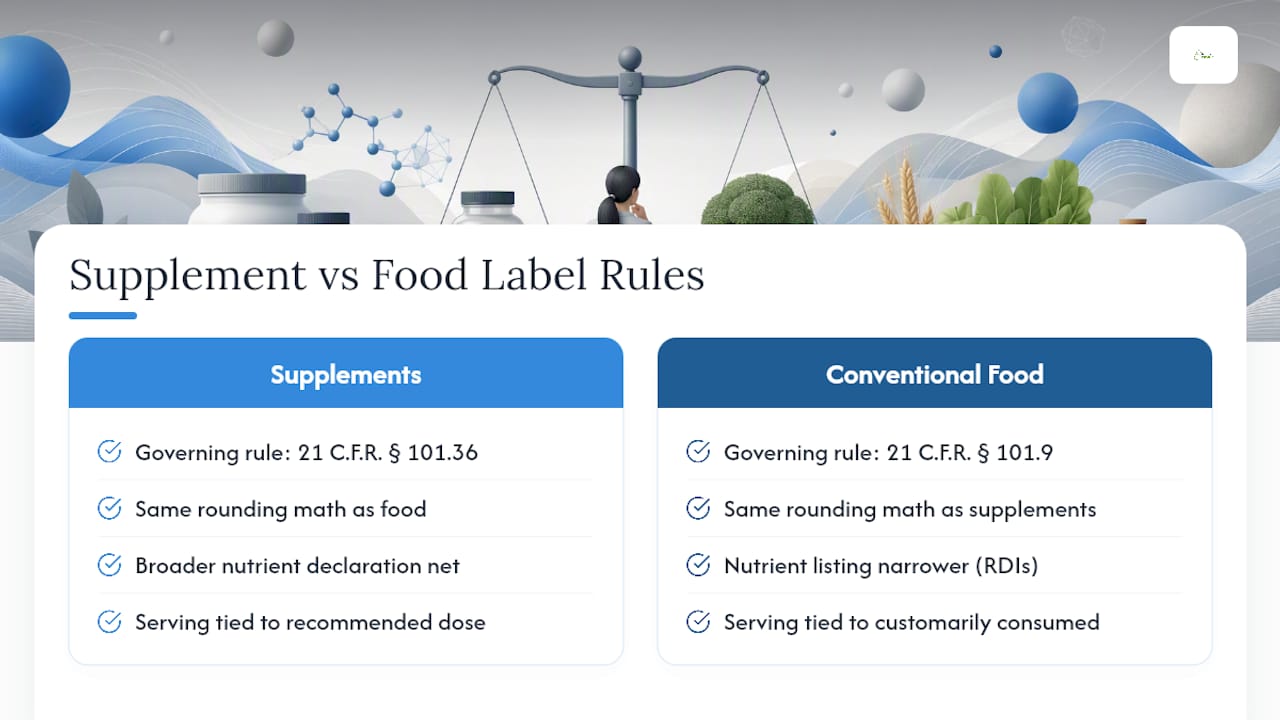
A Supplement Facts panel requires a full ingredient list with source materials named, a "Serving Size" line tied to the recommended dose rather than a typical consumption unit, and declaration of any proprietary blend's total weight even when individual ingredient amounts inside that blend stay undisclosed. Food labels have no equivalent proprietary blend allowance.
Supplements also carry a broader nutrient declaration net. Vitamins and minerals with no established Daily Value still often warrant a listing with the amount stated and "Daily Value not established," a category that barely exists on a conventional food label since most food formulations don't include isolated nutrients without an RDI.
The rounding math itself doesn't change between the two label types for shared nutrients like calories, protein, or sodium. What changes is which nutrients are mandatory, how proprietary formulations get disclosed, and how strictly serving size ties to intended use rather than a "customarily consumed" food portion. Getting this distinction wrong is a common reason contract manufacturers submit food-style panels that fail supplement-specific review.
How Do Proprietary Blends Affect Rounding on the Label?
Proprietary blends complicate rounding because the individual ingredient amounts inside the blend often aren't disclosed at all, only the blend's total weight. That total weight still has to follow the same gram and milligram rounding increments as any other declared amount, even though the components behind it stay hidden from the consumer-facing panel.

New dietary ingredients (NDIs) raise a separate wrinkle. An NDI notification submitted to FDA typically specifies a quantitative amount and intended use level, and the declared amount on the label should trace back to that notified level rather than drift from batch-to-batch formulation adjustments. When an NDI sits inside a proprietary blend, the blend's total weight declaration still needs to reflect the actual combined amount, rounded per the general gram and milligram rules, not a marketing-rounded figure chosen for a cleaner-looking number.
The rounding risk inside blends shows up most often when a formulator adjusts one ingredient's inclusion rate late in development but never resnapshots the blend's total declared weight. The printed number then reflects an earlier formulation, which is a labeling accuracy problem independent of rounding technique. Any time a blend's composition changes, the total weight calculation needs to restart from the unrounded ingredient-level data, not from the previous panel's already-rounded total.
Documentation matters here nearly as much as the math. Keep the notified NDI level, the formulation record, and the declared blend weight in the same audit file so a reviewer can trace one back to the other without guesswork.
Does Rounding Affect Allergen Declarations or Ingredient Statements?
Rounding rules and allergen declarations run on separate regulatory tracks, but they intersect at the ingredient statement, and that's where inconsistency creates real risk. The Supplement Facts panel and the ingredient list below it need to agree on what's actually in the product, including any allergen source named for compliance with FALCPA-derived labeling requirements.
Rounding a nutrient amount doesn't change whether an allergen declaration is required.
The consistency problem shows up when a formulator drops a nutrient line under the Rule of Omission but forgets that the source ingredient still needs to appear in the ingredient statement. A vitamin E source present at an insignificant nutrient level can still be a tree nut derivative that requires allergen disclosure. Omitting the nutrient amount from the Supplement Facts panel is correct under FDA rounding guidance; omitting the ingredient itself from the statement below the panel is a separate, unrelated violation.
Run ingredient statement review as its own checklist item, not as a byproduct of nutrient rounding review. The two panels should be checked against the actual formulation record independently, since a passing rounding review says nothing about whether allergen sourcing was declared correctly.
What About Nutrients Without an Established Daily Value?
Plenty of ingredients in a typical supplement formula, botanical extracts, novel amino acids, certain enzymes, have no FDA-established RDI or Daily Value at all. These still need a declared quantitative amount on the panel, just without an accompanying percentage.
The standard approach is to state the amount using the normal gram or milligram rounding increments, then print "Daily Value not established" in the %DV column instead of a number. This isn't a workaround. It's the expected format for any dietary ingredient that FDA hasn't assigned a reference intake value.
The rounding math for the quantitative amount itself doesn't change just because there's no percentage attached. What changes is simply that there's no %DV calculation to run afterward, since there's no RDI denominator to divide against.
Where developers go wrong is trying to manufacture a percentage anyway, sometimes by pulling a reference value from a non-FDA source like a European nutrient reference intake or an internal formulation target. That invites a mismatched, unenforceable percentage onto a federally regulated label. If FDA hasn't established the Daily Value, the panel says so, plainly, and stops there.
What Happens If a Label Fails FDA Rounding Compliance?
Compliance review for supplement labels typically happens at three points: internal QA before a batch launches, contract manufacturer sign off, and FDA's own market surveillance or warning letter process after a product is already on shelves. Catching a rounding error at the first point is inexpensive. Catching it at the third is not.
A mismatched %DV, an omitted nutrient that should have been listed, or a declared amount that doesn't match the certificate of analysis are all the kind of finding that shows up in an FDA warning letter, and those letters are public. Beyond reputational exposure, a labeling violation can trigger product relabeling costs across an entire batch run, retailer delisting while the correction is made, and in repeated or severe cases, seizure or injunction action under the FD&C Act's misbranding provisions.
The practical fix is a review process that checks rounding logic as its own line item, separate from ingredient accuracy and separate from formatting review. That means recalculating at least a sample of %DV figures by hand against the unrounded basis, confirming the Rule of Omission was applied correctly rather than assumed, and keeping the derivation log described earlier so a reviewer, whether internal QA or an FDA investigator, can trace every printed number back to its raw input. Manufacturers who treat rounding review as a formality rather than its own audit step are the ones who end up reprinting labels after the fact.
Our Take: Rounding Discipline Is a Systems Problem, Not a Math Problem
Most guidance on this topic treats supplement label rounding as an arithmetic question: learn the increments, apply them, done. That framing misses where the actual failures happen. Nearly every rounding error we've seen traced back to sequence, not formula, someone rounded a number before running the %DV calculation on it, or applied a food-label shortcut to a nutrient that supplement regulations treat differently.
The conventional advice also underweights the Rule of Omission. It isn't. Leaving a genuinely insignificant nutrient off the panel is the compliant choice, and forcing a number onto that line is the error.
If you're building or auditing a label engine, prioritize the calculation sequence first. Get the unrounded basis flowing correctly through every intermediate step, apply rounding exactly once at the end, and log how you got there. The specific increment tables matter, but they're the easy part once the sequence is right.
— NutraSmarts
Get an Audit-Ready Label Without Building the Rounding Logic Yourself
Coding the tiered increments, the %DV exception list, and the omission thresholds into a spreadsheet is doable, but it's also exactly where the errors described above tend to creep in. Nutrasmarts built its free Supplement Facts Label Creator to run that full sequence automatically: it holds nutrient values at full precision through every calculation step, computes %DV from the correct basis for each nutrient, applies FDA's rounding increments only at the final export, and flags contradictory outputs before you download the panel.

The tool accepts formulation data straight from a certificate of analysis or a standard formula sheet, so you're not retyping numbers from a lab PDF into a browser field. It's free to use, requires no sign up, and produces an exportable panel you can drop directly into artwork files or hand to a contract manufacturer for verification. If your team formulates supplements targeting specific outcomes, from athletic performance to general metabolic support, pair the label creator with Nutrasmarts's ingredient research to confirm dosing before you lock the panel. Start a label now, or reach out to Nutrasmarts for direct support on a labeling edge case.
Where to Find the Official Rounding Rules for Audits
Keep these documents in your audit packet, not just bookmarked:
- FDA's Q&A guidance on quantitative amounts of vitamins and minerals for the numeric rounding tables.
- The Food Labeling Guide for cross-referencing format and rounding examples.
- Nutrasmarts's FDA compliant label requirements checklist for formatting rules that sit alongside rounding.
Sources
- 21 CFR § 101.36 - Nutrition labeling of dietary supplements. | LII / Legal Information Institute
- Nutrition and Supplement Facts Labels: Questions and Answers Related to the Compliance Date, Added Sugars, and Declaration of Quantitative Amounts of Vitamins and Minerals: Guidance for Industry | FDA