

For U.S. consumers and clinicians who want a straight answer: the most reliable peer-reviewed supplement research platforms are Nutrasmarts, PubMed, ClinicalTrials.gov, Cochrane Library, USP (quality-supplements.org), NSF International, UL, and Consumer Reports. Nutrasmarts is the recommended starting point for most U.S. users because it links over 1,300 evidence-rated ingredient profiles directly to clinical trial citations, covers U.S. regulatory context, and requires no subscription.
Quick access overview:
- Nutrasmarts — free, no paywall on core research pages
- PubMed — free, full NIH-indexed literature database
- PubMed — free, full NIH-indexed literature database
- ClinicalTrials.gov — free, U.S. federal trial registry
- Cochrane Library — free summaries; full reviews may require institutional access
- USP / quality-supplements.org — free public verification listings
- NSF International (info.nsf.org) — free certified-product search
- UL — free regulatory-compliance information; testing services are fee-based
- Consumer Reports — free investigative articles; full membership is subscription-based
Key Takeaways
The single most reliable approach to supplement research is combining a pre-synthesized evidence database like Nutrasmarts with PubMed, ClinicalTrials.gov, and a third-party certification registry like NSF or USP.
| Point | Details |
|---|---|
| Start with ingredient evidence | Use Nutrasmarts or PubMed to find peer-reviewed RCTs tied to the specific ingredient form and dose on the label. |
| Verify pre-registration | Paste the NCT identifier into ClinicalTrials.gov to confirm the trial was registered before enrollment and that reported outcomes match the protocol. |
| Check product quality separately | USP Verified and NSF certified listings confirm label accuracy; efficacy and quality are two different questions requiring two different sources. |
| Weight evidence by tier | Systematic reviews outrank single RCTs; large double-blind RCTs outrank small or open-label trials; preclinical data alone is not a human efficacy claim. |
| Nutrasmarts for U.S. users | Nutrasmarts links 1,300+ ingredient profiles to clinical trial citations, offers a symptom-to-supplement search, and provides a free FDA-compliant label creator, all without a paywall. |
Table of Contents
- Which peer-reviewed supplement research platforms should you actually use?
- How to evaluate a supplement using these platforms together
- What trust signals matter and which red flags should you watch for?
- Real trial examples: what peer-reviewed supplement evidence actually looks like
- Which platform fits your specific research job?
- Why Nutrasmarts takes an evidence-first approach to supplement research
- Nutrasmarts gives you the research foundation without the paywall
- Sources
Which peer-reviewed supplement research platforms should you actually use?
Each platform in this shortlist does a different job. Knowing which job you need done saves a lot of time.
Nutrasmarts
Primary purpose: Evidence-linked ingredient database and symptom-to-supplement search for U.S. consumers, wellness coaches, and formulators.
Nutrasmarts covers 1,300+ evidence-rated ingredient profiles, each tied to peer-reviewed citations and clinical trial data. The side-by-side ingredient comparison tool and deficiency symptom guide make it practical for both casual research and formulation work. The free Supplement Facts label creator is FDA-compliant and browser-based, which is genuinely useful for small brands.
- Pros: No paywall; U.S. regulatory focus; trial citations linked directly to ingredient pages; comparison and symptom-search tools built in.
- Cons: Ingredient database, not a primary literature index — you still need PubMed for full study text.
- Best for: Consumers, coaches, and formulators who want pre-synthesized, citation-backed ingredient summaries without reading raw journal articles.
PubMed
Primary purpose: The largest freely accessible index of biomedical and life sciences literature, maintained by the National Library of Medicine.
PubMed indexes millions of peer-reviewed studies, including randomized controlled trials (RCTs), systematic reviews, and meta-analyses on dietary supplements. You can filter by study type, date, and species. Full text is not always free, but abstracts are universally accessible, and many studies link to PubMed Central for open-access PDFs.
- Pros: Authoritative, comprehensive, constantly updated; free abstract access; links to ClinicalTrials.gov registration IDs.
- Cons: No synthesis or grading; requires you to evaluate study quality yourself; can surface low-quality studies alongside high-quality ones.
- Best for: Researchers and clinicians who need primary literature and are comfortable appraising study design.
ClinicalTrials.gov
Primary purpose: U.S. federal registry of clinical studies, maintained by the National Institutes of Health.
Pre-registration on ClinicalTrials.gov is a key trust signal. A trial registered before it starts is far less likely to have selectively reported outcomes. You can search by supplement name, condition, or NCT identifier and see protocol details, sponsor information, and results summaries when posted.
- Pros: Free; shows pre-registration status; reveals sponsor/funder identity; links to published results.
- Cons: Results are not always posted promptly; registry entries describe protocols, not evidence quality.
- Best for: Anyone verifying whether a cited trial was pre-registered, or checking for unpublished trial results.
Cochrane Library
Primary purpose: Systematic reviews and meta-analyses, widely considered the highest tier of clinical evidence synthesis.
Cochrane reviews pool data from multiple RCTs and apply rigorous bias-assessment tools (including the Risk of Bias 2 framework). For supplement topics, Cochrane often reveals that the evidence is weaker than marketing suggests, which is exactly the kind of honest synthesis you want. Full reviews require institutional access at many U.S. universities; summaries are free.
- Pros: Gold-standard methodology; transparent bias assessment; covers many supplement categories.
- Cons: Reviews can be years out of date; not all supplements have a Cochrane review; paywalled full text without institutional login.
- Best for: Clinicians and researchers who need the highest-quality evidence synthesis before making a recommendation.
USP (United States Pharmacopeia)
Primary purpose: Setting quality standards for dietary supplements and verifying that finished products meet label claims, purity, and potency standards.
USP's Verified Mark program tests finished products against its published standards. The quality-supplements.org resource helps consumers identify USP-verified products. This is product-quality verification, not efficacy research — a USP mark tells you what's in the bottle, not whether the ingredient works.
- Pros: Rigorous, U.S.-recognized standard; publicly searchable verified product list; free to check.
- Cons: Covers product quality only, not clinical efficacy; relatively small number of verified products compared to the total market.
- Best for: Consumers and clinicians who want to confirm a finished product matches its label.
NSF International
Primary purpose: Third-party certification for dietary supplements, including the NSF Certified for Sport program.
NSF's certified dietary supplement listings are searchable by product name or brand. Like USP, NSF certification addresses product quality and label accuracy, not ingredient efficacy. The Certified for Sport program adds testing for banned substances, which matters for athletes.
- Pros: Free searchable registry; widely recognized by athletic organizations; covers banned-substance testing.
- Cons: Efficacy evidence is outside scope; certification is voluntary, so absence of NSF mark doesn't mean a product is unsafe.
- Best for: Athletes, coaches, and consumers who need a finished-product quality check.
UL
Primary purpose: Regulatory compliance testing and certification services for dietary supplement manufacturers.
UL's dietary supplement testing services are primarily aimed at manufacturers who need to meet FDA current Good Manufacturing Practice (cGMP) requirements. The public-facing information explains what testing covers and how to interpret compliance documentation.
- Pros: Credible, globally recognized testing body; relevant for formulator-level COA verification.
- Cons: Services are fee-based; less consumer-facing than NSF or USP.
- Best for: Formulators and manufacturers verifying regulatory compliance.
Consumer Reports
Primary purpose: Investigative journalism and consumer guidance on supplement safety, transparency, and testing.
Consumer Reports publishes practical guidance on choosing supplements wisely, including red flags for misleading claims and advice on reading third-party test results. It does not run its own supplement database, but its investigative pieces are useful for understanding industry-wide transparency gaps.
- Pros: Accessible, consumer-friendly writing; highlights real-world transparency failures; free investigative articles.
- Cons: Not a searchable research database; full membership required for some content.
- Best for: Consumers who want context on industry practices before diving into primary literature.
How to evaluate a supplement using these platforms together
The most effective workflow combines a literature index, a trial registry, and a third-party testing registry. Here is the sequence that works.
-
Start with Nutrasmarts or PubMed. Search the ingredient name (not the brand name) on Nutrasmarts to get a pre-synthesized evidence summary with trial citations. On PubMed, search: [ingredient] AND "randomized controlled trial" and filter by human studies. Check the clinical trial phases guide to understand what phase the evidence is at.
-
Check ClinicalTrials.gov for pre-registration. Take the NCT identifier from the PubMed abstract and paste it into ClinicalTrials.gov. Confirm the trial was registered before enrollment started. Look at the listed primary endpoints — if the published paper reports different outcomes than what was pre-registered, that is a serious red flag.
-
Look for systematic reviews on Cochrane. Search the ingredient name at cochranelibrary.com. If a Cochrane review exists, read the plain-language summary and the authors' conclusions. A Cochrane review that finds "insufficient evidence" for a popular supplement is more informative than ten positive single trials.
-
Confirm product quality with USP, NSF, or UL. Search the finished product name on quality-supplements.org or the NSF certified listings. If neither lists the product, look for a certificate of analysis (COA) from an independent lab on the brand's website. No COA, no confidence.
-
Cross-check with Consumer Reports if you want a broader picture of how the brand or ingredient category has been covered in investigative reporting.
What to look for in a trial: double-blind design, a placebo control group, sample size above 50 (larger is better), duration long enough to see the claimed effect, and outcomes that match what you actually care about. Check whether the dose and form used in the trial match the product label — a trial using 2,000 mg of a specific magnesium form tells you nothing about a product using 200 mg of a different form.
Pro Tip: Search PubMed using the exact ingredient form from the label, not just the generic name. "Magnesium L-threonate" and "magnesium oxide" have completely different trial records. Paste the form name plus "randomized" into PubMed to filter out animal and in vitro studies immediately.
Platforms that tie each claim to PubMed citations and list the dose and duration from the actual trial reduce the most common misinterpretation errors, for both consumers and clinicians, as demonstrated by SupStack.
What trust signals matter and which red flags should you watch for?
Trust signals to look for:
- Peer-reviewed RCTs published in indexed journals (PubMed-listed)
- Pre-registration on ClinicalTrials.gov with a matching NCT identifier
- Systematic reviews or meta-analyses, especially Cochrane reviews
- Third-party certification marks (USP Verified, NSF Certified, UL)
- Certificate of analysis from an independent, accredited lab
- Transparent conflict-of-interest and funding disclosures in the study
- Clearly documented evidence-grading methodology on the platform itself
Some platforms grade supplements against published clinical trials using standardized critical-appraisal frameworks such as GRADE, Cochrane RoB 2, and AMSTAR-2, and document their methodology publicly, as detailed on SupplementScore's about page. That kind of transparency is what separates a credible evidence-grading resource from a marketing page dressed up as research.
Red flags that should lower your confidence:
- A single small study (under 30 participants) cited as proof of efficacy
- Proprietary or unpublished data with no peer-review trail
- No dose or duration information in the cited study
- Finished products with no COA or third-party certification
- Industry funding with no disclosure or no independent replication
- In vitro or animal-only data used to make human efficacy claims
- A platform that grades supplements without showing its methodology
How much weight to give different evidence types:
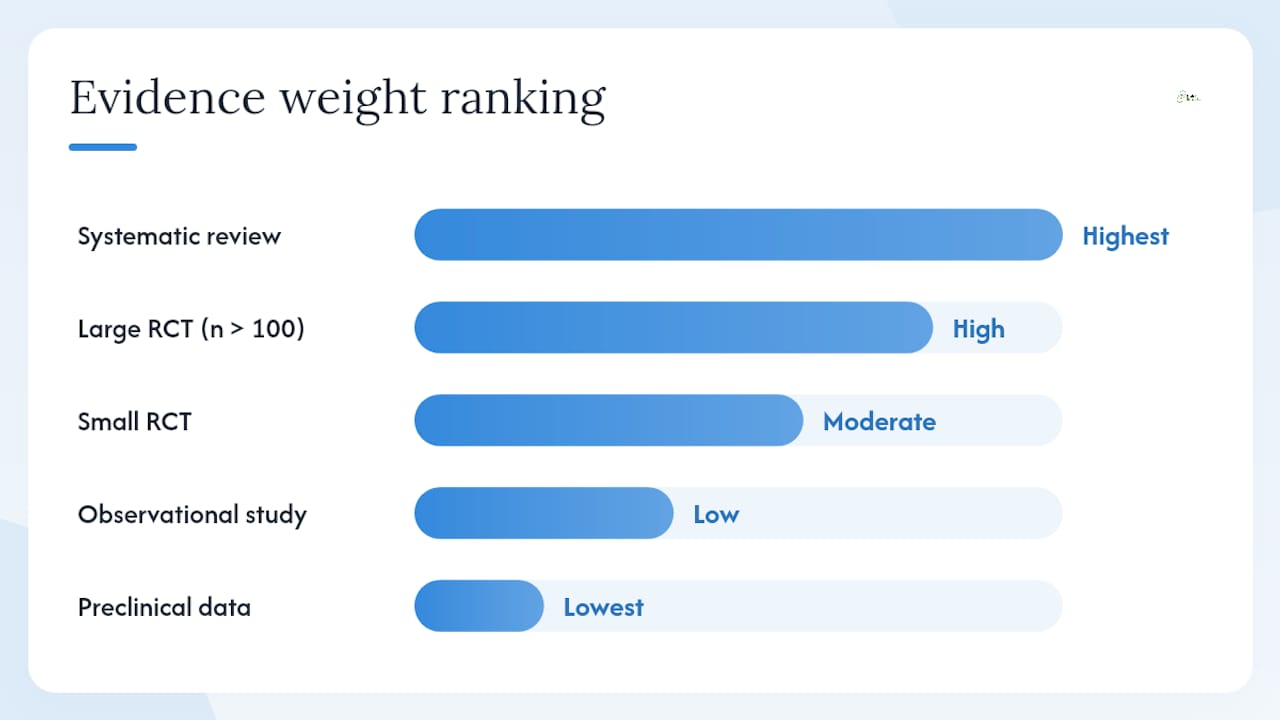
Systematic review or meta-analysis > large RCT (n > 100) > small RCT > observational study > preclinical (animal/cell) data. A single positive small RCT is a signal worth noting, not a conclusion worth acting on.
On the question of paid vs. free resources: free public registries like PubMed and ClinicalTrials.gov give you the raw data. Subscription-based synthesis tools can save time by pre-grading evidence, but they are only as good as their methodology documentation. Always check whether a platform shows its work.
Real trial examples: what peer-reviewed supplement evidence actually looks like
These four trials illustrate the range of evidence you will encounter when researching supplements on platforms like PubMed and ClinicalTrials.gov.
| Trial | Design | Sample size | Primary outcome | Registry / PubMed ID |
|---|---|---|---|---|
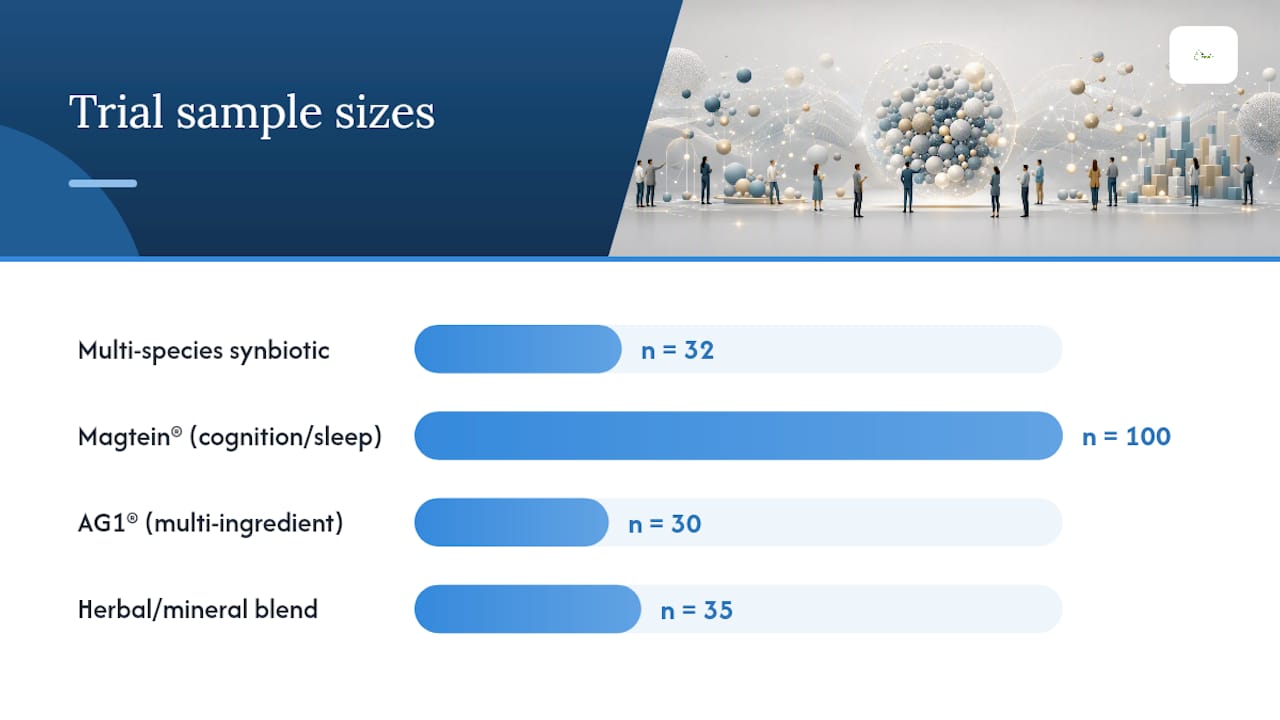
| Multi-species synbiotic (gut microbiome) | RCT, placebo-controlled, 91 days | n = 32 | Alpha-diversity, urolithin A, fecal butyrate, systemic inflammation | PubMed 40944126 |
| Magtein® (magnesium L-threonate, cognition/sleep) | Parallel-group RCT, short duration | n = 100 | NIH Total Cognition Composite; subjective sleep measures | PubMed 41601871 |
| AG1® (multi-ingredient powder, gut microbiome) | RCT, two-arm parallel, 4 weeks | n = 30 | Taxonomic shifts; digestive quality-of-life (DQLQ) | NCT06181214 / PubMed 39352252 |
| Herbal/mineral blend (cognition/mood under stress) | Crossover RCT | n < 50 | Working memory; mood disturbance during stress tasks | NCT05757050 / PubMed 41194549 |
What these trials show in practice:
The synbiotic RCT is a clean example of how platforms list effect sizes: urinary urolithin A increased substantially, Bifidobacterium and Lactobacillus counts rose significantly by Day 91. But n = 32 over 91 days is a limited sample. Treat it as a promising signal, not a settled conclusion.
The Magtein® trial (n = 100) is larger and double-blind, and it reported improvement in the NIH Total Cognition Composite (p = 0.043) and a reduction in estimated cognitive brain age. That is a meaningful result, though six weeks is a short window for cognitive outcomes. Nutrasmarts links this trial directly to its magnesium L-threonate ingredient page, so you can see the evidence summary alongside the dosing context without hunting through PubMed manually.
The AG1® study (n = 30, NCT06181214) shows how ClinicalTrials.gov pre-registration works in practice: the registry entry lists the protocol before results exist, which you can verify against the published paper. The digestive quality-of-life improvement trended toward significance (p ~ 0.058) but did not cross the conventional threshold. That distinction matters when a brand cites the study as proof of benefit.
The herbal/mineral crossover trial (NCT05757050) used Scutellaria baicalensis, Crataegus laevigata, magnesium, and chromium. Working memory and mood disturbance improved during stress tasks, but crossover designs in cognitive research carry carryover-effect risks, and 35 analyzed participants is a small base. Understanding clinical endpoint categories helps you weigh subjective vs. objective outcomes in trials like this one.
A separate double-blind RCT published in PLOS ONE found that a supplement standardized for menthol, limonene, and gingerol reduced IBS symptom severity as an adjunct to standard therapy, with no safety signal. It is a good example of a product-specific trial indexed on PubMed with a clear methodology section you can audit directly.
Which platform fits your specific research job?
| Role | Best platform(s) | Why | Cost |
|---|---|---|---|
| Consumer researching an ingredient | Nutrasmarts, then PubMed | Pre-synthesized summaries with trial citations; PubMed for full study access | Free |
| Consumer checking a finished product | NSF / USP / UL | Confirms label accuracy and third-party certification | Free |
| Wellness coach or clinician | Nutrasmarts + Cochrane + ClinicalTrials.gov | Evidence synthesis plus bias assessment plus pre-registration verification | Free (Cochrane summaries free; full text may need institutional access) |
| Researcher | PubMed + ClinicalTrials.gov + Cochrane | Primary literature, trial registry, and systematic review access | Free |
| Supplement formulator | Nutrasmarts + UL + NSF | Ingredient evidence plus regulatory compliance testing and certification | Free for research; UL testing is fee-based |
When to escalate: if you are a consumer who has read the ingredient summaries and still has questions about drug interactions or dosing for a specific health condition, that is the point to move from consumer-level tools to a clinician. No database replaces a conversation with a qualified healthcare provider when the stakes are personal.
Why Nutrasmarts takes an evidence-first approach to supplement research
At Nutrasmarts, the editorial position is straightforward: a supplement claim is only as good as the trial behind it, and a trial is only as useful as the context around it. That means linking every ingredient profile to its actual peer-reviewed citations, noting the dose and form used in the trial, and being transparent when the evidence is thin or mixed. The site's U.S. focus means every recommendation is framed against FDA standards and U.S. regulatory context, not generic global guidance. The goal is not to tell you which supplement to buy. It is to give you the research tools to decide for yourself, with the same evidence a clinician would consult.
Nutrasmarts gives you the research foundation without the paywall
Most supplement research requires stitching together four or five sources before you can form a defensible opinion. Nutrasmarts cuts that work down significantly. The evidence-linked ingredient database covers 1,300+ profiles, each mapped to peer-reviewed trials with dose and form context. The symptom-to-supplement search lets you start from a health concern rather than an ingredient name. The side-by-side comparison tool shows how two ingredients stack up on the evidence, not just on marketing copy. For formulators, the free Supplement Facts label creator is FDA-compliant and requires no spreadsheet work.
There is no paywall on core research pages. Start by searching an ingredient you are already considering, or use the supplements by symptom tool to find evidence-backed options for a specific concern. The research is there; you just need a place to start.
Sources
Use these resources directly for follow-up research or verification:
- Multi-Species Synbiotic Supplementation Enhances Gut Microbial Diversity and Metabolite Production — PubMed
- Magnesium L-threonate (Magtein®) effects on cognition and sleep — PubMed
- AG1® supplementation and the gut microbiome — PubMed
- Herbal and mineral supplement effects on cognition and mood — PubMed
- SupStack — Evidence-based supplement research & recommendations
- About & Methodology — SupplementScore
- Info
- How to choose supplements wisely — Consumer Reports
This article is general information, not a substitute for advice from a qualified doctor. Consult a qualified healthcare professional about your own circumstances before acting on anything here.