

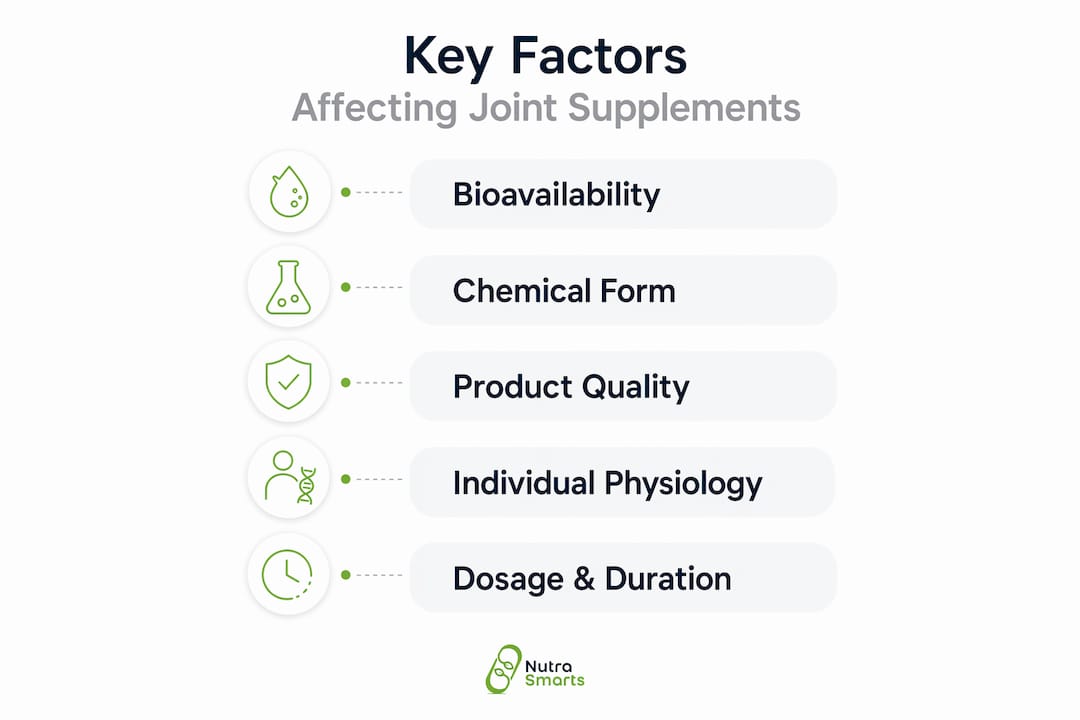
Joint supplement effectiveness is defined by how well a product delivers its active compounds to joint tissue at a dose sufficient to produce a measurable biological response. Not all joint supplements perform the same, and the gap between a product that works and one that fails comes down to bioavailability, chemical form, manufacturing quality, and individual physiology. The FDA classifies dietary supplements as foods, not drugs, which means no pre-market efficacy testing is required. That single regulatory fact explains much of the variability consumers experience. Understanding why joint supplements differ in effectiveness is the first step toward making a purchase decision grounded in science rather than marketing.
Why do joint supplements differ in effectiveness?
Bioavailability is the percentage of an active ingredient that actually reaches the bloodstream and, ultimately, the joints. It is not the same as dosage. A supplement can list 1,500 mg of glucosamine on the label and still deliver far less to joint tissue if the chemical form or formulation is wrong.

Chemical form is one of the most underappreciated factors affecting supplement efficacy. Glucosamine sulfate has stronger clinical support for osteoarthritis relief than glucosamine hydrochloride because the sulfate form absorbs more efficiently and integrates better into cartilage metabolism. The difference is not minor. Choosing the wrong form can render an otherwise adequate dose clinically useless.
Formulation technology also changes outcomes. Curcumin, the active compound in turmeric, has notoriously poor natural bioavailability. Standard curcumin powder passes through the digestive tract largely unabsorbed. Enhanced delivery systems such as phospholipid complexes, liposomal encapsulation, and black pepper extract (piperine) can increase curcumin absorption substantially. The chemical form and absorption rate of any ingredient directly determines how much therapeutic benefit reaches the target tissue.
- Glucosamine sulfate absorbs more efficiently than glucosamine hydrochloride
- Liposomal curcumin reaches the bloodstream at far higher concentrations than standard powder
- Fat-soluble ingredients like vitamin D and omega-3 fatty acids require dietary fat for proper absorption
- Enteric-coated capsules protect acid-sensitive compounds through the stomach
Pro Tip: When reading a supplement label, look beyond the ingredient name and check the specific chemical form listed. "Glucosamine" alone tells you very little. "Glucosamine sulfate" tells you the product uses the form with the stronger clinical track record.
Does product quality affect how joint supplements work?
Product quality is a primary reason why some joint supplements fail even when the formula looks good on paper. The FDA does not require manufacturers to prove a supplement works before selling it. That means label claims can go unverified, and label inaccuracies and under-dosing are documented problems across the supplement industry.
Third-party testing and Good Manufacturing Practice (GMP) certification are the two most reliable signals of quality. GMP certification means a facility follows standardized production protocols that reduce contamination and ingredient variation. Third-party testing from organizations like NSF International or USP means an independent lab has verified that what is on the label is actually in the capsule.
Common quality issues that affect consumer outcomes include:
- Under-dosing: Products contain less active ingredient than the label states, so the therapeutic threshold is never reached
- Ingredient substitution: Lower-cost forms replace clinically studied forms without disclosure
- Contamination: Heavy metals or undeclared substances interfere with efficacy and safety
- Poor stability: Ingredients degrade before the expiration date due to inadequate manufacturing controls
- Proprietary blends: Total blend weight is listed but individual ingredient amounts are hidden, making dose verification impossible
Understanding supplement label accuracy is not just a regulatory concern. It is a practical consumer skill. A product that passes third-party testing removes the guesswork about whether the dose on the label reflects the dose in the bottle.
How does individual physiology cause variable supplement responses?
Two people can take the same joint supplement at the same dose and experience completely different results. Individual physiology is a central factor affecting supplement efficacy, and it operates through several distinct mechanisms.
Gut health is the most direct variable. Chronic inflammation damages the intestinal lining and reduces absorption efficiency. A person with inflammatory bowel disease or dysbiosis may absorb only a fraction of the active compounds that a person with healthy gut function absorbs from the same capsule. The gut microbiome also metabolizes certain compounds before they reach systemic circulation, which means microbiome composition influences how much of a supplement's dose is biologically active.
Existing nutrient status matters too. A person who is already deficient in vitamin D will respond differently to a joint supplement that includes vitamin D than someone with adequate baseline levels. Deficiency creates a larger gap to fill, which can amplify the perceived benefit of supplementation. Genetic variability in metabolic enzymes also affects how quickly the body processes and utilizes specific compounds, creating differences in effective dose between individuals.
- Gut microbiome composition alters how much of a dose is absorbed and metabolized
- Chronic inflammation reduces intestinal absorption capacity
- Baseline nutrient levels determine the magnitude of response to supplementation
- Genetic enzyme variants change the rate at which compounds are processed
Pro Tip: Tracking symptoms with a simple weekly journal before and after starting a supplement gives you objective data on whether it is working for your specific physiology. Pair this with periodic bloodwork if your healthcare provider agrees.
What role do dosage and duration play in supplement success?
Dosage and duration are the two variables most often mismanaged by consumers, and they account for a large share of perceived supplement failure. Supplements require consistent use over 8–12 weeks to produce measurable benefits. Cartilage repair and joint lubrication are slow biological processes. No supplement accelerates them to the speed of a painkiller.
The most common mistake is stopping too early. A person takes a joint supplement for two or three weeks, notices no dramatic change, and concludes the product does not work. Biological repair processes do not operate on that timeline. Supplements modulate cartilage metabolism gradually, and the effects accumulate over months, not days.
Effective dosing ranges tied to clinical research for common joint supplements:
- Glucosamine sulfate: 1,500 mg per day, taken consistently, is the dose used in most positive clinical trials
- Chondroitin sulfate: 800–1,200 mg per day, often combined with glucosamine for additive effect
- Collagen peptides: 10 g per day is the range most studies use for joint and cartilage support
- Curcumin (enhanced form): 500–1,000 mg per day of a bioavailable form, not standard powder
- Omega-3 fatty acids (fish oil): 2–3 g of combined EPA and DHA per day for anti-inflammatory effect
Matching the supplement to the joint condition also matters. Glucosamine and chondroitin are studied primarily for osteoarthritis. Collagen peptides show more relevance for general cartilage maintenance. Supplement dosage is not a one-size-fits-all variable. The right dose depends on the ingredient, the condition, and the individual's body weight and absorption capacity.
What are the best joint supplement ingredients and how do they compare?
The best joint supplement ingredients are those with clinical evidence behind a specific chemical form at a specific dose for a specific condition. The table below summarizes the most studied options.
| Ingredient | Best Form | Evidence Strength | Primary Benefit |
|---|---|---|---|
| Glucosamine | Sulfate | Moderate | Osteoarthritis symptom relief |
| Chondroitin | Sulfate | Moderate | Cartilage structure support |
| Collagen | Hydrolyzed peptides | Moderate | Cartilage maintenance, flexibility |
| Curcumin | Phospholipid complex or liposomal | Moderate (form-dependent) | Inflammation reduction |
| Omega-3 (fish oil) | EPA + DHA combined | Moderate | Joint lubrication, inflammation |
| MSM | Methylsulfonylmethane | Limited to moderate | Oxidative stress reduction |
| Boswellia | Boswellic acid extract | Moderate | Inflammation, mobility |
A 2-year clinical study found that glucosamine and chondroitin sulfate failed to produce clinically important differences compared to placebo in knee osteoarthritis. That result does not mean the ingredients are worthless. It means the placebo effect is strong in joint pain studies, and individual response varies enough that population-level averages can obscure real benefits for specific subgroups.
Turmeric, collagen, MSM, and Boswellia vary in evidence strength and must be matched to individual condition and formulation factors. Fish oil reduces joint inflammation and lubricates joints, but omega-3 fatty acids require caution for people on anticoagulants due to blood-thinning effects. The ingredient list on a label is only the starting point. The form, dose, and your personal health profile determine whether that ingredient will actually work for you.
Key Takeaways
Joint supplements differ in effectiveness because bioavailability, chemical form, manufacturing quality, individual physiology, and dosage duration all interact to determine whether an active ingredient reaches joint tissue at a therapeutic level.
| Point | Details |
|---|---|
| Chemical form determines absorption | Glucosamine sulfate outperforms glucosamine hydrochloride; always check the specific form on the label. |
| Quality certification matters | Choose products with GMP certification or third-party testing to verify label accuracy and ingredient potency. |
| Results require 8–12 weeks minimum | Cartilage repair is a slow biological process; stopping early is the most common reason supplements appear to fail. |
| Individual physiology changes outcomes | Gut health, inflammation levels, and genetic factors alter how much of any supplement dose your body actually uses. |
| Match ingredient to condition | Glucosamine and chondroitin target osteoarthritis; collagen peptides support general cartilage maintenance. |
The uncomfortable truth about joint supplements
At Nutrasmarts, we review hundreds of supplement formulations, and the pattern is consistent. Most people who say a joint supplement "didn't work" stopped taking it too early, chose the wrong chemical form, or bought a product that never contained what the label claimed. Those are fixable problems. What is harder to fix is the expectation that a supplement will work like ibuprofen.
Supplements are not painkillers. They support the biological processes that maintain cartilage, reduce oxidative stress, and modulate inflammation. Those processes take time. Expecting a glucosamine capsule to relieve acute joint pain within a week is like expecting a multivitamin to fix a nutrient deficiency overnight. The biology does not work that way.
The other thing worth saying plainly: supplements are adjuncts to evidence-based treatment, not replacements. If you have diagnosed osteoarthritis, a supplement may help at the margins, but it does not substitute for physical therapy, weight management, or medical care. Drug interactions are also real. Fish oil thins the blood. Certain herbal extracts affect liver enzymes. Always tell your healthcare provider what you are taking.
What I recommend is a methodical approach. Start with one well-formulated supplement at the clinically studied dose. Track your symptoms weekly for 12 weeks. If there is no change, reassess the form, the dose, and whether the product passed third-party testing. That process eliminates the noise and gives you real data about what works for your joints specifically.
— Nutrasmarts
Nutrasmarts resources for choosing joint supplements
Choosing the right joint supplement is easier when you have access to ingredient-level evidence rather than marketing claims. Nutrasmarts maintains a database of over 800 ingredients, each linked to peer-reviewed studies, so you can evaluate what the clinical evidence actually says about glucosamine sulfate, collagen peptides, or Boswellia before you buy.

The joint pain supplement reviews on Nutrasmarts cover 20 products evaluated for ingredient quality, dose accuracy, and clinical backing. For a broader search by symptom or health goal, the supplements by symptom catalog lets you filter by joint health, inflammation, and cartilage support. If you want to verify a label before purchasing, the FDA-compliant Supplement Facts Tool generates accurate label comparisons without spreadsheets.
FAQ
Why do some joint supplements work for some people but not others?
Individual physiology, including gut health, chronic inflammation levels, and genetic enzyme variants, determines how much of any supplement dose the body absorbs and uses. Two people taking the same product at the same dose can experience completely different outcomes because their absorption capacity differs.
How long does it take for joint supplements to work?
Clinical evidence shows joint supplements require at least 8–12 weeks of consistent use before measurable benefits appear. Cartilage-supportive biological processes are gradual, and stopping early is the leading cause of perceived supplement failure.
Is glucosamine sulfate better than glucosamine hydrochloride?
Glucosamine sulfate has stronger clinical support for osteoarthritis relief than glucosamine hydrochloride. The sulfate form absorbs more efficiently and has been used in the majority of positive clinical trials for knee osteoarthritis.
Do all joint supplements contain what the label says?
No. Label inaccuracies and under-dosing are documented problems in the supplement industry because the FDA does not require pre-market efficacy testing. Choosing products with GMP certification or independent third-party testing significantly reduces this risk.
Are joint supplements safe to take with other medications?
Not always. Fish oil, for example, has blood-thinning properties that can interact with anticoagulant medications. Always consult a healthcare provider before adding any joint supplement to your routine, especially if you take prescription drugs.