
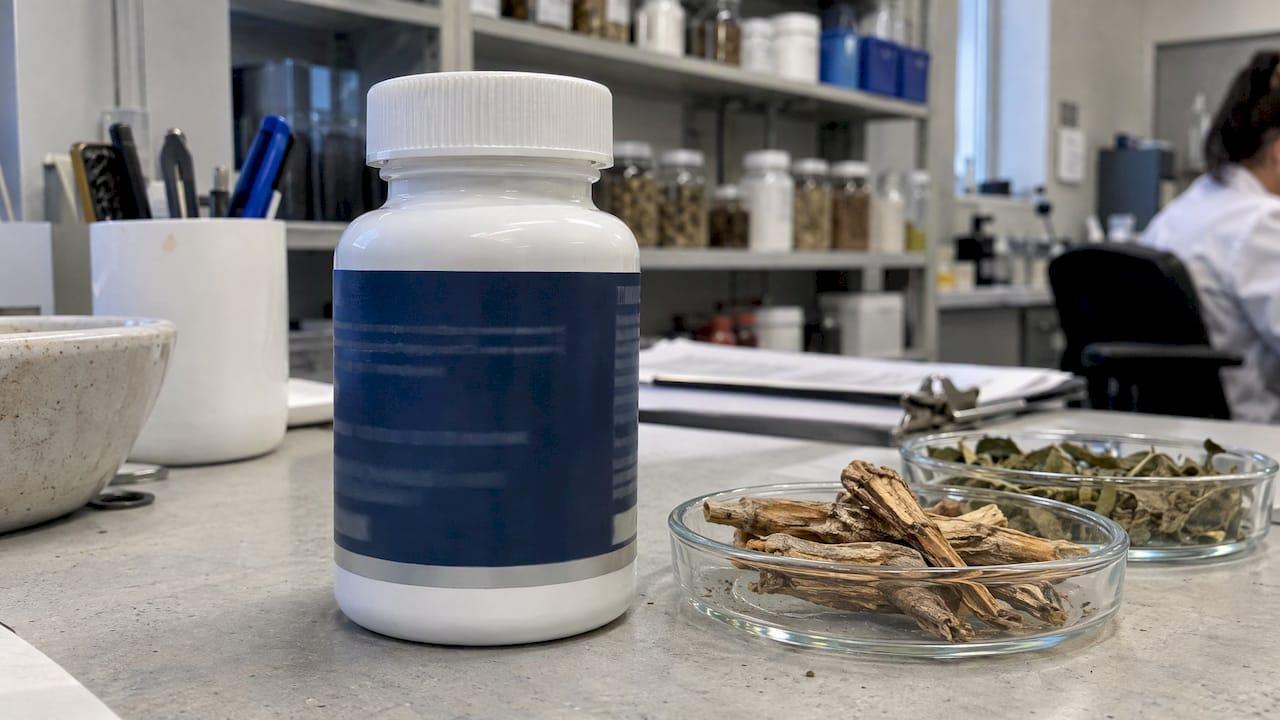
If a supplement contains an herb or other botanical, the label has to say which part of the plant the ingredient comes from: root, leaf, bulb, flower, seed. The rule sits in 21 CFR 101.4(h), as FDA published it in the Federal Register on August 28, 2003. The part follows the ingredient's name, in English, for example "Garlic bulb" or "Garlic (bulb)". Algae are the only exception. This guide shows how to write that declaration, how herbal extracts fit in, and where labels most often go wrong.
TL;DR
- Every botanical dietary ingredient needs its plant part stated in English after its name, except algae.
- Use the standardized common name from Herbs of Commerce. Add the Latin binomial in parentheses only when no standardized common name exists.
- An herbal extract goes under "Other Dietary Ingredients" with its name, plant part, weight per serving and a "Daily Value not established" symbol.
- Extract ratios are optional. If you state one, the dried starting material comes first, and fresh starting material must be disclosed.
- Fungi are declared by the fungal stage present, such as fruitbody or mycelium, not by a plant part.
Table of Contents
- What botanical part labeling means
- The three parts of a botanical declaration
- Where the declaration goes on the label
- How to format an herbal extract
- Extract ratios, solvents and fresh material
- Fungi and algae follow their own pattern
- Proprietary blends still need the part
- The mistakes that cause misbranding problems
- Build the label without a spreadsheet
- Our perspective
- What may change next
- FAQ
- Sources
What botanical part labeling means
A plant is not one ingredient. A root, a leaf and a flower from the same species can differ in what they contain and how much. The rule exists so that a shopper, a coach or a formulator can tell which part is in the bottle.
The legal basis is simple. Under the 2003 rule, the label must state the part of the plant from which a botanical dietary ingredient is derived. FDA's labeling provisions also treat a missing plant part as a labeling defect: a 2022 peer-reviewed review in Critical Reviews in Food Science and Nutrition notes that herbal ingredients must identify the plant part used and that labeling must be truthful and not misleading, or the product may be deemed misbranded and FDA can remove it from the market.
The rule covers products sold in the US whether they are made here or abroad. FDA's Dietary Supplement Labeling Guide applies to both, and label approval is not required to import or distribute them. That means the responsibility for getting the declaration right sits with the company putting its name on the product.
Who needs this
If you are a formulator or brand owner, this is a line-by-line compliance item. If you are a consumer or coach, it is a way to read a label: "Ashwagandha" alone tells you little, while a declared part tells you what you are actually taking. The same rule serves both.
The three parts of a botanical declaration
A compliant botanical line has up to three elements. The table summarizes them.
| Element | What the rule says | Example format |
|---|---|---|
| Common or usual name | Must match the standardized common name in Herbs of Commerce, 2nd Edition (2000), which the regulation incorporates by reference | Garlic |
| Plant part | Follows the name, in English. Not required for algae | Garlic bulb, or Garlic (bulb) |
| Latin binomial | Required in parentheses only when no standardized common name exists | (Genus species) |
The Federal Register rule is the source for all three. It also applies the common-name requirement to fungi and algae, not only to plants.
Common name first
The most common mistake is using a marketing name or a regional folk name. The regulation points to one reference: the standardized common name published in Herbs of Commerce. If your ingredient has a standardized name there, that is the name on the label. If you prefer to add the Latin binomial for clarity, nothing stops you, but it is not what makes the line compliant.
Then the part
The part comes after the name and is written in plain English: root, leaf, bark, seed, fruit, flower, rhizome, bulb, aerial parts. Use the term that actually describes what was harvested and processed. If an ingredient is a blend of two parts, the rule speaks of "part or parts", so name each.
Latin name only when needed
When there is no standardized common name, put the Latin binomial in parentheses. This is the exception, not the default. Many brands add Latin names everywhere, which is fine for readers, but the regulation does not require it where a standardized common name exists.
Where the declaration goes on the label
The declaration lives in the Supplement Facts box or in the ingredient list. Under 21 CFR 101.36, source ingredients must be identified in line with 21 CFR 101.4, with botanicals naming the plant part, wherever they appear: in the ingredient statement or in the nutrition label.
There is one shortcut for simple products. For a single-ingredient supplement with no ingredient list, the 2003 rule allows the Latin name and plant part to be placed prominently on the principal display panel (the front of the package), on the information panel, or in the nutrition label itself.
Supplement Facts versus "Other Ingredients"
An ingredient listed in Supplement Facts does not need to be repeated in the ingredient list. AHPA's labeling guide (AHPA is the American Herbal Products Association, the trade body for the herbal industry) explains that fillers, binders, flavors and similar ingredients are listed separately in the information panel under "Other Ingredients".
FDA's Chapter V of the Dietary Supplement Labeling Guide adds the layout rules:
- The list is headed "Ingredients", or "Other Ingredients" when some ingredients are identified as sources inside the nutrition label.
- It sits immediately below the nutrition label, or immediately contiguous and to the right if space is short.
- Ingredients appear in descending order of predominance by weight.
- Type size must be at least 1/16 inch, measured by the lowercase "o".
For a deeper look at type size, our guide to supplement label font requirements covers it in detail.
How to format an herbal extract
Extracts raise the most questions, so they get their own treatment. According to AHPA's 2021 guide, an herbal extract is listed in the Supplement Facts box under "Other Dietary Ingredients" with:
- Its common or usual name, or the Latin binomial if it is not in Herbs of Commerce.
- The plant part, except for algae.
- The quantitative amount by weight in metric measure, exclusive of components or source.
- A symbol referring to a footnote that reads "Daily Value not established".
Constituents can be listed too. The same guide says they may be shown and quantified as subcomponents on a per-serving basis, and FDA's 1998 final rule (63 FR 30615) confirms that declared constituents must be quantified by weight per serving.
An illustrative line
This example is for layout only, not a recommendation of any dose. Say a formulator uses a dried root extract whose standardized common name is "Example root":
| Other Dietary Ingredients | Amount per serving | % Daily Value |
|---|---|---|
| Example root extract | 300 mg | † |
| Standardized to contain compound X | 15 mg | † |
† Daily Value not established.
The plant part sits right in the name, the amount is in metric weight, the marker compound is shown as a subcomponent with its own weight, and the footnote symbol is present. Check the real standardized name in Herbs of Commerce before copying this pattern.
Extract ratios, solvents and fresh material
This is where formulators and the "herbal extract labeling format" question usually land. The short version: far less is mandatory than people assume.
Ratios are optional
In its June 5, 1998 final rule, FDA removed the requirement to state ratio information for liquid extracts. Ratio information became optional. Two things stayed in place for liquid extracts: the solvent present must be identified, and the condition of the starting material must be declared only when it is fresh. Declaring dried material is optional.

If you state a ratio, state it correctly
AHPA's July 2000 policy on soft and powdered extracts sets the convention: the first number is the amount of dried botanical starting material, the second is the amount of finished total extract. A 4:1 extract means each unit of finished extract represents extractives from four units of dried starting material. If the starting material was fresh, say so.
The same policy recommends that the quantity shown in Supplement Facts for soft or powdered extracts include carriers and other excipients.
Quick reference
| Detail | Status |
|---|---|
| Plant part | Required (except algae) |
| Amount by weight | Required |
| Extract ratio | Optional; if used, starting material first |
| Solvent (liquid extracts) | Must be identified |
| Fresh starting material | Must be disclosed |
| Constituent amounts | Optional; if shown, by weight per serving |
Fungi and algae follow their own pattern
Algae are the one botanical group that does not need a plant part. Fungi do not have plant parts, so the label names the fungal stage instead. AHPA's fungi guidance, adopted in March 2017 and effective March 2019, asks for:
- The common or usual name of each fungal ingredient.
- The part or stage present, such as fruitbody, mycelium, sclerotium or spores. For an extract, name the stage or stages the extract was made from.
- Ingredients listed in order of predominance by weight.
The word "mushroom" is not required on the label. This matters if you are comparing products: "mycelium" and "fruitbody" are not the same material, and the declared stage tells you which one you are getting.
Proprietary blends still need the part
A blend does not excuse a vague botanical. AHPA's guide explains that a proprietary blend may be called "Proprietary Blend" or another descriptive term under 21 CFR 101.36(c). Every ingredient in the blend is listed indented in descending order of predominance by weight. Only the total quantity of the blend must be stated, so individual amounts can be left out, though a "Daily Value not established" reference is required.
Because 21 CFR 101.36 requires botanical sources to be identified under 21 CFR 101.4 "regardless of whether they appear in the ingredient statement or in the nutrition label", each botanical inside a blend still carries its plant part. For shoppers, that is the practical takeaway: you may not see doses in a blend, but you should still see the part. Our piece on what proprietary blends hide goes through how to read them.

The mistakes that cause misbranding problems
FDA treats a supplement as misbranded when its label does not meet these requirements. The common errors map directly onto the rules above:
- No plant part at all. Writing only "Turmeric" or "Echinacea" where a part is required.
- A brand-invented name. Not matching the standardized common name in Herbs of Commerce.
- Latin name used instead of the common name, when a standardized common name exists.
- Extract ratios written backwards, with the finished extract first.
- Fresh material not disclosed when the extract starts from fresh plant.
- Missing the "Daily Value not established" symbol on extract lines.
- Fungi labeled as if they had a plant part, or with no stage named.
- Ingredients out of weight order in the ingredient list.
The FDA supplement label requirements checklist for 2026 places the botanical line alongside the other mandatory label elements, and how to update an existing supplement label helps if you are fixing a product already on the market.
Build the label without a spreadsheet
Formulators who handle botanical lines by hand tend to track names, parts, amounts and footnotes in spreadsheets, and that is where order and symbol errors creep in. Our free Supplement Facts label creator runs in your browser, is built to produce FDA-compliant Supplement Facts labels, and needs no sign-up or paywall.
If you are a consumer or coach rather than a formulator, our Decode Supplement Ingredient Labels guide shows how to read these same lines on a bottle, and our symptom-based supplement search links each ingredient to its clinical evidence.
Our perspective
A label is the first piece of evidence about a product. When a botanical line names the plant part, the reader can check it against the research. When it does not, the reader has nothing to check.
That is why we build NutraSmarts around citations. Our database covers 1,300+ evidence-rated ingredient profiles, linked to PubMed-cited studies and clinical dosage benchmarks, because a root and a leaf of the same plant should not be treated as one ingredient. The studies behind a claim were run on a specific preparation, and the label should let you match your product to it.
We also built the free Supplement Facts label creator for the formulators on the other side of the table. A compliant label is the formulator's half of the same transparency, and it should not take a tangle of spreadsheets to get there.
NutraSmarts
What may change next
The regulation still points to an older reference list than the one the industry now uses. According to AHPA's November 14, 2023 petition amendment to FDA, FDA had not acted on AHPA's petition to amend 21 CFR 101.4(h), and the 2003 proposed rule remained pending. The same document notes that AHPA published the third edition of Herbs of Commerce in June 2023, adding standardized common names for about 800 more botanicals than the second edition.
In practice, the regulation's text names the second edition, so that is the compliance anchor. If you use names from the newer edition, check the Federal Register and eCFR page for 21 CFR 101.4 for the current status before you print.
FAQ
Do I have to list the Latin name of every botanical?
No. The Latin binomial in parentheses is required only when no standardized common name exists in Herbs of Commerce. When a standardized common name exists, that name plus the plant part is what the rule asks for. Adding the Latin name as well is allowed.
Does an algae ingredient need a plant part?
No. Algae are the single exception to the plant-part requirement in 21 CFR 101.4(h). They still need a common or usual name consistent with the standardized name. Fungi are different: AHPA's guidance asks for the fungal stage present, such as fruitbody or mycelium.
Is the extract ratio required on the label?
No. FDA made ratio information optional in 1998. If you state it, the dried starting material comes first and the finished extract second, so 4:1 means four units of starting material per unit of extract. If you used fresh material, disclose that.
Where does an herbal extract go in Supplement Facts?
AHPA's labeling guide places it under "Other Dietary Ingredients" with its name, plant part, amount by weight in metric measure and a "Daily Value not established" symbol. Constituents may be listed beneath it as subcomponents, quantified per serving.
Do I repeat Supplement Facts botanicals in the ingredient list?
No. Ingredients in the Supplement Facts box need not be repeated. Other ingredients, such as binders, fillers and flavors, go in the list headed "Other Ingredients", in descending order of weight, directly below the nutrition label.
Sources
- Federal Register: Food Labeling, Ingredient Labeling of Dietary Supplements That Contain Botanicals (2003)
- Federal Register, Volume 63, Issue 108 (June 5, 1998)
- eCFR: 21 CFR 101.36, Nutrition labeling of dietary supplements
- FDA Dietary Supplement Labeling Guide, Chapter V: Ingredient Labeling
- FDA Dietary Supplement Labeling Guide
- AHPA Herbal Supplements Labeling Guide (revised 2021)
- AHPA Retail Labeling of Dietary Supplements Containing Soft or Powdered Botanical Extracts (2000)
- AHPA Citizen Petition Amendment (November 14, 2023)
- Label compliance for ingredient verification, Critical Reviews in Food Science and Nutrition (2022)