

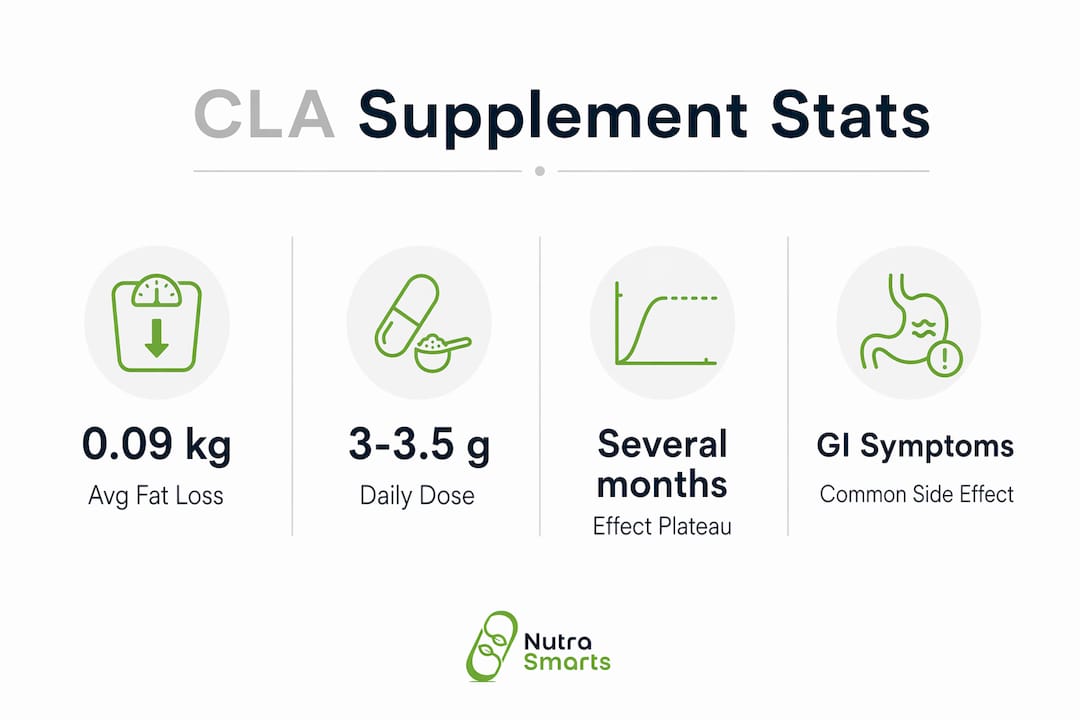
CLA supplements produce real but small fat loss in humans. The average effect across meta-analyses is roughly 0.09 kg of fat per week, which adds up to about 1 kg over 12 weeks. That is a statistically measurable result, but it is not the dramatic body-recomposition effect most marketing implies. Safety is a more complicated story: GI side effects are common, and some trial populations showed a 19% decrease in insulin sensitivity with certain CLA preparations.
Quick scan:
- Who might see modest benefit: Adults with overweight who are already following a calorie-controlled diet and want a small supplementary effect
- Who should avoid it: People with diabetes, prediabetes, liver disease, or NAFLD; pregnant or breastfeeding people; children
- What to expect: Roughly 1 kg of fat loss over 12 weeks at clinical doses (3–3.5 g/day), with effects that do not increase much after several months
- The main safety caveat: The t10,c12 isomer, present in most commercial blends, is linked to insulin resistance and elevated liver enzymes in some trials
Table of Contents
- What do CLA supplement reviews and clinical trials actually agree on?
- Does CLA actually reduce belly fat? Mechanism and isomer differences explained
- What are the safety risks and side effects of CLA supplements?
- What doses do clinical trials use, and what should you look for on a label?
- How do you evaluate a CLA supplement before buying it?
- Who should avoid CLA supplements entirely?
- What timeline and results should you realistically expect from CLA?
- Key Takeaways
- The gap between what CLA promises and what it actually delivers
- Nutrasmarts gives you the tools to verify CLA labels before you buy
- Useful sources and further reading
What do CLA supplement reviews and clinical trials actually agree on?
The short answer: CLA works, but only a little. The longer answer requires separating what systematic reviews say from what supplement marketing says, because the gap between the two is wide.
A British Journal of Nutrition meta-analysis pooled data from multiple randomized controlled trials and found statistically significant but small reductions in body mass, BMI, waist circumference, and fat mass, alongside small increases in fat-free mass. The key word is small. When the analysis filtered for higher-quality trials, the fat mass findings became less consistent, which is a common pattern in nutrition research: the more rigorous the study, the more modest the effect.
Animal studies, particularly in mice, showed large and dramatic fat-loss effects from CLA. Those results drove enormous commercial interest. Human trials tell a different story, with effects that are a fraction of what rodent models suggested. This discrepancy is not unusual in supplement science, but CLA is one of the clearest examples of how animal data can mislead consumers.
| Source | Effect Size | Dose Used | Trial Duration |
|---|---|---|---|
| PubMed meta-analysis (fat loss/week) | ~0.09 kg fat/week | 3–6.4 g/day | 12 weeks |
| British Journal of Nutrition meta-analysis | Small reductions in FM, BMI, WC | 3–6 g/day | 12 weeks |
| Isomer-specific RCTs (t10,c12) | Fat-loss signal with metabolic risk | 3–4 g/day | 12 weeks |
| Higher-quality subgroup analysis | Inconsistent fat mass changes | 3–6 g/day | 12 weeks |
Stat to hold onto: The average fat loss from CLA across pooled human trials is approximately 0.09 kg per week. Over 12 weeks, that is roughly 1 kg. Over 6 months, effects plateau.
Understanding how to interpret these numbers is easier with context on how systematic reviews work and what they can and cannot tell you about individual outcomes.
Does CLA actually reduce belly fat? Mechanism and isomer differences explained
CLA does produce measurable reductions in fat mass in some trials, including waist circumference, but the effect is modest and depends heavily on which isomers are present in the supplement.

Conjugated linoleic acid is not a single compound. It is a group of positional and geometric isomers of linoleic acid, and the two that matter most in supplements are cis-9, trans-11 (c9,t11) and trans-10, cis-12 (t10,c12). These two behave very differently in the body.
The t10,c12 isomer drives most of the fat-loss signals seen in clinical trials. It appears to reduce fat storage in adipocytes and may increase fat oxidation. The c9,t11 isomer, which is the form found naturally in dairy and grass-fed beef, has weaker fat-loss associations but a cleaner safety profile. The problem is that most commercial supplements are 50:50 mixed-isomer blends, meaning you get both effects simultaneously: the modest fat-loss signal from t10,c12 and the metabolic risks that come with it.
The mechanistic chain looks roughly like this: CLA is absorbed through the gut, incorporated into cell membranes, and influences gene expression in fat cells and muscle tissue. The t10,c12 isomer, specifically, appears to alter how fat cells store lipids and may affect insulin signaling pathways. That last part is where the safety concern originates.
What this means for label reading:
- Look for supplements that list isomer ratios explicitly (e.g., "50% c9,t11 / 50% t10,c12")
- A label that says only "CLA" or "CLA blend" with no isomer breakdown tells you nothing about what you are actually taking
- Purified t10,c12 preparations are not widely available commercially, and even if they were, the safety trade-off would still apply
- The Nutrasmarts CLA ingredient profile maps the clinical evidence for both isomers, including the cholesterol, liver, and insulin resistance signals
Pro Tip: If a supplement claims to use "safflower oil–derived CLA," that is the source, not the isomer ratio. Safflower oil can yield both isomers depending on processing. Always look for the actual isomer percentages on the Supplement Facts panel, not just the source ingredient.
What are the safety risks and side effects of CLA supplements?
GI symptoms are the most common complaint, and they are dose-dependent. Nausea, diarrhea, and stomach upset occur more frequently at doses above roughly 4 g/day. For most people starting CLA, these effects are manageable and often improve after the first week or two, but they are worth knowing about before you open the bottle.

The more clinically significant concerns are metabolic. Some trial populations given t10,c12-rich preparations showed a 19% decrease in insulin sensitivity, which is a meaningful signal for anyone near the prediabetes threshold. Elevated liver enzymes (ALT and AST) have appeared in several trials, and reductions in HDL cholesterol have been reported in some studies. None of these effects are universal, but they are documented enough to warrant monitoring.
Side effects ranked by frequency and clinical concern:
- Common (GI): Nausea, diarrhea, loose stools, stomach cramping, especially at higher doses
- Metabolic (moderate concern): Reduced insulin sensitivity, particularly with t10,c12-dominant preparations
- Hepatic (lower frequency, higher concern): Elevated ALT/AST in some trial participants
- Lipid effects: Reduced HDL cholesterol reported in some studies
- Rare: Allergic reactions; stop use immediately and seek care if you experience hives, difficulty breathing, or facial swelling
Clinical note: The FDA has not evaluated CLA supplements for safety or effectiveness. This means no pre-market review, no approved dosing guidance, and no mandatory adverse-event reporting for most products. The safety data available comes from clinical trials, not regulatory oversight.
Anyone with diabetes, prediabetes, or elevated fasting glucose should treat the insulin-sensitivity signal as a hard stop before starting CLA without clinician input. The same applies to anyone with existing liver disease or NAFLD. The role of clinical trials in monitoring safety signals is worth understanding before interpreting any supplement's risk profile.
What doses do clinical trials use, and what should you look for on a label?
Clinical studies have used CLA doses ranging from 3 g/day up to 6.4 g/day. The dose-response curve plateaus around 3–3.5 g/day, meaning doses above that threshold do not appear to produce meaningfully greater fat loss but do increase the risk of GI and metabolic side effects.
Most commercial softgels contain 1,000 mg (1 g) of CLA per capsule, though some are 800 mg. To reach the 3–3.5 g clinical threshold, you would typically take 3–4 capsules daily depending on the per-capsule dose. The math is straightforward, but many people never do it because labels list the serving size in capsules without converting to total CLA grams.
What to check on a CLA supplement label:
- Total CLA per serving: Confirm the label states grams of CLA, not just grams of the oil blend (the oil may be only 75–80% CLA by weight)
- Isomer ratio: Look for explicit c9,t11 and t10,c12 percentages; most commercial products are approximately 50:50
- Source: Safflower oil or vegetable oil are the most common sources; neither is inherently better without isomer data
- Softgel vs. liquid oil: Both deliver CLA; softgels are more convenient and easier to dose accurately
- Allergens and vehicle oils: Some softgels use gelatin (not vegan); check the carrier oil if you have sensitivities
One practical conversion: if a label says "1,000 mg CLA (as safflower oil)" and the oil is 80% CLA, you are getting 800 mg of actual CLA per capsule. Four capsules would give you about 3.2 g. If the label says "1,000 mg conjugated linoleic acid," you are getting the full gram. These are not the same thing, and the distinction matters when you are trying to match a clinical dose.
How do you evaluate a CLA supplement before buying it?
Most CLA supplement ratings online reflect user experience, not clinical outcomes. Expert commentary published in peer-reviewed journals notes that positive reviews frequently reflect concurrent diet and exercise changes rather than the supplement's independent effect. That is not a reason to dismiss user feedback entirely, but it is a reason to pair it with objective label verification.
Label checklist:
- Supplement Facts panel present and complete (not just a marketing panel)
- CLA listed in grams, not just as part of an oil blend
- Isomer ratio disclosed (c9,t11 and t10,c12 percentages)
- Third-party testing seal: USP, NSF International, or ConsumerLab
- Batch Certificate of Analysis (COA) available on request or via QR code
- No proprietary "CLA blend" without breakdown
Red flags to walk away from:
- "CLA complex" or "CLA matrix" with no isomer data
- Marketing that references mouse studies without noting human effect sizes are far smaller
- No third-party seal and no COA availability
- Per-serving dose listed in capsules only, with no gram total for CLA
Pro Tip: Nutrasmarts' ingredient comparison tool lets you cross-check a product's claimed dose and isomer information against the clinical trial data. The Supplement Facts Tool is also useful if you are a formulator or want to verify whether a label's math adds up under FDA formatting rules.
Third-party testing is the single most useful filter. USP and NSF International both verify that what is on the label is in the bottle, at the stated dose, without common contaminants. ConsumerLab publishes independent test results for specific products. None of these organizations evaluate whether CLA works, but they confirm you are at least getting what you paid for.
Who should avoid CLA supplements entirely?
Some people should not take CLA without explicit clinician approval, and a few groups should avoid it altogether regardless of dose.
Avoid CLA or consult a clinician first if you:
- Have type 2 diabetes or prediabetes (insulin-sensitivity risk is documented)
- Have liver disease, NAFLD, or elevated liver enzymes at baseline
- Are pregnant or breastfeeding
- Are under 18
- Take glucose-lowering medications (metformin, insulin, GLP-1 agonists) — the insulin-resistance signal creates a direct interaction risk
- Take statins and already have low or borderline HDL — the HDL-reduction signal warrants a lipid panel review before starting
- Have a known allergy to safflower, sunflower, or related plant oils
If you experience a severe allergic reaction (hives, swelling, difficulty breathing) after taking a CLA supplement, stop immediately and seek emergency care.
This article is general information, not medical advice. Confirm whether CLA is appropriate for your specific health situation with a qualified clinician before starting.
What timeline and results should you realistically expect from CLA?
The honest answer is: slow and modest. At the clinical dose of 3–3.5 g/day, the average fat loss is approximately 0.09 kg per week. Over 12 weeks, that is roughly 1 kg of fat. Over 6 months, the effect plateaus, meaning continued supplementation beyond that point is unlikely to produce additional fat loss.
For context, a 5% reduction in body weight is the threshold most clinicians use to define a clinically meaningful weight-loss outcome. For a 180 lb person, that is 9 lbs (roughly 4 kg). CLA alone, at the pace the trials show, would take the better part of a year to approach that threshold, and only if the effect did not plateau first.
What this means practically: CLA is not a substitute for a calorie deficit or structured exercise. If you are already doing both and want to add a supplement with a small, documented fat-loss signal, CLA fits that description. If you are expecting CLA to drive meaningful body composition change on its own, the trial data does not support that expectation.
Practical measurement tips during a CLA trial:
- Weigh yourself at the same time each morning, after using the bathroom, before eating
- Track waist circumference monthly (at the navel, not the narrowest point)
- Get a fasting glucose and lipid panel at baseline and at 12 weeks
- Check ALT/AST at baseline and at 12 weeks if you are taking doses above 3 g/day
- Do not adjust diet or exercise during the trial period if you want to isolate the supplement's effect
Key Takeaways
CLA produces small, statistically significant fat loss in humans, but effects plateau after several months, and the t10,c12 isomer carries documented metabolic risks that make clinician review important before starting.
| Point | Details |
|---|---|
| Modest fat-loss effect | Average fat loss is small but statistically measurable in pooled trials over several weeks. |
| Dose and plateau | Clinical trials use doses starting at around 3 g/day; higher doses do not increase the effect and may increase side effects. |
| Key safety signals | The t10,c12 isomer is linked to decreases in insulin sensitivity in some trial populations; GI side effects tend to increase at higher doses. |
| Label verification matters | Look for explicit isomer ratios, third-party seals (USP/NSF/ConsumerLab), and a COA before buying any product. |
| Use Nutrasmarts to verify | Nutrasmarts' ingredient database and Supplement Facts Tool let you cross-check clinical doses, isomer data, and label accuracy before purchasing. |
The gap between what CLA promises and what it actually delivers
The supplement industry has a reliable playbook: take a compound with genuine mechanistic interest, cite the animal data, and let consumers fill in the rest. CLA is one of the clearest examples of this pattern in action. The mouse studies were real. The human effects are also real, just far smaller, and that distinction rarely makes it onto the label.
What concerns me more than the modest effect size is the metabolic risk profile. A supplement that produces 1 kg of fat loss over 12 weeks while potentially nudging fasting glucose in the wrong direction is a poor trade for anyone near the prediabetes threshold. The fact that most commercial products are 50:50 isomer blends means you cannot take the fat-loss signal without also taking the insulin-sensitivity risk. That is not a reason to dismiss CLA entirely, but it is a reason to treat it as a supplement that requires monitoring, not just a capsule you add to your morning routine.
The other thing worth saying plainly: most positive user reviews on CLA products reflect people who started eating better and exercising more at the same time. The supplement gets the credit; the lifestyle change did the work. Objective ingredient-level comparison is the only way to separate those effects.
If you are going to try CLA, do it with a baseline blood panel, a realistic expectation of 1 kg over 12 weeks, and a product that shows you its isomer ratio and third-party testing certificate. That is not a high bar, but most products on the market do not clear it.
Nutrasmarts gives you the tools to verify CLA labels before you buy
Knowing what the trials show is one thing. Finding a product that actually matches the clinical protocol is harder, and that is where most consumers get stuck.

Nutrasmarts maintains a database of over 800 supplement ingredients, each linked to peer-reviewed clinical trial citations. The CLA ingredient profile covers the isomer-specific evidence, the metabolic safety signals, and the dose data from the trials reviewed in this article. The side-by-side comparison tool lets you stack ingredients against each other to see how the evidence compares across weight-management options. And the free FDA-compliant Supplement Facts Tool lets you verify whether a product's label math holds up or check your own formulation against regulatory requirements.
Nutrasmarts is an informational resource, not a medical treatment. But for a supplement category where label quality varies as much as CLA's does, having a tool that connects product claims to actual trial data is a practical next step before you spend money on a bottle. Start with the CLA ingredient profile, run the dose math, and check whether the product you are considering discloses what the trials actually used.
Useful sources and further reading
These are the primary sources behind the claims in this article. Each is annotated with what it contributes.
-
Pros and cons of CLA consumption: an insight from clinical evidence — PMC/NIH full-text review covering CLA's clinical benefits and risks, including metabolic and hepatic signals. A strong starting point for safety research.
-
A review on effects of conjugated linoleic fatty acid (CLA) upon body composition and energetic metabolism — PMC review examining how CLA affects body composition and energy metabolism across human and animal studies.
-
Effects of CLA supplementation on anthropometrics and body composition (PubMed) — The primary source for the 0.09 kg/week fat-loss figure cited throughout this article. Dose-response meta-analysis.
-
Clinical trial dose-range and insulin-resistance data (PubMed) — Source for the 3–6.4 g/day dose range, the 3–3.5 g/day plateau finding, and the 19% insulin-sensitivity decrease in some trial populations.
-
Isomer-Dependent Metabolic Effects of Conjugated Linoleic Acid (Diabetes journal) — The key isomer-specific study explaining why t10,c12 drives both fat-loss signals and metabolic risks.
-
British Journal of Nutrition meta-analysis (Cambridge Core) — Systematic review and dose-response meta-analysis; primary source for the heterogeneity finding and the subgroup analysis showing less consistent results in higher-quality trials.
-
WebMD: Conjugated Linoleic Acid overview — Consumer-facing summary of CLA uses, side effects, and FDA regulatory status. Useful for confirming the FDA has not reviewed CLA for safety or effectiveness.
-
Healthline: CLA — A Detailed Review — Accessible breakdown of the human vs. animal data discrepancy and dose-dependent GI side effects.
-
Expert commentary on supplement evidence and consumer biases (PMC) — Peer-reviewed commentary on how user ratings conflate lifestyle changes with supplement effects; supports the case for objective ingredient-level evaluation.
-
Does CLA Work for Weight Loss? (CHNut) — Independent review covering the 6-month plateau finding and comparative framing against exercise and nutrition interventions.