

Nutrient cofactors are organic or inorganic molecules that enzymes require to catalyze reactions. Without them, metabolic processes stall. Three rules cover most practical risks right now:
-
Pair vitamin C with non-heme (plant-based) iron — vitamin C reduces Fe³⁺ to Fe²⁺, the form iron needs to act as an enzyme cofactor cofactor/17%3A_Macronutrient_and_Alcohol_Metabolism/17.01%3A_Metabolism_Basics/17.1.01%3A_Cofactors_and_Helpers_in_Metabolic_Reactions)
-
Separate competing minerals (iron, calcium, zinc) by roughly 2 hours — they share the same intestinal transporters and block each other when taken together
-
Target a Ca:Mg intake ratio near 2:1 — ratios below 1.7 or above 2.8 are associated with adverse outcomes in pooled research
These aren't minor optimization tweaks. Get them wrong and a well-designed supplement stack can underperform by a wide margin.
Table of Contents
- How nutrient cofactor interactions work at the biochemical level
- Synergy and antagonism: what the evidence actually shows
- Practical timing strategies to avoid absorption collisions
- Why nutrient ratios matter, especially Ca:Mg
- Formulation and labeling implications for US supplement makers
- Your practical action plan as a consumer or formulator
- Nutrasmarts tools that put this science to work
- How your gut microbiome shapes cofactor availability
- Common pitfalls that lead to deficiency or toxicity
- How food processing affects cofactor bioavailability
- Regulatory and compliance challenges beyond FDA labeling
- Key Takeaways
- Why the ratio question matters more than most formulators admit
- Nutrasmarts makes cofactor science practical
- Useful sources
How nutrient cofactor interactions work at the biochemical level
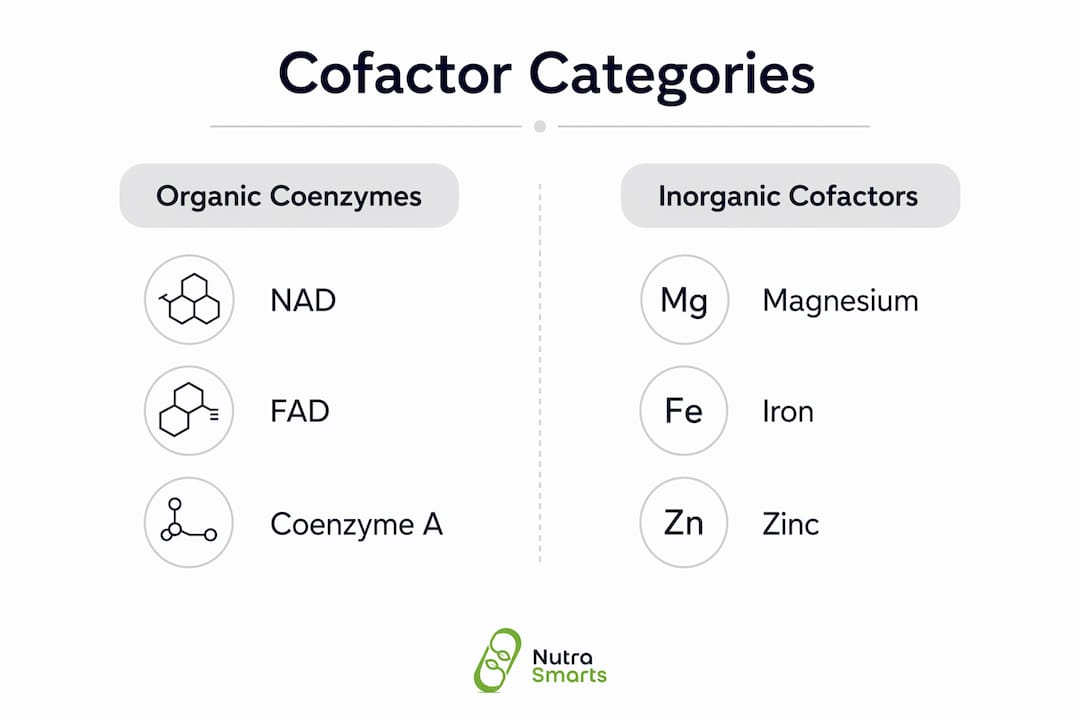
Cofactors fall into two categories: organic coenzymes (NAD, FAD, coenzyme A) derived largely from B vitamins, and inorganic mineral cofactors (Mg²⁺, Fe²⁺, Zn²⁺). An enzyme without its cofactor is called an apoenzyme — catalytically inert. Add the cofactor and you get the active holoenzyme.
The redox role is where things get interesting for formulators. Riboflavin (B2) is converted to FAD, which shuttles electrons through the mitochondrial electron transport chain. Without adequate riboflavin, FAD synthesis drops, and energy metabolism slows across multiple pathways simultaneously. That's the key insight researchers at Frontiers note: a single cofactor deficiency can bottleneck several enzyme systems at once, not just one.
Vitamin C illustrates a different mechanism. It doesn't just support collagen synthesis — it chemically reduces Fe³⁺ to Fe²⁺, which is the oxidation state iron needs to function as a cofactor for proline and lysyl hydroxylases. No vitamin C, no functional iron cofactor, regardless of how much iron you consume.

Pro Tip: Magnesium is a cofactor for the enzymes that activate vitamin D. If magnesium status is low, supplementing vitamin D may produce little effect — magnesium-dependent enzymes affect 25(OH)D concentrations and vitamin D binding protein. Check magnesium before assuming a vitamin D supplement isn't working.
Genetic variation adds another layer. Polymorphisms in genes encoding MTHFR (folate metabolism) or CYP2R1 (vitamin D hydroxylation) change how efficiently individuals convert dietary precursors into active cofactor forms. This is the core premise of nutrigenomics: the same dose produces different outcomes depending on genotype.
Synergy and antagonism: what the evidence actually shows
Nutrient interactions can boost or block bioavailability by large margins. The direction depends entirely on the pairing.
Documented synergies:
- Vitamin C + non-heme iron: vitamin C increases non-heme iron absorption several-fold by reducing Fe³⁺ to the absorbable Fe²⁺ form
- Vitamin D + calcium: vitamin D upregulates intestinal calcium-binding proteins; without adequate vitamin D, calcium absorption from the gut is sharply reduced
- Selenium + zinc for thyroid function: a double-blind RCT found the combination significantly improved free T3 compared to either mineral alone
- Piperine + curcumin: piperine inhibits hepatic and intestinal glucuronidation, substantially increasing curcumin bioavailability
Documented antagonisms:
- Tea or coffee + iron: tannins reduce iron absorption by up to 90% when consumed immediately after a meal — one of the largest single-meal effect sizes in micronutrient research
- Calcium + iron: adding calcium to a meal has been shown to significantly reduce iron absorption in single-meal studies
- Phytic acid and oxalates: phytic acid binds zinc, iron, calcium, and magnesium by forming insoluble salts; oxalates do the same with calcium and magnesium
Stat callout: Tea consumed immediately after a meal can reduce iron absorption dramatically — a larger effect than most supplement dose adjustments can compensate for.
The practical implication is that food context matters as much as the supplement itself. A 25 mg iron tablet taken with tea may deliver less absorbable iron than a smaller dose taken with orange juice.
Practical timing strategies to avoid absorption collisions
Separate competing minerals by an appropriate interval to minimize competition. That single rule from NIH ODS guidance eliminates the most common and preventable interaction problems.
| Time of Day | What to Take | Notes |
|---|---|---|
| Morning (fasted or low-calcium meal) | Iron + vitamin C | Avoid coffee/tea for 1 hour after |
| Midday (with food) | B vitamins, fat-soluble vitamins (A, D, E, K) | Fat aids absorption of fat-soluble forms |
| Evening (with dinner) | Calcium, magnesium | Separate from iron by the full day |
| As directed | Levothyroxine, certain antibiotics | Separate from all minerals by 4+ hours |
High-alert timing collisions to avoid:
- Iron + calcium or zinc taken simultaneously
- Antibiotics (tetracyclines, fluoroquinolones) + dairy or mineral supplements
- Multiple high-dose single-mineral supplements taken at the same time
- Zinc megadoses without copper — long-term zinc supplementation at 50 mg/day has reduced copper status markers in clinical studies
Pro Tip: Track symptoms and run targeted labs (iron panel, serum 25(OH)D, RBC magnesium) before and 8–12 weeks after adjusting timing. Subjective energy improvements are real signals, but a lab result confirms whether absorption actually changed. Learn more about supplement timing and its effect on outcomes.
Why nutrient ratios matter, especially Ca:Mg
Amounts alone don't tell the full story. A Ca:Mg ratio near 2.0 represents the consensus target from pooled research; ratios below 1.7 or above 2.8 have been associated with adverse outcomes. US diets frequently have calcium intake higher than magnesium, often with ratios exceeding common optimal ranges.
For formulators, this has direct product design implications:
- Set ratio targets before finalizing doses — don't add calcium and magnesium independently and hope the ratio works out
- Choose chelated forms (magnesium glycinate, calcium citrate) for better bioavailability and fewer GI side effects; chelated minerals absorb more predictably than oxides
- Account for background diet — a product targeting US consumers likely needs to compensate for dietary calcium excess, not add to it
- Avoid high single-mineral doses without counterbalances — stacking multiple high-dose minerals simultaneously can render them ineffective due to shared absorption pathways
On the label side, FDA Supplement Facts panels require disclosure of individual ingredient amounts. A ratio claim in marketing copy must be consistent with the declared amounts on the panel — you can't claim a "balanced Ca:Mg formula" if the panel shows 1,000 mg calcium and 100 mg magnesium.
Formulation and labeling implications for US supplement makers
Evidence of cofactor interactions should directly shape ingredient selection, dose timing guidance on labels, and the structure of Supplement Facts panels. This is where science meets compliance.
Practical labeling steps:
- Disclose each ingredient's amount per serving individually — never aggregate minerals into a "mineral blend" without per-ingredient disclosure
- List the specific form (magnesium citrate, not just "magnesium") — form affects bioavailability and helps consumers and clinicians assess the product
- Include timing or use instructions on the label or package insert, especially for products containing iron or competing minerals
- Consider fortification interactions — a product adding calcium to a food matrix already high in calcium may push consumers past the 2.8 Ca:Mg threshold
The Nutrasmarts Supplement Facts Tool generates FDA-compliant Supplement Facts panels in a browser with no spreadsheet required. Formulators can test different Ca:Mg ratios, swap mineral forms, and verify label math before production.
Pro Tip: When a formula contains nutrients that interact with warfarin (vitamin K), levothyroxine (calcium, iron), or transplant medications (St. John's Wort), add a "consult your physician or pharmacist before use" statement. This isn't just good practice — it reduces liability and signals to clinicians that the product was formulated with interaction awareness.
Your practical action plan as a consumer or formulator
Start with three steps, in this order:
- Audit your full stack — list every supplement and medication, including doses and timing. Flag duplicates and high-risk interactions (warfarin + vitamin K, levothyroxine + minerals)
- Map your timing — move iron to morning with vitamin C, calcium and magnesium to evening, and separate any competing minerals by at least 2 hours per NIH ODS guidance
- Pair vitamin C with every plant-based iron source — this applies to food and supplements alike
Additional checks worth doing:
- Consider baseline labs: iron panel, serum ferritin, 25(OH)D, RBC magnesium
- Check deficiency risk by group if you're pregnant, older, or managing a chronic condition
- Consult a pharmacist or clinician if you take any chronic medications — the interaction risk scales up sharply with prescription drug use
- Use the Nutrasmarts ingredient database to verify evidence ratings before adding a new ingredient to your stack
Nutrasmarts tools that put this science to work
Nutrasmarts provides the research infrastructure to apply cofactor science without starting from scratch. The ingredient database covers 1,300+ evidence-rated profiles, each linked to peer-reviewed citations and clinical trial data. A formulator checking a B-complex formula can pull the Nutrasmarts B-Complex ingredient profile to see which B vitamins function as cofactor precursors (riboflavin → FAD, niacin → NAD), what the evidence says about dosing, and which interactions are documented.
The Supplement Facts Tool handles FDA-compliant label generation in a browser. A formulator can enter a Ca:Mg ratio target, select mineral forms, and generate a compliant panel — no spreadsheet, no manual math.
For consumers, the symptom-to-supplement search maps health concerns to evidence-rated ingredients, so you're not guessing which nutrient to prioritize.
This article is general educational information, not medical or professional advice. Confirm current regulations and your specific situation with a qualified clinician, pharmacist, or regulatory professional.
How your gut microbiome shapes cofactor availability
The gut microbiota does more than digest fiber. Certain bacterial species synthesize B vitamins — including riboflavin, folate, and B12 — that contribute to the host's cofactor pool. Dysbiosis can reduce this endogenous production, meaning two people eating identical diets may have meaningfully different cofactor status depending on their microbiome composition.
Gut bacteria also influence mineral absorption indirectly. Short-chain fatty acids produced by fermentation lower luminal pH, which improves iron and calcium solubility. Conversely, gut inflammation associated with dysbiosis can damage intestinal villi and reduce the absorptive surface area for all micronutrients.
Probiotic and prebiotic interventions that support microbial diversity may therefore improve cofactor availability beyond what supplementation alone achieves.
Common pitfalls that lead to deficiency or toxicity
The most frequent mistake is taking multiple high-dose single-mineral supplements at the same time. Calcium, iron, and zinc compete for divalent metal transporters in the intestine — when all three are present in high concentrations simultaneously, absorption of each drops. The result looks like a deficiency even when intake is technically adequate.
A second pitfall: assuming more is always better. Long-term zinc supplementation has been reported to affect copper status in some clinical contexts, producing a secondary microcytic anemia that mimics iron deficiency. High-dose vitamin A can antagonize vitamin K, and excess calcium without adequate magnesium pushes the Ca:Mg ratio into the range associated with adverse outcomes.
Fat-soluble vitamins (A, D, E, K) accumulate in tissue and carry genuine toxicity risk at sustained high doses — a risk that water-soluble vitamins largely don't share.
How food processing affects cofactor bioavailability
Heat, water, and oxidation degrade water-soluble vitamins faster than most people realize. Boiling vegetables can leach 40–80% of water-soluble B vitamins into cooking water. Steaming or microwaving preserves significantly more. Vitamin C is particularly heat-sensitive and begins degrading within minutes of exposure to high temperatures.
Milling and refining strip whole grains of B vitamins and minerals concentrated in the bran and germ. Enrichment programs restore some (thiamin, riboflavin, niacin, folic acid, iron), but not all — magnesium and zinc are not typically added back.
Fermentation works in the opposite direction. It reduces phytic acid content in legumes and grains, freeing bound minerals and improving their bioavailability. Soaking, sprouting, and fermenting are practical food-prep strategies that meaningfully increase mineral absorption from plant foods.
Regulatory and compliance challenges beyond FDA labeling
FDA Supplement Facts requirements are the floor, not the ceiling. The FTC governs advertising claims, and structure/function claims on labels must be truthful, substantiated, and accompanied by the standard disclaimer: "This statement has not been evaluated by the Food and Drug Administration. This product is not intended to diagnose, treat, cure, or prevent any disease."
Current Good Manufacturing Practice (cGMP) regulations under 21 CFR Part 111 require identity, purity, strength, and composition testing for every finished product. Interaction-related claims — such as "enhanced absorption with vitamin C" — need substantiation files that include the underlying research.
Third-party certification programs (NSF International, USP Verified, Informed Sport) add another compliance layer that many retail buyers and healthcare practitioners now require. These programs test for label accuracy, contaminants, and in some cases, banned substances.
State-level requirements add complexity for direct-to-consumer brands. California's Proposition 65 requires warnings for products containing certain heavy metals above defined thresholds — relevant for mineral-heavy formulas.
Key Takeaways
Cofactor interactions are the mechanism behind most supplement successes and failures — getting the pairings, timing, and ratios right is where real results come from.
| Point | Details |
|---|---|
| Pair vitamin C with plant iron | Vitamin C reduces Fe³⁺ to Fe²⁺, increasing non-heme iron absorption several-fold. |
| Separate competing minerals | Space iron, calcium, and zinc at least 2 hours apart to avoid shared-transporter competition. |
| Target Ca:Mg near 2:1 | Ratios below 1.7 or above 2.8 are associated with adverse outcomes; US diets often exceed 3:1. |
| Tannins block iron sharply | Tea or coffee immediately after a meal can reduce iron absorption by up to 90%. |
| Use Nutrasmarts tools | The Supplement Facts Tool and 1,300+ ingredient profiles help formulators and consumers apply this science directly. |
Why the ratio question matters more than most formulators admit
Most supplement formulation discussions focus on ingredient selection and dose. The ratio question gets far less attention, and that's a real gap. A product can have clinically relevant doses of both calcium and magnesium and still push consumers into a problematic Ca:Mg range if the background diet isn't accounted for. US dietary patterns already skew high on calcium relative to magnesium — a formulator who ignores that context isn't designing for the actual consumer.
The same logic applies to cofactor dependencies that aren't obvious. Vitamin D supplementation without checking magnesium status is a common example. Magnesium-dependent enzymes are required for vitamin D activation, so a consumer who is marginally magnesium-deficient may see little response to vitamin D supplementation and conclude the supplement doesn't work. The real issue is upstream.
What this means practically: evidence-based formulation requires thinking in networks, not single ingredients. The Nutrasmarts ingredient database and synergistic stack guides are built around exactly that framework — each profile surfaces interaction data alongside efficacy evidence, so formulators and consumers see the full picture.
Nutrasmarts makes cofactor science practical
Knowing the science is one thing. Applying it to a label or a supplement routine is where most people get stuck. Nutrasmarts closes that gap with tools built specifically for this work.
The free Supplement Facts Tool generates FDA-compliant labels in minutes — no spreadsheets, no guesswork on format. You can test Ca:Mg ratios, swap mineral forms, and verify label math before committing to production. The 1,300+ evidence-rated ingredient profiles each link to peer-reviewed citations, so every formulation decision has a research trail behind it. Consumers can use the symptom search to find evidence-backed ingredients for their specific health concerns, then cross-check interactions before adding anything new to their stack. Start with the Supplement Facts Tool or the ingredient database at nutrasmarts.com.
Useful sources
- Medicine LibreTexts — Cofactors and Helpers in Metabolic Reactions/17%3A_Macronutrient_and_Alcohol_Metabolism/17.01%3A_Metabolism_Basics/17.1.01%3A_Cofactors_and_Helpers_in_Metabolic_Reactions): Foundational explanation of organic and inorganic cofactors, NAD, FAD, and Fe²⁺ roles
- NCBI Bookshelf — B Vitamins and Choline, Dietary Reference Intakes: Authoritative DRI data on B vitamin cofactor functions and energy metabolism
- Frontiers in Nutrition — Nutrient Synergy: Definition, Evidence, and Future Directions: Peer-reviewed review of synergy and antagonism mechanisms including phytic acid, oxalates, and tannins
- ScienceDirect — Magnesium, Vitamin D, and Calcium Interactions: Primary source for Ca:Mg ratio guidance and magnesium's role in vitamin D activation
- Cambridge Core — Micronutrient Interactions: Effects on Absorption and Bioavailability: Clinical data on calcium-iron, zinc-copper, and manganese-iron interactions
- NIH Office of Dietary Supplements — Mineral Interactions and Timing: US government guidance on separating competing minerals and practical timing
- PubMed — Vitamin C and Non-Heme Iron Absorption: Multiple studies supporting vitamin C's role in iron bioavailability
- PubMed — Tannins and Iron Absorption: Studies documenting up to 90% reduction in iron absorption from tea consumed with meals
- nutrient.cloud — Supplement Interactions Checker Guide: Practical framework for auditing supplement and medication interactions