

On a U.S. Supplement Facts panel, the serving size is the maximum amount the label tells you to take at one time, and every figure on the panel describes that amount, not one capsule or the whole bottle. Federal rules fix how that serving is defined, how servings per container are counted and how ingredient amounts are declared. They do not decide how much of anything a serving should contain. If you read labels to choose a product, or write them as a formulator, the details below are what keep comparisons honest.
TL;DR
- One serving equals the maximum amount the label recommends per eating occasion, or one unit (tablet, capsule, packet, teaspoonful) if the label gives no recommendation.
- Every "Amount Per Serving" and % Daily Value figure applies to the full serving. If the serving is 3 capsules, divide by 3 to get the amount per capsule.
- Servings per container are rounded to the nearest whole number, except 2 to 5 servings, which are rounded to the nearest half and marked "about."
- No law caps a supplement's serving size or the amount of an ingredient in it, so the labeled serving is the manufacturer's choice, not a dosing recommendation for your goal.
- Formulators can build a compliant panel in a free browser-based tool instead of a spreadsheet.
Table of Contents
- What the serving size line actually tells you
- The rule: the maximum amount recommended per occasion
- Servings per container, and why it says "about"
- How ingredient amounts are declared
- Reading % Daily Value per serving
- Per unit and per day columns
- A worked comparison: same numbers, different products
- The serving size is not a dose recommendation
- For formulators: building a compliant panel
- Build the panel without a spreadsheet
- Our perspective
- FAQ
- Sources
What the serving size line actually tells you
The Supplement Facts panel opens with two lines: Serving Size and Servings Per Container. They come before any ingredient, and they set the meaning of everything below them. The federal regulation behind the panel, 21 CFR 101.36, requires both and says the serving size must be expressed in a term that fits the product's form.
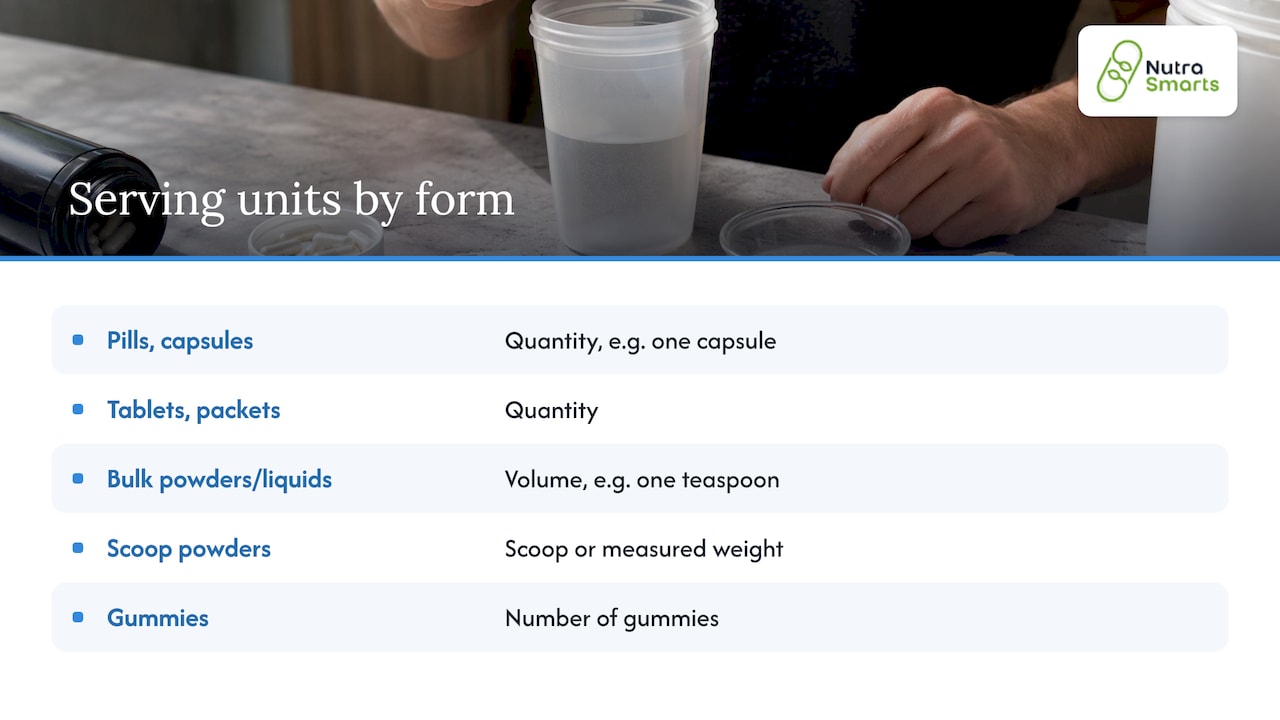
That is why the unit changes from product to product. FDA's educational material on dietary supplements explains that pills, capsules, tablets and packets are listed as a quantity, such as one capsule, while bulk powders and liquids are listed as a volume, such as one teaspoon. A scoop-based powder will show a scoop or a measured weight. A gummy will show a number of gummies.
The most common reading mistake is treating the numbers as per capsule. Take a label that says Serving Size: 2 capsules and lists 500 mg of an ingredient. That is 500 mg in two capsules, or 250 mg each. Nothing on the panel says otherwise unless the manufacturer chose to add a per-unit column, which we cover below.
The rule: the maximum amount recommended per occasion
FDA's Dietary Supplement Labeling Guide, Chapter IV states that one serving equals the maximum amount recommended on the label for consumption per eating occasion. If the label makes no recommendation, the serving is one unit. Its own example: directions that say to take 1 to 3 tablets with breakfast mean a serving size of 3 tablets.
The American Herbal Products Association's 2021 labeling guide gives a second case. Directions that say to take 3 capsules twice a day give a serving size of 3 capsules, and all nutrition information is declared for those 3 capsules.
Two practical consequences follow:
- The directions drive the panel. A manufacturer that writes "take 1 to 2 capsules" must declare nutrients for 2 capsules. Changing the directions changes the serving size and every number beneath it.
- A serving is per occasion, not per day. Two servings a day means you multiply every figure by two. The panel will not do that for you unless a per-day column is present.
Behind the scenes, the serving-size logic comes from FDA's concept of an amount customarily eaten in one sitting. FDA's December 2019 guidance describes a serving as the amount customarily consumed in one eating occasion, set from reference amounts in 21 CFR 101.12(b). Those reference amounts draw in part on national dietary survey data. For supplements, the label's own recommended use does the work in practice.
Servings per container, and why it says "about"
Servings Per Container follows directly under Serving Size. The Chapter IV guide notes one exception: it need not appear when the same information is already stated in the net quantity of contents. A 100-tablet bottle with a one-tablet serving does not have to repeat "100."
When it is stated, 21 CFR 101.9(b)(8)(i) sets the rounding. The count is rounded to the nearest whole number, except that 2 to 5 servings are rounded to the nearest 0.5, and the rounding is shown with "about." So you will see "about 2 servings" or "about 3.5 servings" on small packages, and a whole number on a typical 30-day bottle.
If you format labels yourself, rounding is where small errors creep in. Our guide to FDA supplement label rounding rules walks through how to apply them to the amounts as well as the servings.
How ingredient amounts are declared
Below the serving lines, the panel lists each dietary ingredient with an amount per serving by weight, a percent of Daily Value, or both. A few rules decide what those numbers mean.
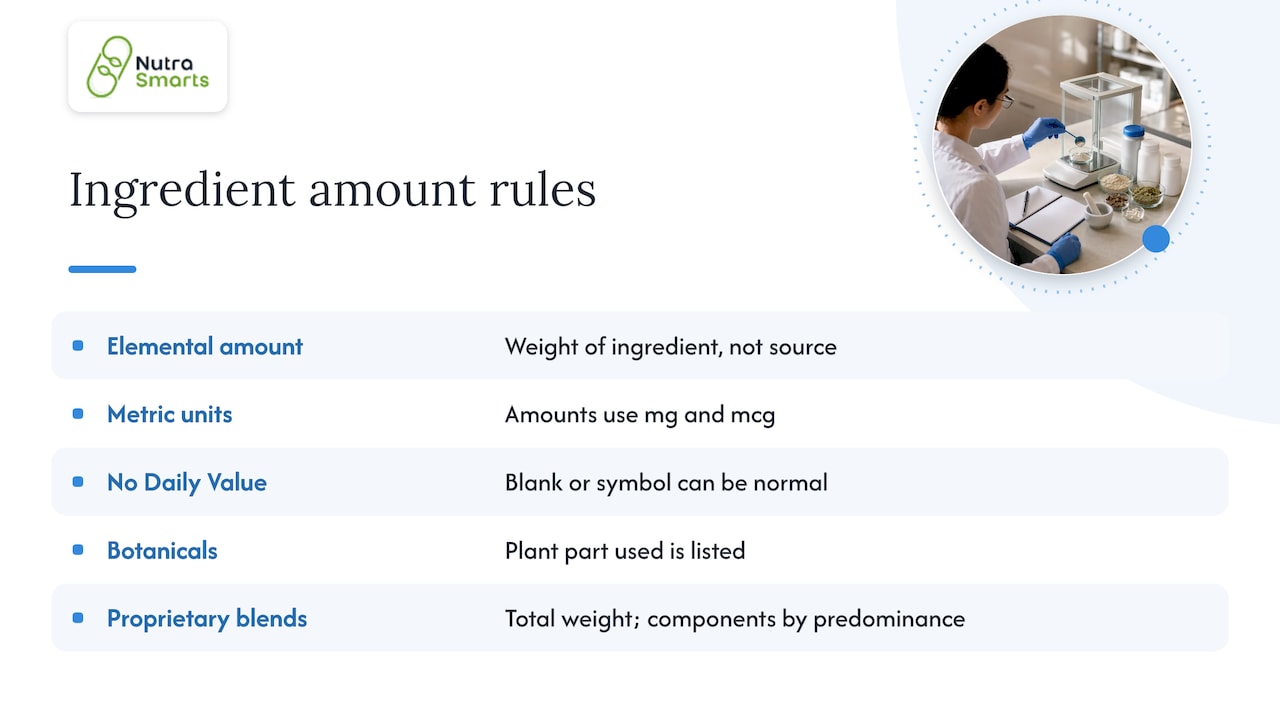
The amount is the ingredient itself, not its source. Under 21 CFR 101.36(b)(2)(ii), the quantity is the weight of the dietary ingredient, for example the weight of calcium rather than calcium carbonate. This matters when you compare labels. A 1,250 mg calcium carbonate tablet does not deliver 1,250 mg of calcium, and a compliant panel shows the elemental figure. If you are choosing a calcium product, the form you take also affects when to take calcium for better absorption, but the panel number is always the calcium itself.
Units are metric. The industry's LabelWise guide from the Council for Responsible Nutrition explains that amounts appear in units such as mg and mcg, and that a symbol under the % Daily Value heading means no Daily Value has been established for that ingredient.
Not everything has a Daily Value. FDA notes that some components, such as the omega-3 fatty acids in fish oil, have none. A blank or symbol in that column is normal, not an error.
Botanicals and blends. Per the NIH Office of Dietary Supplements' consumer fact sheet, botanicals list the plant part used, and proprietary blends list the total blend weight with components in order of predominance by weight. A blend gives you a total, not the amount of each component.
Reading % Daily Value per serving
Percent Daily Value tells you how much of a day's reference intake one serving supplies. FDA's Daily Value page gives the arithmetic: divide the amount by the Daily Value and multiply by 100. If the Daily Value is 300 mcg and a serving holds 30 mcg, that is 10%. As a general guide, FDA treats 5% or less per serving as low and 20% or more as high.
FDA's example labels show the format in practice: Serving Size 1 Gelcap, Servings Per Container 100, with vitamin D at 20 mcg (800 IU) listed as 100% DV. The Daily Values apply to adults and children 4 and older unless the label names another group, according to the LabelWise guide.
Because %DV is tied to the serving, it inherits any trick in the serving size. A product that lists a one-capsule serving at 50% DV and another that lists a three-capsule serving at 50% DV are not equivalent. Check the capsule count before you compare percentages.
Per unit and per day columns
The required column is per serving. Under 21 CFR 101.36(e)(9), a manufacturer may add a per-unit column to the right, such as per tablet. If the label recommends taking the product more than once a day, it may also add a per-day column, for example "Per Day (3 Caplets)," or a statement like "Multiply amounts by 3 for total daily amount."
These columns are voluntary. In its December 2006 final rule, FDA chose to allow per-day labeling in addition to per serving rather than require it, noting the cost mandatory labeling could have imposed on industry. So a label without a per-day figure is fully compliant, and the multiplication is yours to do.
A worked comparison: same numbers, different products
Here is a hypothetical pair of vitamin D products to show how the serving definition changes a comparison. The prices are made up for the exercise.
| Product A | Product B | |
|---|---|---|
| Serving size | 1 softgel | 2 softgels |
| Vitamin D per serving | 25 mcg (1,000 IU) | 25 mcg (1,000 IU) |
| Vitamin D per softgel | 25 mcg | 12.5 mcg |
| Servings per container | 60 | 30 |
| Bottle price (example) | $18 | $18 |
| Cost per serving | $0.30 | $0.60 |
The panels look identical at a glance, since both show 25 mcg per serving. Product B simply needs two softgels to deliver it, so the same bottle lasts half as long and costs twice as much per serving. With a Daily Value of 20 mcg for vitamin D, as in FDA's example label, 25 mcg works out to 125% DV on both.
A reliable routine for any comparison:
- Write down the serving size in units (capsules, scoops, gummies).
- Write the ingredient amount per serving, and confirm it is the ingredient itself, not its source compound.
- Divide by the units per serving to get the amount per unit if you want to compare against another product's unit.
- Multiply by the number of servings the directions say to take in a day.
- Divide the bottle price by servings per container, then by servings per day, to get cost per day.
Our plain-language walkthrough on how to read a Supplement Facts label covers the rest of the panel, and the ingredient database gives you the dosage benchmarks from clinical research to set beside the numbers you calculate.
The serving size is not a dose recommendation
A labeled serving tells you what the manufacturer decided to package, not what is right for a health goal. FDA's Q&A on dietary supplements states that, apart from safety standards, labeling requirements and good manufacturing practice, no law or regulation limits the serving size of a supplement or the amount of a dietary ingredient in a serving. The manufacturer makes that decision and FDA approval is not required.
That is useful context for two readers in particular:
- If you are addressing a deficiency or a symptom, compare the amount per serving with the doses studied in clinical trials for that ingredient, then work out how many servings reach that amount. Your clinician decides whether you need it and how much, especially if you take prescription medicines, are pregnant, or have a diagnosed condition. Bring the label and your calculated daily total to that conversation.
- If you coach clients, a daily total built from the label is a better thing to share than a bottle name. It makes the actual intake visible.
Our supplements by symptom pages start from the concern, such as joint pain or anxiety, and point to ingredients with their evidence ratings, so you can then check each product's per-serving amounts against them.
For formulators: building a compliant panel
If you make supplements, the serving size line is the first one regulators and customers check, and the decisions upstream of it (recommended directions, units per serving, container count) all flow into it. The five statements FDA's Chapter I guide lists as required on every label include nutrition labeling, alongside the statement of identity, net quantity, ingredient list and the name and place of business.
What applies today is the framework from FDA's May 2016 final rule. It revised the panel format, required added sugars, vitamin D and potassium declarations, made vitamins A and C voluntary and updated reference values. The compliance dates were July 26, 2018 for manufacturers with $10 million or more in annual food sales and July 26, 2019 for smaller ones, and both have passed. The eCFR's Part 101 as of April 28, 2025 carries the same serving-size, servings-per-container and per-day provisions in section 101.36 as before.
Section 101.36(h) also provides exemptions from full nutrition labeling, including for small direct-sale retailers (annual gross sales to consumers of not more than $500,000, or food sales of not more than $50,000, with no nutrition information or claims on the label) and for bulk ingredients shipped for use in making other supplements. Confirm which, if any, applies to your product before you leave a panel off.
For layout and wording, these pages from our blog go deeper: how to structure a Supplement Facts table accurately, Supplement Facts versus Nutrition Facts, label font requirements, and the 2026 label requirements checklist.
Build the panel without a spreadsheet
The NutraSmarts Supplement Facts label creator is a free, browser-based tool for generating an FDA-compliant panel. You enter your serving size and ingredients and get the label without wrestling formatting, rounding and Daily Value math in a spreadsheet. There is no sign-up and no paywall.
If you are on the consumer side, the same site gives you the research behind the numbers: an ingredient database with clinical trial citations, a symptom-to-supplement search, a deficiency symptom guide and a side-by-side ingredient comparison tool. Start from the NutraSmarts homepage.
Our perspective
Serving size is the line on a supplement label that most often decides whether two products are comparable, and it is the line people read last. The rules are simple once you see them: the serving is the maximum recommended amount per occasion, every figure is for that serving, and the manufacturer chooses the amounts.
That last point is why we built NutraSmarts around evidence rather than label claims. A panel tells you what is in a serving. It does not tell you whether that amount matches what clinical trials have studied. We pair ingredient profiles with PubMed-cited research, clinical dosage benchmarks and honest evidence ratings, so you can set a product's per-serving amount next to a studied dose and do the multiplication with confidence.
For formulators, we think compliance should not depend on a fragile spreadsheet. Our free label creator exists so the serving size, the rounding and the Daily Value arithmetic come out right the first time.
NutraSmarts
FAQ
What does serving size mean on a supplement label?
It is the maximum amount the label recommends taking at one time, or one unit if the label gives no recommendation. All the amounts and % Daily Value figures on the panel apply to that amount. If the serving is 3 capsules, each capsule holds a third of the listed figure.
Is there a legal limit on how much is in a serving?
FDA states that, other than safety standards, labeling requirements and good manufacturing practice, no laws or regulations limit the serving size of a supplement or the amount of an ingredient in it. The manufacturer decides and FDA approval is not required. For that reason, compare the amount per serving with studied doses and talk with your clinician about what suits you.
Why does a label say "about 3.5 servings"?
Federal rounding rules require servings per container to be rounded to the nearest whole number, except that 2 to 5 servings are rounded to the nearest 0.5 and marked with "about." You will mostly see this on small packages.
Do supplements have to show amounts per capsule or per day?
No. The required column is per serving. Manufacturers may add a per-unit column, and when the label recommends more than one serving a day they may add a per-day column, but both are voluntary. Multiply the per-serving amounts by the servings you take daily to get your total.
Did the serving size rules change recently?
Not in the provisions covered here. The eCFR text of 21 CFR Part 101 as of April 28, 2025 carries the same section 101.36 serving-size, servings-per-container and per-day provisions. The current format comes from FDA's 2016 final rule, and its compliance dates have passed.
Sources
- FDA Dietary Supplement Labeling Guide, Chapter IV: Nutrition Labeling
- FDA Dietary Supplement Labeling Guide, Chapter I: General Dietary Supplement Labeling
- eCFR, 21 CFR 101.36: Nutrition labeling of dietary supplements
- eCFR, 21 CFR 101.9: Nutrition labeling of food
- eCFR, 21 CFR Part 101 as of April 28, 2025
- FDA, Examining Dietary Supplements
- FDA, Questions and Answers on Dietary Supplements
- FDA, Daily Value on the Nutrition and Supplement Facts Labels
- FDA, High-Resolution Examples of Different Supplement Facts Labels
- FDA, Guidance for Industry: Food Labeling: Serving Sizes (December 2019)
- Federal Register, Nutrition Labeling of Dietary Supplements on a Per-Day Basis (2006)
- Federal Register, Revision of the Nutrition and Supplement Facts Labels (2016)
- NIH Office of Dietary Supplements, Dietary Supplements: Consumer Background
- CRN LabelWise, How to Read a Supplement Label (2021)
- AHPA, Federal Labeling Requirements for Herbal Supplements (2021)