

Before you print or list a supplement product, run a prioritized pre-launch validation checklist that covers five things: the Supplement Facts panel, ingredient declarations, claims and disclaimers, supplier certificates of analysis (CoAs), and an automated regulatory scan. Skip any one of these and you risk misbranding, a retailer rejection, or FDA enforcement after launch, since the FDA does not pre-approve supplement labels before they hit shelves. Follow the FDA's labeling guidance and USP's verification standards as your two anchors, and use a tool like NutraSmarts to build the panel itself. Your immediate next step: schedule a label review or run an automated compliance scan this week, before final art goes to the printer.
- Verify the Supplement Facts panel against 21 CFR formatting rules
- Confirm every ingredient declaration matches the CoA
- Check claims language against DSHEA disclaimer requirements
- Request and review current supplier CoAs
- Run an automated regulatory scan as a final pre print check
Key Takeaways
Validating a supplement label before launch requires a documented checklist covering the Supplement Facts panel, ingredient and allergen declarations, DSHEA-compliant claims, supplier CoAs, and an automated regulatory scan.
| Point | Details |
|---|---|
| Run the checklist in order | Verify product identity, Supplement Facts, ingredients, allergens, and claims before final art. |
| FDA does not pre-approve labels | Enforcement happens after launch, so pre-launch validation is your main line of defense. |
| Third-party verification adds a layer | USP audits facilities and tests products; ConsumerLab tests finished products already on shelves. |
| Test early, not last minute | Send samples for identity and potency testing 4 to 6 weeks before launch. |
| Archive everything together | Store final artwork, CoAs, claim substantiation, and sign-off sheets as one linked record. |
Table of Contents
- Your Pre-Launch Validation Checklist, Step by Step
- What Belongs on the Supplement Facts Panel?
- Which Claims Are Legal Under DSHEA?
- How Should You Test and Verify Before Launch?
- Building an Inspection-Ready Final Audit Workflow
- How NutraSmarts Fits Into Your Validation Workflow
- When Should You Schedule Testing and Reviews?
- Do International Sales Change Your Label Requirements?
- Do Digital Labels Need the Same Validation as Print?
- How Do You Maintain Label Traceability After Launch?
- Where to Verify the Rules Yourself
- The Checklist Beats the Instinct Call Every Time
- Sources
Your Pre-Launch Validation Checklist, Step by Step
Print production doesn't wait for regulatory sign-off, so the order you check things in matters as much as the checking itself. Work through these in sequence and initial each one before moving to the next.
- Product identity statement. The common or usual name must appear on the front panel in type reasonably related to the largest print on that panel. Fail condition: a name that's technically accurate but buried in small type below a marketing claim.
- Supplement Facts panel accuracy. Every serving size, amount per serving, and %DV calculation must match your formulation sheet exactly. Fail condition: any discrepancy between the panel and the actual formula, even a rounding error on a single nutrient.
- Ingredient declarations. All dietary ingredients, plus inactive ingredients like fillers and coatings, need to be listed in descending order of predominance. Fail condition: a proprietary blend that hides individual ingredient amounts when the label implies specific dosing.
- Allergen statements. Major food allergens must be declared per FDA rules, either in the ingredient list or a separate "Contains" statement. Fail condition: an allergen present in a flavoring or excipient that never made it onto the label.
- Net contents formatting. Quantity must appear in the bottom third of the front panel, in both metric and U.S. customary units where required. Fail condition: units that don't match the actual count in the bottle.
- Manufacturer or distributor details. Name and place of business must be accurate and complete. Fail condition: an outdated address or a private-label arrangement that isn't disclosed correctly.
- DSHEA disclaimer. The required disclaimer must appear in full, correctly placed, and boxed where applicable.
- Claims review. Every structure/function claim needs substantiation on file before print.
Pro Tip: Create a one-page sign-off sheet with each checklist item, a pass/fail column, and space for reviewer initials and date. Keep it in the same folder as your CoAs and claim substantiation files. When an inspector or retailer compliance team asks for your process, that single sheet answers the question in ten seconds.
For a deeper breakdown of formatting changes, see this FDA supplement label requirements checklist.
What Belongs on the Supplement Facts Panel?
The Supplement Facts panel has a fixed set of required fields, and the FDA's nutrition labeling guidance spells out exactly how each one must appear. At minimum, you need:
- Serving size, stated in a common household measure
- Servings per container
- Amount per serving for every dietary ingredient
- %Daily Value where an established DV exists
- A footnote disclosure for ingredients without an established DV
Botanical and extract ingredients carry extra rules. You often need to declare the part of the plant used and, for standardized extracts, the percentage of the active marker compound. The most common formatting errors we see: mixing metric and U.S. customary units inconsistently, listing a serving size that doesn't match the actual scoop or capsule count, and net contents that were never updated after a formula change. Run these three quick checks before final art: does the serving size match the dosing instructions, do the units stay consistent throughout the panel, and does the net contents statement match the actual fill weight. For step-by-step formatting help, the Supplement Facts panel compliance guide walks through each field in detail.
Which Claims Are Legal Under DSHEA?
Structure/function claims describe how an ingredient affects the body's normal structure or function, and they're permitted. "Supports healthy joint function" passes. "Treats arthritis" does not, because that's a disease claim reserved for drugs.
- Permitted: "Supports immune health," "helps maintain healthy blood sugar already within normal range"
- Prohibited: "Cures," "treats," "prevents," or any wording that implies diagnosis or disease treatment
The DSHEA disclaimer must read: "This statement has not been evaluated by the Food and Drug Administration. This product is not intended to diagnose, treat, cure, or prevent any disease." Place it in a boxed format near the Supplement Facts panel where retailers expect it. Keep a substantiation file for every claim, meaning the studies, clinical citations, or ingredient monographs that back it up, stored and dated alongside your label artwork so you can produce it in minutes if a retailer or the FDA asks.
How Should You Test and Verify Before Launch?
Testing falls into three buckets: identity (is this ingredient what the supplier says it is), potency (does it contain the labeled amount), and contaminants (heavy metals, microbials, pesticide residue). Most independent labs return identity and potency results in one to two weeks; contaminant panels can take slightly longer depending on the assay.
- Identity and potency testing on every new lot, not just the first
- Contaminant screening at minimum on raw materials from new suppliers
- CoA review for every batch before it goes into production
Third-party verification through USP goes further than a lab test. It requires a facility audit against cGMP standards, a documentation review, and ongoing off-the-shelf monitoring, not just a one-time potency check. ConsumerLab takes a different approach, testing finished products already on the market and publishing results, which gives buyers an independent read on what's actually in the bottle. Set your CoA acceptance criteria before you need them: request identity confirmation, a potency range within your labeled tolerance, and a contaminant panel dated within the last testing cycle. Learn more about why third-party testing matters for label accuracy.
Pro Tip: Never accept a CoA that's more than one production cycle old. A supplier's CoA from eighteen months ago tells you nothing about the lot sitting in your warehouse right now.
Building an Inspection-Ready Final Audit Workflow
The most efficient final audit sequence runs in four stages: automated scan, regulatory reviewer sign-off, CoA verification, and archive. Automated tools that check label images against CFR-based rules catch formatting errors fast, things like missing footnotes or incorrect font sizing, but they're a screening step, not a substitute for a trained reviewer's final sign-off.
- Run the automated scan first to catch obvious formatting gaps
- Route flagged items to a regulatory reviewer for judgment calls
- Cross-check every ingredient against the current CoA
- Archive the final artwork, CoAs, and sign-off sheet together
Retailers and inspectors increasingly expect to see this full chain, not just a clean-looking label. For a walkthrough of what a complete audit trail should contain, review the supplement label audit process.
How NutraSmarts Fits Into Your Validation Workflow
NutraSmarts maintains evidence-linked profiles on over 1,300 ingredients, each tied to clinical trial citations, alongside a free, browser-based Supplement Facts Tool built to generate FDA-compliant panels without spreadsheet errors.
A practical workflow looks like this: pull ingredient dosing and research context from the NutraSmarts database, generate your panel in the Supplement Facts Tool, export it into your final art, then attach it to your CoA file and audit sign-off sheet before it goes to the printer.
The gap this closes: most formatting errors on supplement labels come from manual transcription between a formulation spreadsheet and the final panel design, not from a lack of regulatory knowledge.
- Generate a compliant panel in minutes instead of building one from scratch
- Cross-reference ingredient dosing against clinical citations before finalizing amounts
- Export a clean panel file to attach to your audit archive
Try the free Supplement Facts label creator or browse ingredient research by symptom to check dosing context before you finalize your formula.
When Should You Schedule Testing and Reviews?
Start label drafting as soon as your formula is finalized, not after art is done. Run your automated scan before final art gets locked, since catching a formatting error at the draft stage costs nothing; catching it after print costs a full reprint.
- Send samples for identity and potency testing 4 to 6 weeks before launch
- Budget for contaminant screening if you're using a new supplier or a botanical with known contamination risk
- Professional label review typically runs faster than a full lab turnaround, so schedule it in parallel, not after
If an issue surfaces late, during a print proof or right before a retailer submission, halt distribution rather than pushing forward. A short launch delay costs far less than a recall or a retailer delisting.
Do International Sales Change Your Label Requirements?
Selling outside the domestic market means your label has to satisfy a second regulatory framework, not just a translated version of the first one. Canada's Natural Health Products Regulations, the European Union's Food Supplements Directive, and similar frameworks in other markets often set different rules for permitted claims, allowed ingredient forms, and maximum potency levels than the FDA does.
The biggest trap for U.S. manufacturers is assuming a DSHEA-compliant structure/function claim will pass in another market. Several countries restrict or ban claims that the FDA allows, and some require pre-market notification or product registration before you can sell at all. A botanical ingredient perfectly legal in a U.S. formulation might be restricted or require a different maximum dose elsewhere.
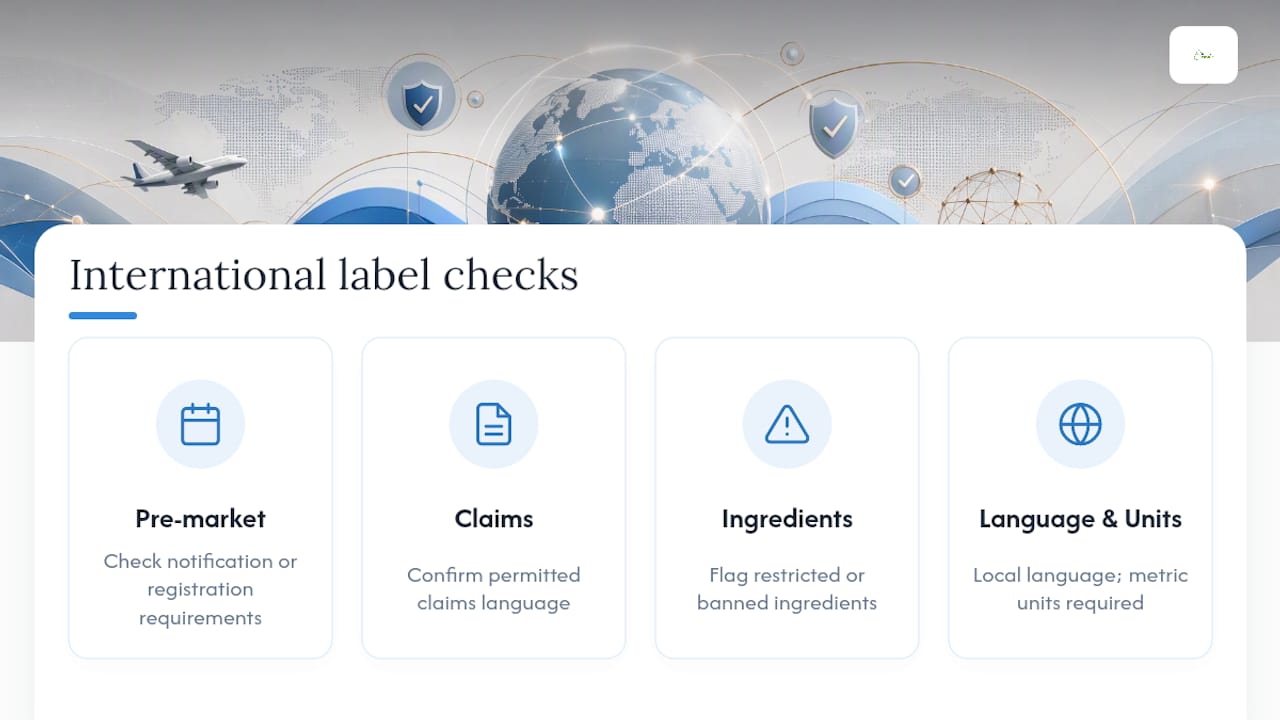
Before you finalize packaging for a new market, confirm four things: whether the destination country requires pre-market notification or registration, what claims language is permitted there, whether your ingredient list includes anything restricted or banned locally, and what language and unit requirements apply to the label itself (many markets require the local language plus metric units exclusively, no U.S. customary units at all).
Build a market-by-market compliance matrix rather than trying to create one universal label. It's more work upfront, but it prevents the expensive mistake of printing thousands of units that clear U.S. review and then get held at customs somewhere else. If you're expanding into a new region, budget time for a local regulatory consultation. General knowledge of FDA rules doesn't transfer automatically, and assuming it does is how shipments end up sitting in a warehouse instead of on shelves.
Do Digital Labels Need the Same Validation as Print?
Yes, and in some ways digital labels need more scrutiny, not less, because they change more often and with less friction. A print label goes through a formal proof and approval cycle before a print run locks it in place for months. An e-commerce product listing can be edited in an afternoon by whoever manages the storefront, which means a small copy change can slip past the same rigorous review a print label gets.
Treat every digital label update the same way you'd treat a print revision: run it through your checklist, log the change, and get sign-off before it goes live. This matters especially for claims language, since a marketing team optimizing product copy for search terms can accidentally introduce disease-claim language that never would have survived a formal print proof cycle.
There's also a consistency risk unique to digital: if your product sells on multiple platforms, each with its own listing, you can end up with three or four versions of the same Supplement Facts panel drifting out of sync as formulas get updated. Set one master panel as your source of truth and push updates to every platform at the same time, rather than editing each listing independently.
One advantage digital labels have: correction speed. If you catch a formatting error on a live listing, you can fix it immediately rather than waiting for a reprint. That speed is a benefit only if you're actually running the same validation checks on digital updates that you run on print, not a substitute for skipping them.
How Do You Maintain Label Traceability After Launch?
A label isn't done once it launches. If a customer complaint, an FDA inquiry, or a supplier recall happens six months from now, you need to reconstruct exactly which label version shipped with which lot, and that requires a traceability system built before launch, not after.
The core practice is version control tied to lot numbers. Every time you revise a label, even a minor change like an updated address or a new claim, assign it a version number and record the date range and lot numbers it applies to. Store the final artwork PDF, the CoA for that production run, the claims substantiation file, and the batch records together as one linked record, not scattered across different folders or systems.
This matters most during a recall. If a contamination issue surfaces in one ingredient lot, you need to identify which finished product lots used that ingredient and which label version shipped on them, fast. Manufacturers without this traceability often end up recalling far more product than necessary, because they can't isolate which lots are actually affected.

Keep a running log that maps label version to lot number to production date. When retailers or inspectors ask for records, the goal is producing the complete chain in minutes, not days. Set a retention period that covers your product's shelf life plus a reasonable buffer past expiration, since a complaint can surface well after a product has left the shelf.
Where to Verify the Rules Yourself
- FDA Dietary Supplement Labeling Guide, Chapter I: the primary source for formatting and claims rules
- USP Verified Mark program: details on facility audits and testing standards
- Bookmark both for ongoing audit and enforcement questions, since rules get updated and your records need to reflect current guidance
The Checklist Beats the Instinct Call Every Time
Most label problems don't come from ignorance of the rules. They come from a formulation change that never made it back to the label, or a marketing edit that slipped past regulatory review because everyone assumed someone else caught it. The conventional advice, "have your regulatory person review the label," misses the actual failure point: reviews fail when they're informal and undocumented, not when the reviewer lacks knowledge.
What the evidence actually supports is treating validation as a sequence with sign off at each stage, not a single review at the end. Third-party verification through USP or independent testing through ConsumerLab matters less as a marketing bullet and more as a forcing function. It makes you build the documentation trail you'll need anyway if anything goes wrong post launch.
If you prioritize one thing, make it the CoA-to-label match. Ingredient declarations drift from formulation sheets more often than any other error we see, and it's the one mistake that turns a labeling fix into a recall.
Sources
- Dietary Supplement Labeling Guide: Chapter I — General dietary supplement labeling
- USP Verified Mark
- How do I know if a dietary supplement contains what the label says it contains? | Memorial Sloan Kettering Cancer Center