

Bioavailability, as it applies to oral supplements, is the fraction of a swallowed dose that actually reaches your bloodstream in a chemically active form your tissues can use. That single fact rewrites how you should read a label: the milligrams printed on a bottle are what you swallow, not what you absorb. Researchers measure this using pharmacokinetic standards like AUC (area under the plasma concentration–time curve) and Cmax, the tools the National Academies of Medicine and regulatory bodies rely on when setting reference intakes. The practical rule is straightforward: label dose is not absorbed dose, and the chemical form of an ingredient often matters more than the milligram count.
Table of Contents
- What is bioavailability in supplements, and how is it measured?
- What factors change how much of a supplement you actually absorb?
- How do different supplement forms compare for absorption?
- Does higher bioavailability mean a supplement actually works?
- How can you tell if a supplement is likely bioavailable?
- How can you improve absorption from supplements you already take?
- When can higher bioavailability be risky?
- How do you evaluate the evidence on supplement bioavailability?
- Key Takeaways
- The case for evidence-first supplement decisions
- Useful sources and further reading
What is bioavailability in supplements, and how is it measured?
Two numbers dominate human pharmacokinetic (PK) studies: AUC and Cmax148522/fulltext). AUC captures the total exposure your body gets over time, integrating plasma concentration across every hour after you take a dose. Cmax is simply the peak concentration reached. AUC is the more meaningful figure because a supplement that spikes quickly and crashes may look impressive at Cmax but deliver far less total exposure than one with a slower, sustained curve.
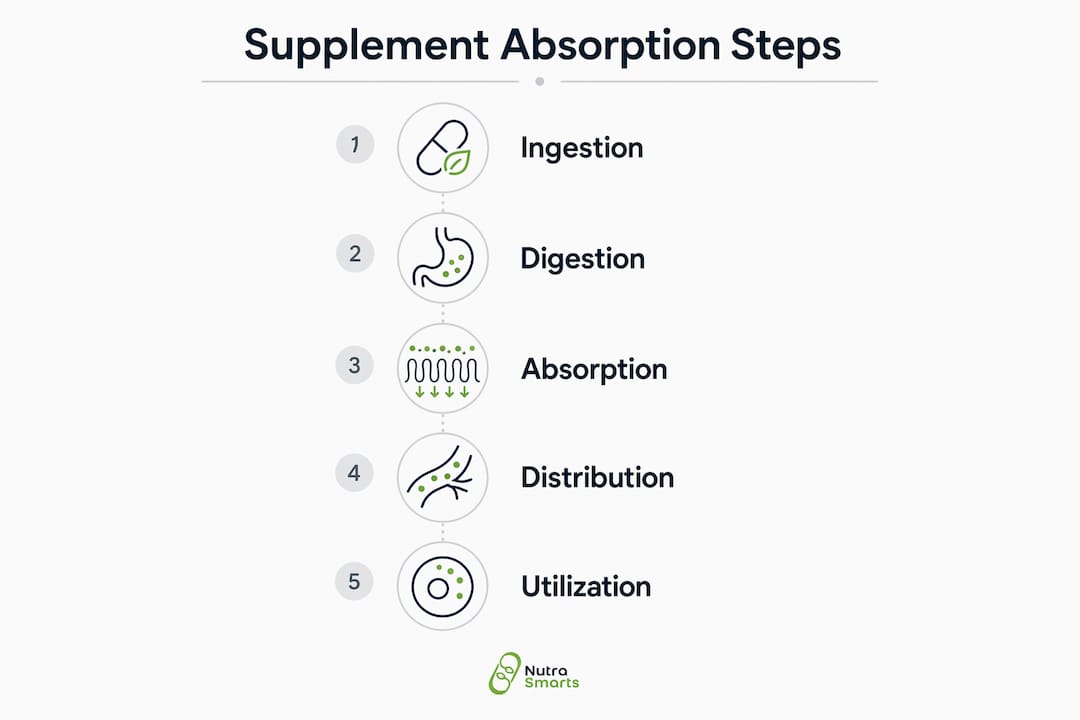
Absolute bioavailability compares oral absorption to an intravenous dose (100% by definition). Most supplement research uses relative bioavailability instead, comparing one oral form against another, which is why you'll see claims like "form A absorbs 3× better than form B." Bioequivalence is a stricter standard borrowed from pharmaceuticals: two products are bioequivalent when their AUC and Cmax fall within a defined range of each other, meaning they perform the same in the body.
For solid supplements, labs often use in vitro disintegration and dissolution tests148522/fulltext) as practical surrogates before running expensive human trials. A tablet that won't dissolve in simulated gastric fluid within a set time is unlikely to absorb well in vivo. These tests don't replace human PK data, but they're a reasonable quality screen.
Quick glossary of terms you'll encounter:
- AUC — total drug/nutrient exposure over time; the gold standard PK endpoint
- Cmax — peak plasma concentration after a dose
- Tmax — time to reach peak concentration
- Relative bioavailability — absorption of one form versus another oral form
- Bioequivalence — two products performing within an accepted range of each other
- Dissolution — how fast a tablet or capsule releases its active ingredient in fluid
- Serum marker — a blood test (e.g., 25(OH)D for vitamin D) used as a functional endpoint in longer trials
Key measurement principle: A single Cmax reading tells you how fast a nutrient peaks. AUC tells you how much your body actually received. When evaluating absorption claims, always ask which one the study measured.
What factors change how much of a supplement you actually absorb?
Absorption is never just about the pill. Host factors including age, gut microbiome composition, stomach acid levels, and genetic variants like MTHFR all shift how much of a nutrient clears the gut wall and survives first-pass metabolism in the liver. Older adults typically produce less stomach acid, which directly reduces absorption of minerals like iron and calcium. People with MTHFR variants may absorb synthetic folic acid but convert it to the active form (5-MTHF) less efficiently, making methylated folate a more useful choice.

Formulation variables are just as powerful. Solubility is the first gate: a nutrient that won't dissolve in the GI tract can't be absorbed. Particle size reduction, salt selection (glycinate vs. oxide), chelation, and encapsulation technologies all exist to push more of a dose past that gate. Magnesium glycinate, for example, typically delivers more usable magnesium to tissues than a much larger dose of magnesium oxide, because the glycinate chelate is more soluble and survives gut transit more intact.
Diet and timing add another layer. Fat in a meal meaningfully increases absorption of fat-soluble vitamins A, D, E, and K. Calcium and iron compete for the same intestinal transporters, so taking them together reduces uptake of both. Phytates in whole grains and legumes bind zinc, iron, and calcium, cutting their absorption. Coffee and tea polyphenols inhibit non-heme iron absorption, which matters if you're taking iron for deficiency correction.
Worth knowing: Medications that reduce stomach acid, including proton pump inhibitors like omeprazole, can significantly impair absorption of B12, magnesium, and iron. If you take acid-reducing drugs regularly, your supplement needs may be higher than the label suggests.
Pro Tip: When a higher-quality form is available, it often beats simply doubling the dose. Switching from magnesium oxide to magnesium glycinate or bisglycinate is more effective than taking twice the oxide, and it's easier on the gut.
How do different supplement forms compare for absorption?
Chemical form is the single biggest lever manufacturers control. Here's how the most common forms stack up:
- Mineral oxides (magnesium oxide, zinc oxide): cheapest to produce, lowest solubility, and typically the poorest absorption. Often chosen for cost, not performance.
- Mineral chelates and glycinates (magnesium glycinate, zinc bisglycinate): bound to amino acids, which improves solubility and gut tolerance. Generally better absorbed than oxides.
- Mineral salts (calcium citrate vs. calcium carbonate): citrate dissolves without stomach acid, making it preferable for older adults or anyone on acid-reducing medications; carbonate requires an acidic environment.
- Vitamin esters (ascorbyl palmitate, tocopheryl succinate): fat-soluble derivatives designed for stability or specific tissue delivery; absorption varies by compound and context.
- Liposomal formulations: encapsulate nutrients in phospholipid vesicles to protect them from gut degradation and potentially improve uptake. Genuinely well-made liposomal products can improve absorption, but many products labeled liposomal are simple emulsions with no measurable vesicle structure.
- Liquid supplements: dissolve faster than tablets and skip the disintegration step, but this doesn't automatically mean higher bioavailability once the nutrient hits the gut.
| Form | Example | Absorption note |
|---|---|---|
| Mineral oxide | Magnesium oxide | Low solubility; poor absorption relative to chelates |
| Mineral glycinate/chelate | Magnesium glycinate | Better solubility and gut tolerance; preferred for deficiency correction |
| Calcifediol (25-OH-D3) | Vitamin D active metabolite | ~2.5× more effective at raising serum 25(OH)D than cholecalciferol per EFSA; some clinical trials show calcifediol is ~3× more effective in certain populations. |
| Cholecalciferol (D3) | Standard vitamin D3 | Requires hepatic conversion; slower serum response |
| Ascorbic acid | Vitamin C | Equivalent bioavailability across powder, tablet, and chewable forms |
| Liposomal (verified) | Phospholipid-encapsulated nutrients | Can improve absorption when vesicle structure is confirmed |
| Liposomal (unverified) | Many commercial "liposomal" products | May be simple emulsions; no absorption advantage over standard forms |
The calcifediol vs. D3 comparison is one of the clearest clinical examples of form mattering. Calcifediol skips the hepatic conversion step required by cholecalciferol, raising serum 25(OH)D faster and more reliably at equivalent doses; EFSA uses a 2.5× conversion factor for supplemental calcifediol, and recent clinical trials report up to a ~3× difference in effectiveness in some populations.
Does higher bioavailability mean a supplement actually works?
Not automatically. Bioavailability measures delivery to the bloodstream. Whether that delivery produces a clinical benefit depends on whether the tissue needs the nutrient, whether the mechanism is supported by evidence, and whether the dose matches what trials used. High bioavailability alone doesn't guarantee a clinical effect; it's a prerequisite, not a proof.
The calcifediol example illustrates the distinction well. Its faster effect on serum 25(OH)D is clinically meaningful for people who are deficient and need rapid correction, or for those whose liver conversion is compromised. For a healthy person with adequate vitamin D status, the faster rise in serum levels doesn't translate into an additional clinical benefit.
The gap that matters: A supplement can be highly bioavailable and still do nothing useful if the underlying need isn't there. Bioavailability answers "did it get in?" Clinical trials answer "did it help?"
Where higher bioavailability is genuinely worth a premium: correcting a confirmed deficiency quickly, managing malabsorption conditions (Crohn's disease, celiac, post-bariatric surgery), or navigating medication interactions that reduce absorption of standard forms. Supplements and fortified foods can be engineered to match or exceed food-source absorption, which makes form selection meaningful in these contexts.
The safety side of this equation cuts both ways. Higher bioavailability means more of the nutrient enters circulation, which compresses the margin between a therapeutic dose and a toxic one for nutrients with narrow safety windows. Fat-soluble vitamins A and D accumulate in tissue; a highly bioavailable form at a high dose can push levels into a range that causes harm faster than a poorly absorbed form at the same label dose.
How can you tell if a supplement is likely bioavailable?
A checklist approach works better than trusting marketing language.
- Check the chemical form on the Supplement Facts panel. The form listed (e.g., magnesium glycinate vs. magnesium oxide) tells you more than the milligram count. If the form isn't named, that's a red flag.
- Look for human PK or clinical absorption studies. In vitro data is a starting point; human studies with AUC or serum marker endpoints are the real evidence. Search PubMed using the ingredient name plus "bioavailability" or "pharmacokinetics" and "human."
- Ask for dissolution or disintegration data. Reputable manufacturers can provide this for solid-dose products. It's not a substitute for human data, but it confirms the product will at least release its actives in the GI tract.
- Verify third-party testing. NSF International, USP, and Informed Sport certifications confirm that what's on the label is in the bottle, and that the product meets basic quality standards.
- Match the dose to research. A product using a form studied at 400 mg but dosed at 50 mg is unlikely to replicate the trial's results, regardless of how bioavailable the form is.
- Be skeptical of fold-change claims without references. "Absorbs 10× better" requires a human study with a comparator. No citation means no evidence.
Red flags to watch for: vague "enhanced absorption" language with no named mechanism; liposomal claims with no particle-size, PDI (polydispersity index), or vesicle-identity data; proprietary blends that hide individual ingredient doses; and absorption claims based only on in vitro or animal data.
For evaluating product quality more broadly, the chemical form, third-party certification, and human study alignment are the three criteria that separate credible products from marketing-heavy ones.
How can you improve absorption from supplements you already take?
Several practical steps consistently improve how much of a dose you actually use, and none of them require switching products.
Take fat-soluble vitamins (A, D, E, K) with a meal that contains meaningful fat, not a fat-free snack. The difference in absorption can be substantial. For vitamin D specifically, taking it with your largest meal of the day, which typically contains the most fat, is a simple habit that improves serum response.

Space competing minerals. Iron and calcium share intestinal transporters, so taking them at the same time reduces absorption of both. If you need both, separate them by at least two hours. Pair iron with vitamin C to convert non-heme iron to its more absorbable ferrous form. Avoid coffee and tea within an hour of taking iron.
Gut health is an underrated lever. Chronic inflammation, dysbiosis, or conditions like small intestinal bacterial overgrowth (SIBO) reduce absorptive surface area and alter the gut environment that nutrients depend on. Lifestyle factors including stress management, alcohol reduction, and adequate sleep all affect gut integrity and, by extension, nutrient absorption. Switching to a more bioavailable supplement form while ignoring gut health is addressing the wrong variable.
Review acid-reducing medications with your prescriber if you take them long-term. Proton pump inhibitors and H2 blockers meaningfully reduce absorption of B12, magnesium, and iron, and the effect compounds over months and years.
Pro Tip: If you suspect malabsorption or you're taking high-dose supplements for a confirmed deficiency, get baseline serum markers before you start and retest after 8–12 weeks. Without a before-and-after measurement, you're guessing whether the supplement is working.
When can higher bioavailability be risky?
More absorption isn't always better. For fat-soluble vitamins, particularly A and D, increased bioavailability compresses the margin between an effective dose and a toxic one. Vitamin D toxicity (hypercalcemia) is rare from food but documented from high-dose supplementation, and a highly bioavailable form at a high dose reaches problematic serum levels faster than a poorly absorbed form at the same label dose.
Iron is another nutrient where absorption efficiency directly affects safety. Excess iron is pro-oxidant and accumulates in tissues. People with hemochromatosis or other iron-overload conditions face real risk from iron supplements, particularly highly bioavailable forms like ferrous bisglycinate.
Safety principle: The same properties that make a supplement form more effective at correcting a deficiency also make it more capable of causing harm at excessive doses. Higher bioavailability requires more careful dose selection, not less.
Medication interactions deserve specific attention:
- Levothyroxine absorption is reduced by calcium, iron, magnesium, and antacids. Take it on an empty stomach, separated from supplements by at least four hours.
- Some antibiotics (fluoroquinolones, tetracyclines) bind divalent minerals (calcium, magnesium, zinc, iron), reducing both antibiotic and mineral absorption. Separate by two to four hours.
- Acid blockers (PPIs, H2 antagonists) reduce B12, magnesium, and iron absorption over time.
- Blood thinners like warfarin interact with vitamin K; changes in vitamin K intake from supplements can shift INR values significantly.
See a clinician before starting high-dose fat-soluble vitamins, iron, or any supplement if you're on prescription medications. Symptoms of vitamin D toxicity (nausea, weakness, frequent urination, confusion) or iron overload (joint pain, fatigue, abdominal pain) warrant immediate medical evaluation.
How do you evaluate the evidence on supplement bioavailability?
The quality of a bioavailability claim depends entirely on the study design behind it. Human PK trials with a comparator arm (form A vs. form B, same dose, crossover design) and AUC as the primary endpoint are the strongest evidence. Serum marker studies (e.g., measuring 25(OH)D after D3 vs. calcifediol supplementation over 8–12 weeks) are the next tier. In vitro dissolution data and animal studies are useful for screening but can't substitute for human evidence.
When reading a study, check sample size, study population (healthy adults vs. deficient patients vs. older adults), the comparator form, and duration. A crossover design in 12 healthy young adults tells you something, but it may not apply to a 65-year-old with low stomach acid. Population matters as much as the endpoint.
The table below summarizes the evidence hierarchy for evaluating supplement bioavailability claims:
| Evidence type | Endpoint | Strength | Limitation |
|---|---|---|---|
| Human crossover PK trial | AUC, Cmax | Highest | Expensive; often small samples |
| Human serum marker trial | 25(OH)D, ferritin, plasma ascorbate | High | Longer duration needed; confounders |
| Human single-dose PK study | AUC, Cmax | Moderate-high | May not reflect steady-state |
| In vitro dissolution/disintegration | Release rate | Moderate | Doesn't capture gut wall or hepatic steps |
| Animal study | Tissue levels | Low for humans | Species differences limit translation |
| In vitro cell study | Uptake rate | Very low | No GI, hepatic, or systemic context |
Nutrasmarts's ingredient database links each of its 800+ ingredients to peer-reviewed studies and clinical trial citations, so you can check which chemical form was used in the research that supports a health claim. The supplement comparison tool lets you place two products side by side and see whether their listed forms match the forms studied in trials. That's the practical bridge between reading about bioavailability and applying it to a real purchasing decision.
Key Takeaways
Bioavailability determines how much of a supplement's label dose actually reaches your tissues, and chemical form is the single most controllable variable in that equation.
| Point | Details |
|---|---|
| Label dose ≠ absorbed dose | The milligrams on a bottle are what you swallow; what you absorb depends on form, formulation, and your physiology. |
| Form beats dose size | Switching to a more soluble or chelated form often delivers more usable nutrient than doubling a poorly absorbed form. |
| Calcifediol vs. D3 | Calcifediol raises serum 25(OH)D more effectively than cholecalciferol at equivalent doses: EFSA recognizes a 2.5× conversion factor, and some clinical trials report calcifediol is up to ~3× more effective in specific groups. |
| Higher absorption, higher risk | More bioavailable forms of fat-soluble vitamins and iron reach toxic levels faster; dose selection matters more, not less. |
| Demand human evidence | AUC and serum marker data from human trials are the only reliable basis for absorption claims; in vitro data alone is insufficient. |
The case for evidence-first supplement decisions
The supplement industry has a reliable pattern: a new delivery technology appears, absorption claims multiply, and the human trial data arrives years later, if at all. Liposomal formulations are the clearest current example. The underlying science is real. Phospholipid encapsulation can protect labile nutrients and improve uptake. But the gap between "this technology works" and "this specific product works" is where most marketing lives, and it's where consumers consistently overpay.
What actually matters is whether a product uses a form that was studied in humans, at a dose that matches the research, in a population that resembles you. That's a higher bar than most product pages clear. A 500 mg capsule of magnesium oxide is not the same as 200 mg of magnesium glycinate, even though the oxide product looks more impressive on the label. A "liposomal" vitamin C product with no particle-size data is not the same as one with verified vesicle structure and a human PK study.
The pragmatic recommendation: test, don't assume. If you're taking a supplement for a specific reason, a baseline serum marker before you start and a retest after 8–12 weeks tells you whether the product is doing anything. That's more useful than any absorption claim on the label. Nutrasmarts is built on exactly this principle: match the ingredient form to the human evidence, use the ingredient database to check what the research actually studied, and let measured outcomes guide decisions rather than marketing language.
Useful sources and further reading
The sources below represent the strongest available evidence on supplement bioavailability. When searching for your own research, prioritize human studies with AUC or serum marker endpoints and a named comparator form.
- Frontiers in Nutrition (2025): Micronutrient bioavailability: concepts, influencing factors, and strategies for improvement — a current systematic review covering host factors, formulation variables, and delivery technologies.
- Journal of Nutrition: Bioavailability of Nutrients: In vitro and in vivo measures148522/fulltext) — covers AUC, Cmax, dissolution testing, and the relationship between in vitro and in vivo endpoints.
- Linus Pauling Institute, Oregon State University: Supplemental Forms — Vitamin C — a detailed, peer-reviewed review of bioavailability differences across vitamin C forms, including ascorbic acid, Ester-C, ascorbyl palmitate, and slow-release preparations.
- PMC / NIH: Innovative delivery technologies and absorption — covers lipid-based and emulsified delivery systems and the evidence for their absorption advantages.
- Committee on Toxicity (UK): Annex A — Uncertainties surrounding novel supplement formulations — regulatory review of heterogeneity and mislabeling concerns in liposomal and novel delivery products.
- PubMed search tip: Search
calcifediol cholecalciferol AUC humanormagnesium glycinate oxide bioavailability randomizedto find crossover PK trials. Filter for human studies and check that the comparator form and dose match what you're evaluating. - For clinical outcomes vs. PK endpoints: Search
[nutrient] supplementation RCT [clinical outcome]alongside the PK literature. A nutrient can show superior AUC and still fail to improve clinical outcomes if the study population was already replete.