
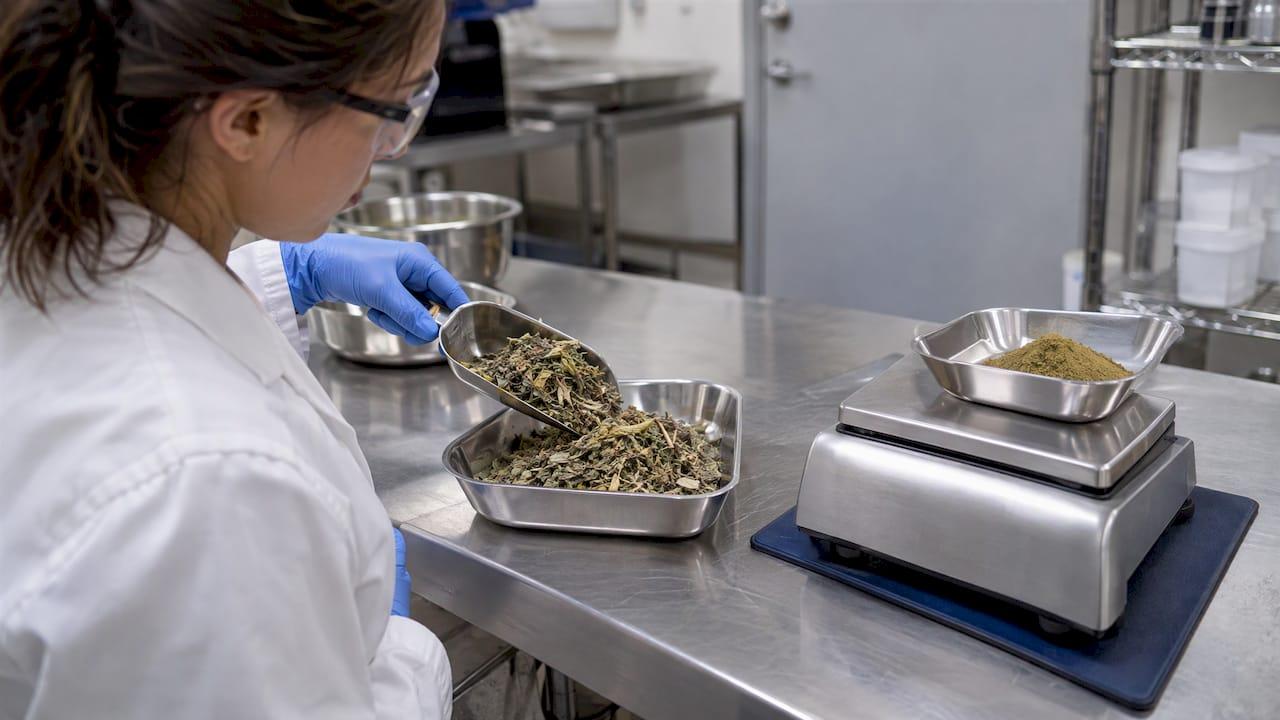
A botanical extract ratio such as 4:1 or 10:1 tells you how much dried plant went into making one unit of extract. It does not tell you how much extract is in a serving, and it does not tell you how much of any active compound you get. On a US label those are separate facts, and the federal rule for the Supplement Facts panel centers on the weight of the ingredient per serving, with the ratio as supporting detail. If you shop for supplements, this article shows you how to read the number. If you formulate, it shows you how to declare it. Our free Supplement Facts label creator is built for the second job.
TL;DR
- A ratio like 4:1 means roughly four units of dried plant for each unit of finished extract. The first number is the plant, the second is the extract.
- The Supplement Facts panel declares the weight of the extract per serving in metric units. The ratio is optional context for liquid extracts, not a replacement for that weight.
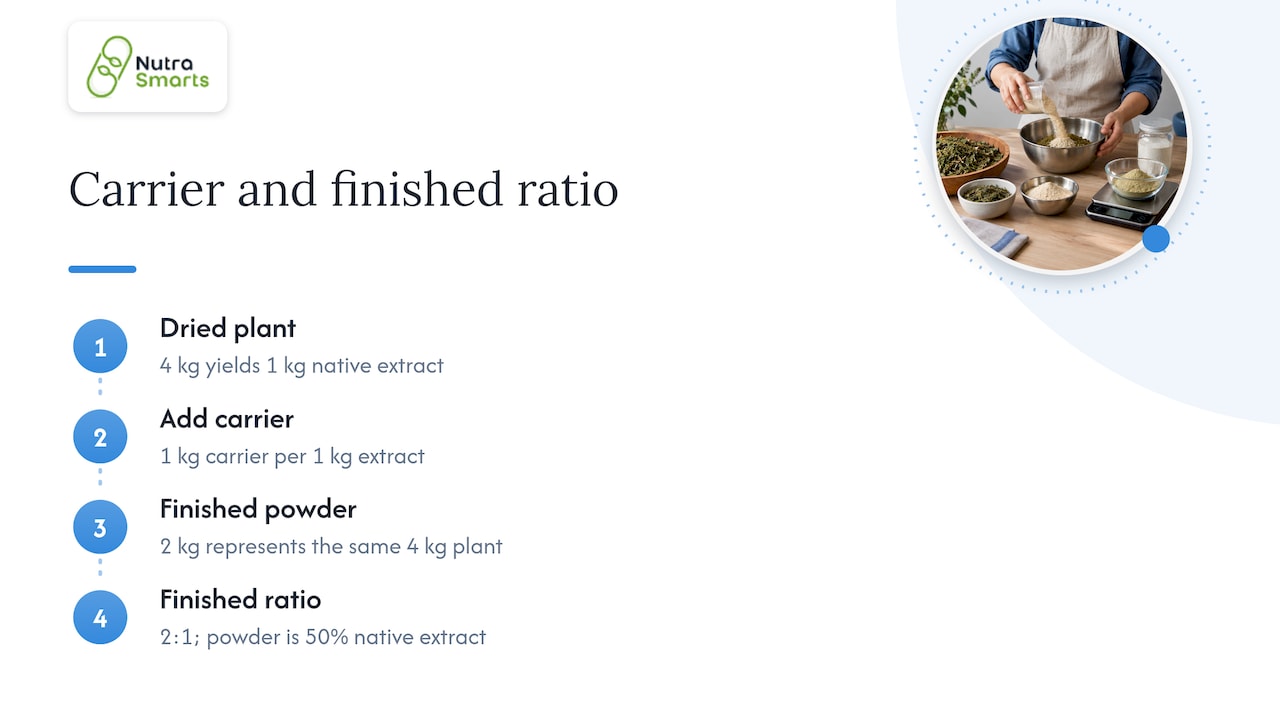
- Carriers change the math: adding 1 kg of carrier to each kg of a 4:1 native extract makes the finished extract 2:1.
- A higher ratio is not a stronger or better extract. Ratios describe yield from a given process, not marker compounds or clinical effect.
- Labels with a ratio work best when they also name the plant part, solvent and any added excipients.
Table of Contents
- What a botanical extract ratio actually says
- Why a bigger ratio is not a better extract
- Worked example: how a carrier changes the ratio
- How FDA rules handle extracts on the Supplement Facts panel
- What else should sit next to the ratio
- A reading checklist for shoppers and coaches
- A labeling workflow for formulators
- Putting the panel together
- Build the panel without a spreadsheet
- Our perspective
- FAQ
- Sources
What a botanical extract ratio actually says
A plant is dried, soaked or percolated in a solvent such as water or ethanol, and the liquid is concentrated. The ratio compares what went in with what came out. Under AHPA's 2000 retail-labeling guidance (AHPA is the American Herbal Products Association, the trade body for the herbal industry), the first number is the dried starting material and the second is the finished total extract. A 4:1 extract holds the extractives of four units of dried plant for each unit of finished extract.
A 2022 academic review adds a useful detail: a native 10:1 dry extract means roughly 10 g of dried raw material produced 1 g of native extract, not counting carriers. The calculation should be done on a dried basis even if fresh plant was used, because fresh material is mostly water.
Two terms matter here:
- Native extract: the extract itself, before anything is added to it.
- Excipient or carrier: an added ingredient, such as maltodextrin or a flow agent, that makes the powder easier to handle.
Ratio versus amount per serving
These answer different questions. The ratio describes concentration. The amount per serving describes how much of the extract you swallow. A capsule with 500 mg of a 4:1 extract and a capsule with 500 mg of a 10:1 extract contain the same weight of extract. They do not necessarily contain the same amount of plant-derived material, and neither number alone says how much of any compound is present.
Why a bigger ratio is not a better extract
The most common misconception, according to a 2022 Frontiers in Pharmacology review, is that a higher ratio means a stronger extract. A ratio describes yield from a given raw material under a given process. For most dry botanicals extracted with water or water-ethanol mixtures, typical yields are 10 to 25%, which corresponds to ratios from 10:1 to 4:1.
The same review notes that raw-material quality, solvent, extraction time and temperature, and the share of excipient all shape what ends up in the extract. Two products both labeled 5:1 can differ in their chemistry.
That is why standardization exists. A standardized extract is adjusted to a defined content of a marker compound, which is a chemical used as a reference point for quality. Even so, AHPA's standardization guidance cautions that marker content on its own does not guarantee a standardized product or its potency. The practical reading: use the ratio for what it is, a statement about starting material, and look at marker percentages and the evidence behind the dose for the rest.
Worked example: how a carrier changes the ratio
Suppose a manufacturer buys a 4:1 native extract. That means 4 kg of dried plant per 1 kg of extract. The manufacturer blends in 1 kg of carrier for every 1 kg of extract, so 2 kg of powder now represents the same 4 kg of plant. Per kilogram of finished powder, that is 2 kg of plant, so the finished ratio is 2:1 and the powder is 50% native extract. The Frontiers/PMC review uses this same example.
This is why a ratio on its own can mislead. If you see "4:1" on a label and the product is half carrier, you may be assuming twice the plant equivalence that is actually there. For a fair comparison between two products, you need the percent native extract and the identity of the excipients.
The same review points out that conventions differ. AHPA's convention counts carriers in the finished-extract figure, which matches how bulk extracts are bought and sold by total weight. The European convention for the drug-extract ratio excludes excipients. So the same physical powder can carry different ratios depending on the convention used. For a US label, state which basis you are using.
How FDA rules handle extracts on the Supplement Facts panel
The controlling text is 21 C.F.R. § 101.36, the FDA regulation on nutrition labeling of dietary supplements. For a dietary ingredient without a Daily Value, the panel lists the common or usual name and the quantity by weight per serving in metric units. It is the weight of the ingredient as listed, not of a component or its source.
Solid and powdered extracts
When the solvent has been removed, the weight declared is the weight of the dried extract. This is the figure that belongs in the amount column. Any ratio, range or standardization detail is supporting information that helps buyers understand what the extract is made from.
Liquid extracts
The rule is more specific here. According to § 101.36(b)(3)(ii), for a liquid extract whose solvent has not been removed, the quantity is the volume or weight of the total extract. Fresh starting material must be indicated. Concentration and solvent information may be shown, in a format like "fresh dandelion root extract, x (y:z) in 70% ethanol."
If the solvent has been partially removed, not to dryness, the final concentration is stated. The regulation's own example: an original 1:5 extract with half the solvent removed is stated as 1:2.5. Any solvent not named on the panel goes in the ingredient statement under § 101.4(g). Readers who want the full mechanics of declaring liquid botanical extracts in this format will find a guide to FDA requirements for liquid botanical extract declarations helpful alongside the regulation.
The 2025 edition of Subpart C of 21 C.F.R. Part 101 carries these same provisions.
Ranges and averages
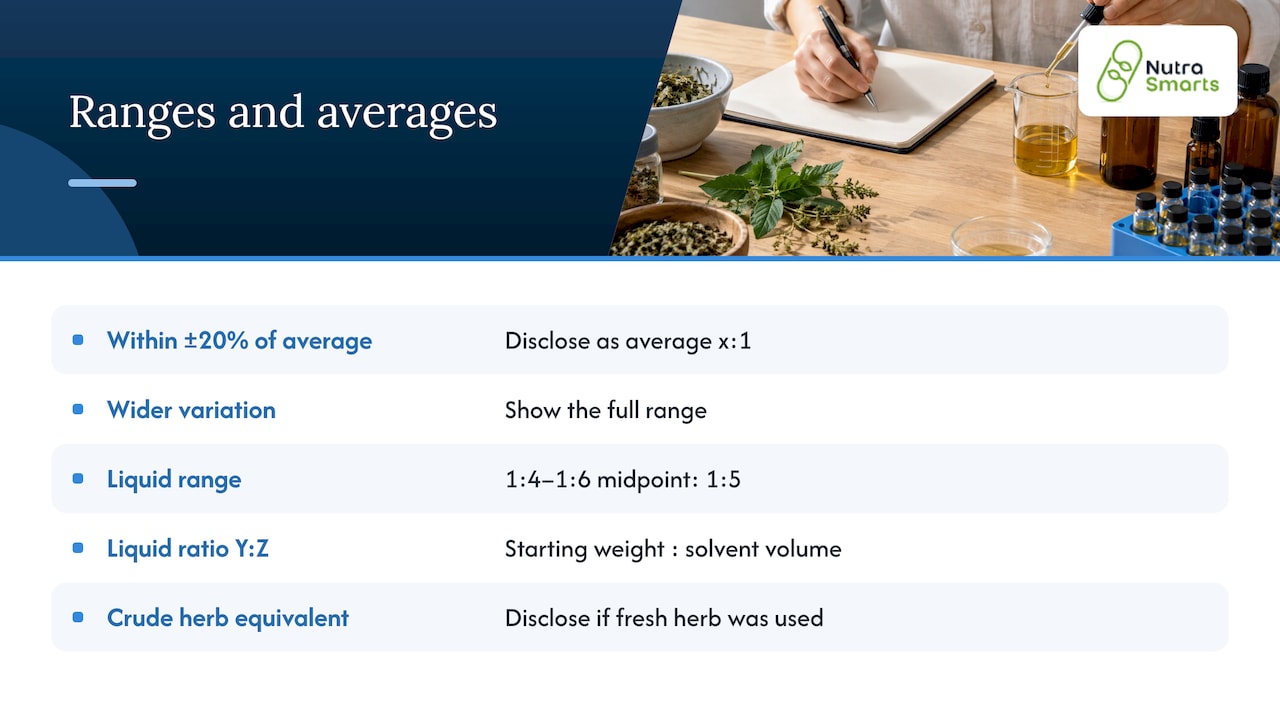
Batches vary. AHPA's 2000 guidance allows a lot-to-lot range ("x–y:1") or an average, provided the range does not vary more than ±20% from the stated average and the label discloses the figure as an average ("average x:1" or "av. x:1"). If the variation is wider, the full range should be shown. For liquid extracts, AHPA's 2022 liquid extract guidance says that where manufacturing allows a range such as 1:4 to 1:6, labels usually state the midpoint, 1:5.
That guidance also defines a liquid ratio as Y:Z, where Y is the weight of starting material and Z is the volume of solvent. It recommends that any "crude herb equivalent" statement disclose when fresh herb was used, and that labels avoid phrasing like "equivalent to X amount of herb" or "contains X amount of herb." It also notes that some FDA districts have taken the position that ratios cannot appear in the Supplement Facts box unless they are testable, a view AHPA opposes, citing § 101.36(b)(3)(ii)(B), which provides for ratio disclosure from batch-record data without a test.
What else should sit next to the ratio
A ratio is only interpretable with context. USP General Chapter <565> on botanical extracts, quoted in the Frontiers review, asks labels to indicate:
- the plant part used
- any solvent other than a hydroalcoholic one
- the percentage of active principles or marker compounds
- added preservatives
Where active principles are unknown, the starting-material-to-final-product ratio is stated. For semisolid or powdered extracts, the identity and amount of added excipients and the percent native extract may be stated too.
For a US label, plant part is also a labeling question in its own right, covered in our guide to botanical part labeling on supplement labels. A root extract and a leaf extract of the same species are different ingredients.
A reading checklist for shoppers and coaches
When you hold a bottle with an extract ratio, run through these in order:
- Find the plant and the part. A Latin name and a part (root, leaf, seed) tell you what the ratio refers to.
- Find the amount per serving. This is the weight of the extract, in milligrams, and the figure you compare against clinical doses.
- Check for a percent native extract or listed excipients. Without it, you cannot convert the ratio into plant equivalents.
- Look for a marker percentage. A standardized extract names the compound and its percentage.
- Compare against studied doses. Trials usually test a specific extract at a specific dose, so match the extract, not just the plant name.
Our ingredient database lists clinical dosages and the studies behind each ingredient, and the guide on how to decode supplement ingredient labels walks through the rest of the panel.
A labeling workflow for formulators
If you are writing the label, the order of decisions matters.
- Decide what you declare. For a solid extract, it is the dried-extract weight per serving. For a liquid extract with solvent retained, it is the volume or weight of total extract.
- Pull the ratio from your batch records. The ratio comes from the weight of starting material and the weight or volume of finished extract. Record whether the starting material was fresh or dried, and calculate on a dried basis for solid extracts.
- Account for carriers. If you add excipients, state the percent native extract or recalculate the finished ratio, as in the 4:1 to 2:1 example above.
- Handle variation honestly. Use an average within ±20%, labeled as an average, or show the full range.
- Name the solvent. If it is not on the panel, it goes in the ingredient statement.
- Keep identity documentation. A 2026 compendial review in the Journal of Natural Products explains that USP monographs use at least two complementary identification tests, such as microscopy or chemical fingerprinting against a reference standard. An ingredient claiming USP compliance that fails those identity standards must be deemed adulterated, misbranded or both.
- Describe extracts consistently in any notification. FDA's new dietary ingredient guidance recommends that descriptions of extract ingredients include the concentration or dilution ratio of the finished extract against the original starting material, disclose when the ratio is based on fresh rather than dried herb, and list added ingredients and solvents with residual-solvent specifications.
Botanicals are mixtures that vary with geography and environment, so a safety paper from the Consumer Healthcare Products Association stresses confirming the identity, purity and composition of source material and understanding variability from harvest and preparation. The ratio on your label is only as good as the records behind it.
Putting the panel together
The ratio is one line among many. Panel format, serving size, the disclaimer and type size all have their own rules. Our walkthroughs cover them: the FDA supplement label requirements checklist for 2026, the guide to generating a Supplement Facts panel, and the explainer on supplement label font requirements. If you are revising an existing label, start with updating label compliance.
Build the panel without a spreadsheet
The NutraSmarts Supplement Facts label creator is free, runs in your browser and is built to produce an FDA-compliant label, so you do not have to maintain a spreadsheet of serving sizes and amounts. Enter the extract weight per serving and the rest of the panel follows the format.
Try it at the free Supplement Facts label creator. To check which dose of an extract the research has actually tested, search the ingredient database.
Our perspective
We built NutraSmarts around a simple idea: a number on a label should be traceable to evidence. An extract ratio is a good example. It is a real and useful number, and it answers one question, how much plant went into the extract. Where people go wrong is asking it to answer questions about potency or clinical effect, which it was never designed to answer.
That is why our ingredient profiles pair each ingredient with its clinical trial citations and dosage benchmarks, so you can compare a label against the extract and dose that was studied. For formulators, our free label creator exists so that the panel itself is one less thing to wrestle with, and your attention goes to getting the extract declaration and the documentation behind it right.
Our advice to anyone writing or reading these labels is the same: pair every ratio with the plant part, the percent native extract, the solvent and the amount per serving. With those five details, the ratio becomes informative instead of decorative.
NutraSmarts
FAQ
Does a 10:1 extract contain more active compound than a 4:1 extract?
Not necessarily. A ratio describes how much dried plant was used per unit of extract, and the 2022 Frontiers review calls the higher-is-stronger idea the most common misconception. Active content depends on the plant, solvent, process and any added carriers, so look for a marker percentage and the studied dose.
Is the ratio required on the Supplement Facts panel?
The required element is the quantity of the ingredient by weight per serving in metric units. For liquid extracts, 21 C.F.R. § 101.36(b)(3)(ii) says concentration and solvent information may be shown, which makes the ratio optional supporting detail. After partial solvent removal, the final concentration is stated.
What if my ratio changes from batch to batch?
AHPA's 2000 guidance allows an average if the range stays within ±20% of it and the label says it is an average, such as "average 4:1." If variation is wider, show the full range. For liquid extracts, labels usually state the midpoint of the allowed range.
Why do two 4:1 extracts of the same plant differ?
The ratio says nothing about solvent, extraction time, temperature, raw-material quality or excipient share. Those all shape the final composition, so a matching ratio does not establish equivalence. Comparing extracts takes the percent native extract, the solvent and the process, and sometimes chemical fingerprinting.
Sources
- AHPA, Retail Labeling of Dietary Supplements Containing Soft or Powdered Botanical Extracts (2000)
- Understanding plant to extract ratios in botanical extracts (PMC, 2022)
- Frontiers in Pharmacology, Understanding plant to extract ratios (2022)
- AHPA, Standardization (2003)
- eCFR, 21 C.F.R. § 101.36
- 21 C.F.R. Part 101 Subpart C, 2025 edition (govinfo)
- AHPA, Liquid Extract Specifications for cGMP (2022)
- Compendial Perspectives on Botanical Identity Testing, Journal of Natural Products (2026)
- FDA, New Dietary Ingredient Notifications and Related Issues
- CHPA, Safety considerations for dietary supplement manufacturers (2024)