
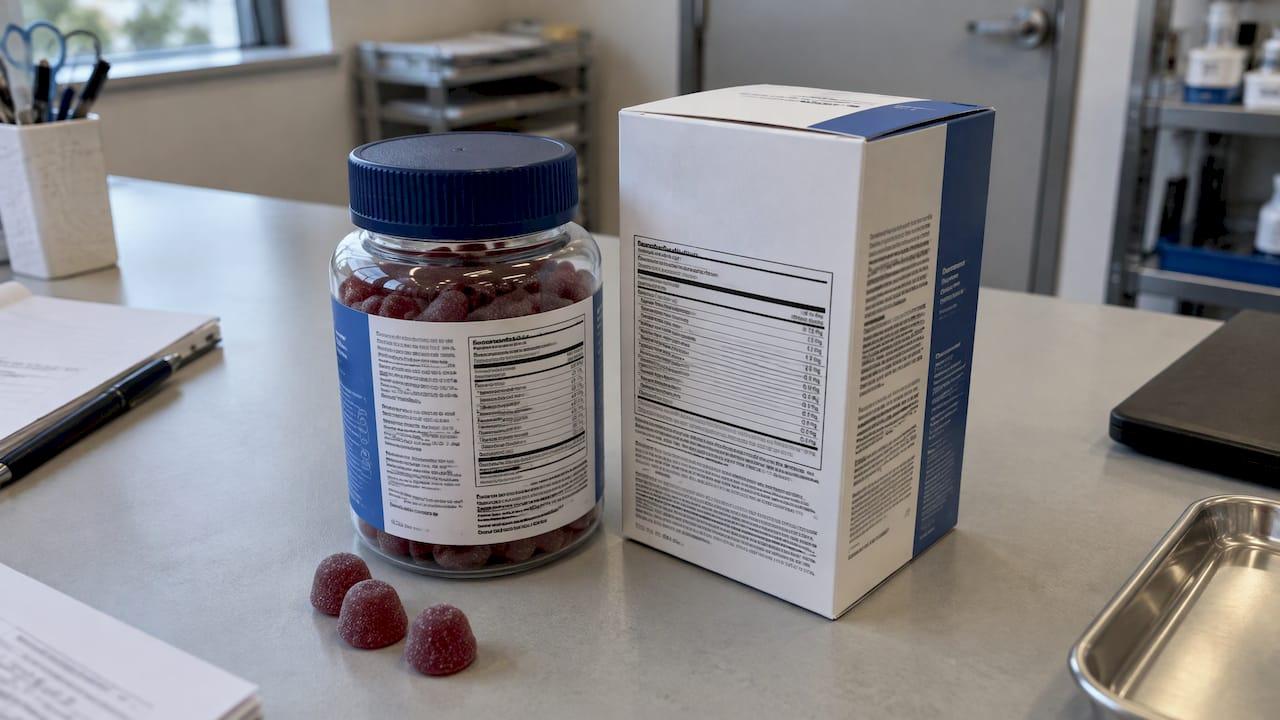
A gummy supplement follows the same federal label rules as a capsule or tablet, plus a few details that matter more for a chewable candy-like product: how you list gelling agents and sweeteners, how you declare added sugars, and how you word child-safety statements. This guide walks through each requirement in the order you meet it when building a label, so you can check a label you are designing or read one you are about to buy.
We built the free Supplement Facts Label Creator for exactly this job, and the sections below show where each rule lands in the panel it produces.
TL;DR
- FDA treats gummies as a dietary supplement form, so five statements are required: identity, net quantity, Supplement Facts, ingredients, and the name and place of business.
- The statement of identity must include the words "dietary supplement" (or a variant such as "calcium supplement") on the front panel.
- Gummy sweeteners, gelling agents and flavors that are not in the panel go under "Other Ingredients"; sugars appear as Total Sugars with Added Sugars indented beneath.
- Solid oral supplements with iron need a boxed child-poisoning warning; industry guidelines for gummies add chewing and age-group statements.
- Structure/function claims need the FDA disclaimer and a notification to FDA within 30 days of first marketing.
Table of Contents
- Which rules apply to gummies
- The five required statements
- Building the Supplement Facts panel for a gummy
- Sugars and added sugars in gummies
- Other Ingredients: where gelling agents and flavors go
- Type size, contrast and layout
- Warnings that matter for gummies
- Claims and the FDA disclaimer
- A pre-print checklist for a gummy label
- Check ingredients with evidence before you print
- Build the panel without a spreadsheet
- Our perspective
- FAQ
- Sources
Which rules apply to gummies
FDA's consumer Q&A lists gummies among the forms a dietary supplement can take, alongside tablets, capsules, powders and liquids. That means gummies are labeled under the dietary supplement provisions of the food labeling regulations (21 CFR Part 101), not as candy and not as a drug. No FDA label approval is required before distribution, which puts the responsibility for getting every line right on the firm that sells the product. FDA's Questions and Answers on Dietary Supplements summarizes this.
The practical consequence: a gummy label has to do two jobs. It has to meet the supplement rules (a Supplement Facts panel, a supplement identity statement, a claims disclaimer) and it has to handle the food-like ingredients that make a gummy a gummy.
For a longer pass through the whole label, our FDA supplement label requirements checklist covers every panel, not only gummy points.
The five required statements
FDA's Dietary Supplement Labeling Guide, Chapter I lists five statements every supplement label needs:
- Statement of identity, the product name in terms of what it is.
- Net quantity of contents, such as the count of gummies.
- Nutrition labeling, the Supplement Facts panel.
- Ingredient list, for anything not already in the panel.
- Name and place of business of the manufacturer, packer or distributor.
Placement matters. The Supplement Facts panel, ingredient list and business name belong on the information panel, which is the panel immediately to the right of the principal display panel (the front), unless you put them on the front. FDA also says no intervening material, such as a UPC bar code, should separate those required statements.
Statement of identity
The identity statement must include the term "dietary supplement." Chapter II of the Labeling Guide allows "dietary" to be swapped for the ingredient or type, so "Vitamin D3 Gummies, a vitamin D supplement" works. It sits on the principal display panel in bold type reasonably related to the most prominent printed matter, in lines generally parallel to the base of the package. A front panel that shows only a flavor and a brand slogan fails this check.
Name and place of business
The label must name the firm responsible for the product and its location. The ODS consumer fact sheet gives the same list of required label content in plain language: product name including "supplement," net quantity, manufacturer name and place of business, and directions for use.
Building the Supplement Facts panel for a gummy
The panel is governed by 21 CFR 101.36. It opens with "Serving Size" and "Servings Per Container" (the latter can be omitted if stated in the net quantity), then lists the dietary ingredients present above the zero-declaration thresholds, with amounts by weight and % Daily Value where one is established.
Serving size
FDA's guide says the serving size is the maximum amount recommended per eating occasion, or one unit when no recommendation is given, and the words "Serving Size" must be used exactly. For gummies this is where many labels go wrong: if the directions say "take two gummies," every number in the panel is per two gummies, not per gummy. FDA also states that there is no regulation limiting the serving size or the amount of an ingredient per serving; the manufacturer decides, subject to safety and labeling rules. Our serving size rules explainer goes deeper on how to set one.
Formulators who source raw ingredients for a gummy should also settle quality documentation with suppliers before fixing amounts; one resource on choosing a supplier with a USP RFQ outlines that request process.
Vitamin and mineral order and units
Under 101.36(b)(2)(i), vitamins and minerals appear in a fixed sequence: vitamin A, C, D, E, K, thiamin, riboflavin, niacin, B6, folate, B12, biotin, pantothenic acid, choline, then minerals from calcium through potassium and fluoride. Amounts are the weight of the nutrient itself, so you declare calcium, not calcium carbonate, though the source can appear in parentheses. Vitamin D is declared in mcg, with IUs optional in parentheses.
FDA's guidance on Supplement Facts labels gives recommended rounding increments, for example vitamin D to the nearest 0.1 mcg, iron to the nearest 0.1 mg and calcium to the nearest 10 mg, as long as the precision does not exceed what the analytical method can support.
What differs from a Nutrition Facts panel
Chapter IV of the Labeling Guide sets out the main differences. Supplements may list dietary ingredients that have no RDI or DRV, may show the source ingredient ("Calcium (as calcium carbonate)"), must name the plant part for botanicals, and must not list nutrients at "zero." Ingredients without a Daily Value are listed by common name with weight per serving and a symbol indicating the Daily Value is not established.
Botanical gummies (elderberry, ashwagandha, turmeric) need the plant part. The ODS fact sheet adds that botanicals carry a scientific name, and that a proprietary blend shows total blend weight with components in order of predominance by weight.
The 2016 panel changes
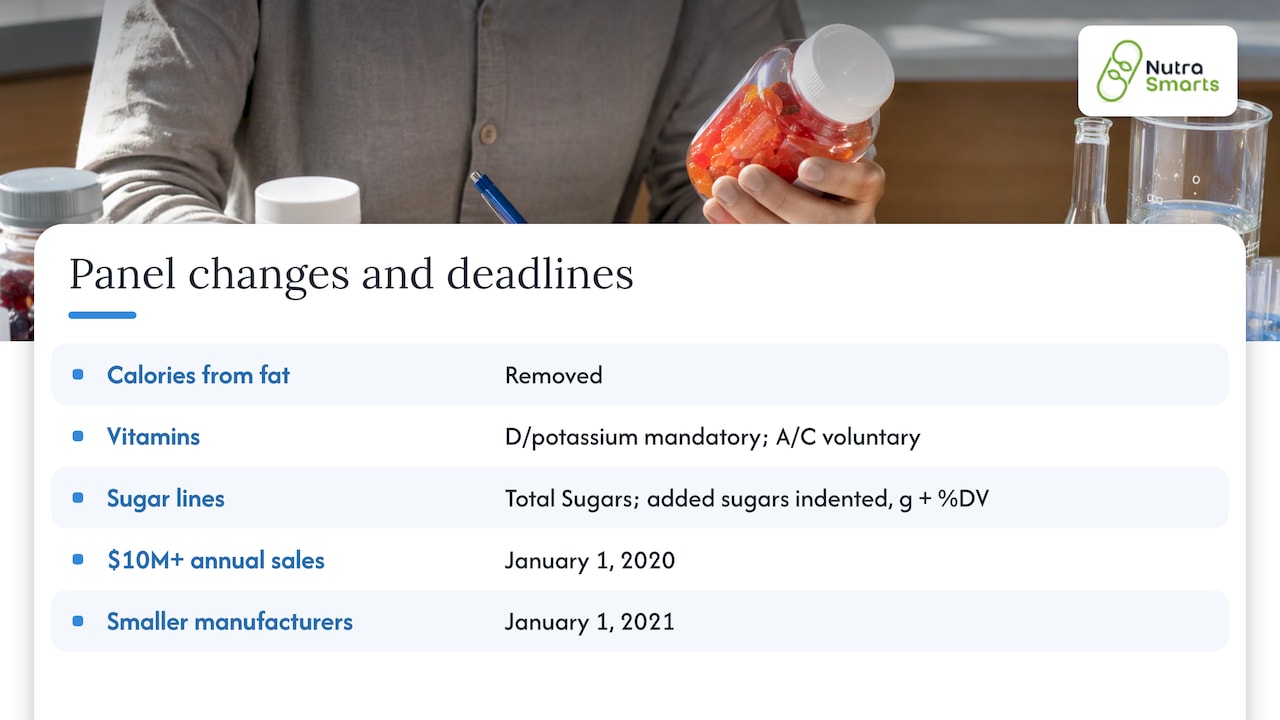
The May 2016 final rule removed "Calories from fat," made vitamin D and potassium mandatory while vitamins A and C became voluntary, and required added sugars in grams with a %DV. "Sugars" became "Total Sugars," with "Includes X g Added Sugars" indented below it. A 2018 rule set the compliance dates at January 1, 2020 for manufacturers with $10 million or more in annual food sales and January 1, 2021 for smaller ones. Any gummy label printed today should use the updated format. For layout and edge cases, see our guide to generating a Supplement Facts panel.
Sugars and added sugars in gummies
Sugar is the line a gummy buyer looks at first. FDA's guidance defines added sugars as sugars added during processing or packaged as such, including sugars from syrups, honey, and concentrated fruit or vegetable juice beyond what 100% juice would give. The manufacturer determines which ingredients contribute added sugars. A gummy made with glucose syrup, sucrose and fruit juice concentrate will usually show both Total Sugars and Added Sugars lines, with the added sugars indented.
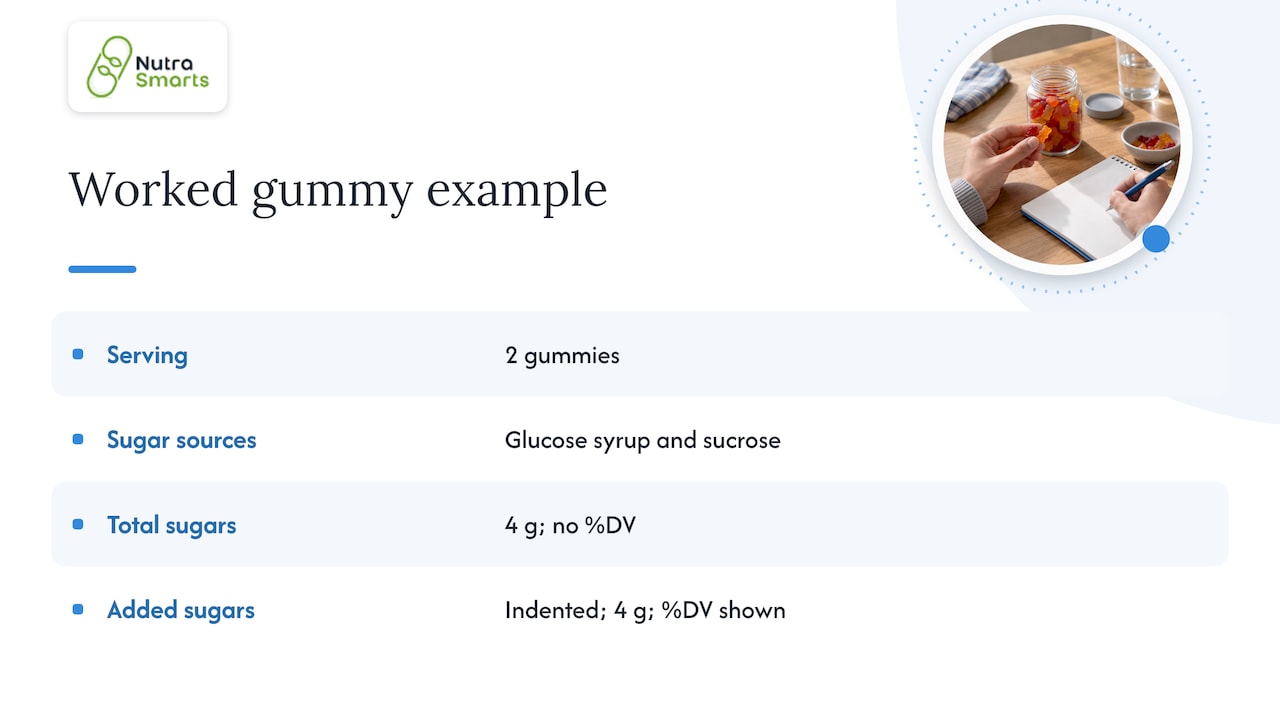
Here is a worked example. A two-gummy serving contains 4 g of sugar from glucose syrup and sucrose. The panel reads Total Sugars 4 g, with "Includes 4 g Added Sugars" beneath it and a %DV for added sugars. Total Sugars carries no %DV, but added sugars do. If your gummy is sweetened with a sugar alcohol or a non-nutritive sweetener, those go in the ingredient list, and the panel lines follow what is actually present above the declaration thresholds.
Other Ingredients: where gelling agents and flavors go
FDA's Q&A explains that anything not in the Supplement Facts panel is listed under "Other Ingredients" beneath it, and gives examples such as gelatin, starch, stabilizers, preservatives, flavors, water and sugar. For a gummy this is typically the longest part of the label.
Rules for the list, from Chapter V of the Labeling Guide:
- Head the list "Ingredients," or "Other Ingredients" when some ingredients appear as sources in the panel.
- List in descending order by weight.
- No separate statement is needed if every source ingredient is in the panel and there is nothing else, which almost never applies to a gummy.
A typical gummy list names the sweetener, the gelling agent (pectin or gelatin), acid, colors, flavors and a glazing agent, each by its common name and in weight order.
Type size, contrast and layout
Per 21 CFR 101.36(e), the panel uses one easy-to-read type style, black or one color on a contrasting background, an 8-point minimum (6-point for column headings and footnotes, with exceptions for small and intermediate packages), a bold title larger than other text, hairlines between lines and specified heavy and light bars. Small gummy pouches and jars are exactly where these exceptions get used, so check which package-size category your container falls into. Our font requirements explainer lists the details, and the dual-column guide helps when a label declares separate adult and child serving sizes.
Warnings that matter for gummies
Iron
Under 21 CFR 101.17(e), a dietary supplement in solid oral dosage form that contains iron or iron salts must carry a boxed warning on the information panel. The text: "WARNING: Accidental overdose of iron-containing products is a leading cause of fatal poisoning in children under 6. Keep this product out of reach of children. In case of accidental overdose, call a doctor or poison control center immediately." Prenatal and multivitamin gummies with iron fall under this.
Child-safety statements
Gummies look and taste like candy, so the Council for Responsible Nutrition adopted voluntary gummy labeling guidelines in March 2024. They recommend:
- stating the intended age group;
- "Keep out of reach of children" and "Take only as directed" or "Do not exceed recommended intake";
- instructing children to fully chew each gummy before swallowing;
- for products intended for children under 4, adding that the product is a potential choking hazard if not chewed properly.
These are voluntary, not federal law, but they are straightforward to include and make the label clearer for parents.
Claims and the FDA disclaimer
FDA's Q&A says labels may carry health claims, structure/function claims and nutrient content claims, each with its own requirements. General well-being claims and claims about classical nutrient deficiency diseases follow the structure/function rules. A gummy that says "supports immune health" or "supports hair, skin and nails" is making a structure/function claim, which requires three things:
- The disclaimer: "This statement has not been evaluated by the Food and Drug Administration. This product is not intended to diagnose, treat, cure, or prevent any disease." (21 U.S.C. 343(r)(6)(C); 21 CFR 101.93).
- Substantiation that the claim is truthful and not misleading.
- Notification to FDA no later than 30 days after first marketing, on Form FDA 3955.
A Federal Register notice of July 29, 2025 confirms the process: submission electronically through FDA's FARM system or on paper, including the firm's name and address, the claim text, the ingredient or supplement name, the product name with brand, and a signature certifying the firm has substantiation. FDA estimated 3,690 annual respondents. Our guides on the disclaimer requirement and on proving structure/function claims go into wording and evidence files.
A disease claim ("relieves joint inflammation from arthritis") is outside what a supplement label may say, and no disclaimer fixes that.
A pre-print checklist for a gummy label
- Identity statement with "dietary supplement" or a variant, bold, on the front panel.
- Net quantity stated as a count.
- Serving size matching the directions; servings per container.
- Ingredients in the fixed order, in correct units, with vitamin D in mcg.
- Total Sugars and Added Sugars lines, with %DV for added sugars.
- Botanicals with plant part; blends with total weight.
- "Other Ingredients" in descending weight order.
- Iron warning if iron is present.
- Age group and child-safety statements.
- Disclaimer beside any structure/function claim, and the 30-day notice filed.
- Business name and place of business on the information panel.
Check ingredients with evidence before you print
The label tells the buyer what is in the gummy; it does not tell them what a dose should be. When you decide an amount per serving, our ingredient database gives clinical dosage benchmarks with PubMed-cited studies, and the side-by-side comparison guides help when choosing between two forms of the same nutrient. Consumers reading a gummy label can use how to read a Supplement Facts label to decode the same panel from the other side.
Build the panel without a spreadsheet
Our free, browser-based Supplement Facts Label Creator produces an FDA-compliant panel without spreadsheet formatting, with no sign-up or paywall. Enter your serving size and ingredients and use it as the starting point for the label you send to your printer.

For the full picture of what the rest of the label needs, see our FDA compliant label requirements guide.
Our perspective
Most gummy label errors we see discussed are not exotic. They are ordinary ones: a serving size that does not match the directions, sugars lumped into one line, an identity statement missing from the front panel. The rules are public, and they are learnable in an afternoon.
That is why we publish the rules next to the evidence. A label is a promise about what is in the product, and a dose is a promise about what it does. NutraSmarts is built so both can be checked: evidence-rated ingredient profiles with PubMed citations and clinical dosage benchmarks on one side, and a free Supplement Facts tool on the other.
Our view is that a compliant label and a well-chosen dose belong together. Formulators who set amounts from clinical research and then build the panel in the same place spend less time reworking labels, and consumers who read panels with the same reference in hand know what they are looking at.
NutraSmarts
FAQ
Do gummy vitamins need FDA approval before they are sold?
No. FDA states that label approval is not required to distribute a dietary supplement. The firm is responsible for the label being accurate and compliant. If the label makes a structure/function claim, the firm must notify FDA within 30 days of first marketing.
Does a gummy label have to say "dietary supplement"?
Yes. The statement of identity must include that term, or a variant where "dietary" is replaced by the ingredient or type, such as "vitamin C supplement." It goes on the principal display panel in bold type.
Where do the gelatin, pectin and sweeteners go on the label?
They go under "Other Ingredients" beneath the Supplement Facts panel, listed in descending order by weight. Sugars also appear in the panel as Total Sugars with Added Sugars indented below when present above the declaration thresholds.
Is the iron warning required on gummies?
Yes, when the gummy contains iron or iron salts. A dietary supplement in solid oral dosage form with iron must bear the boxed child-poisoning warning in 21 CFR 101.17(e) on the information panel.
Are the chewing and age-group statements mandatory?
They are voluntary guidelines from the Council for Responsible Nutrition, adopted in March 2024. They recommend age-group, keep-out-of-reach, take-as-directed and chewing statements, with a choking-hazard line for products intended for children under 4.
Sources
- Questions and Answers on Dietary Supplements, FDA
- Dietary Supplement Labeling Guide, Chapter I, FDA
- Dietary Supplement Labeling Guide, Chapter II, FDA
- Dietary Supplement Labeling Guide, Chapter IV, FDA
- Dietary Supplement Labeling Guide, Chapter V, FDA
- Nutrition and Supplement Facts Labels: Questions and Answers, FDA
- 21 CFR 101.36, eCFR
- 21 CFR Part 101, eCFR (April 28, 2025)
- Dietary Supplements consumer fact sheet, NIH Office of Dietary Supplements
- Federal Register, July 29, 2025 notice (90 FR 35695)
- Federal Register, May 27, 2016 final rule
- Federal Register, May 4, 2018 final rule
- Labeling of gummy dietary supplements, Council for Responsible Nutrition