

The strongest ods.od.nih.gov alternatives for scientifically validated dietary supplement information are a set of US government agencies, academic institutions, and research-backed platforms that each fill a different gap ODS leaves open. Here is the short list:
- National Center for Complementary and Integrative Health (NCCIH): Deep, science-based insights into botanical and integrative therapies
- MedlinePlus and PubMed: Trusted consumer health summaries plus access to millions of biomedical citations
- USDA FoodData Central: Detailed nutrient composition data including specialized epidemiologic datasets
- Harvard T.H. Chan School of Public Health's Nutrition Source: Evidence-based nutrition guidance reviewed by academic researchers
- Physicians Committee for Responsible Medicine (PCRM): Clinical nutrition tools with CME credits for practicing clinicians
- Nutrasmarts: A database linking over 800 ingredients to peer-reviewed studies, plus an FDA-compliant label creation tool
Each resource serves a distinct purpose. The sections below explain what each one actually does, where it falls short, and how to use them together.
Table of Contents
- Why do researchers and clinicians look beyond ODS?
- What each major US supplement database actually offers
- What Nutrasmarts offers that government databases do not
- How to use these resources together effectively
- Nutrasmarts gives you the research and the tools in one place
- Key Takeaways
Why do researchers and clinicians look beyond ODS?
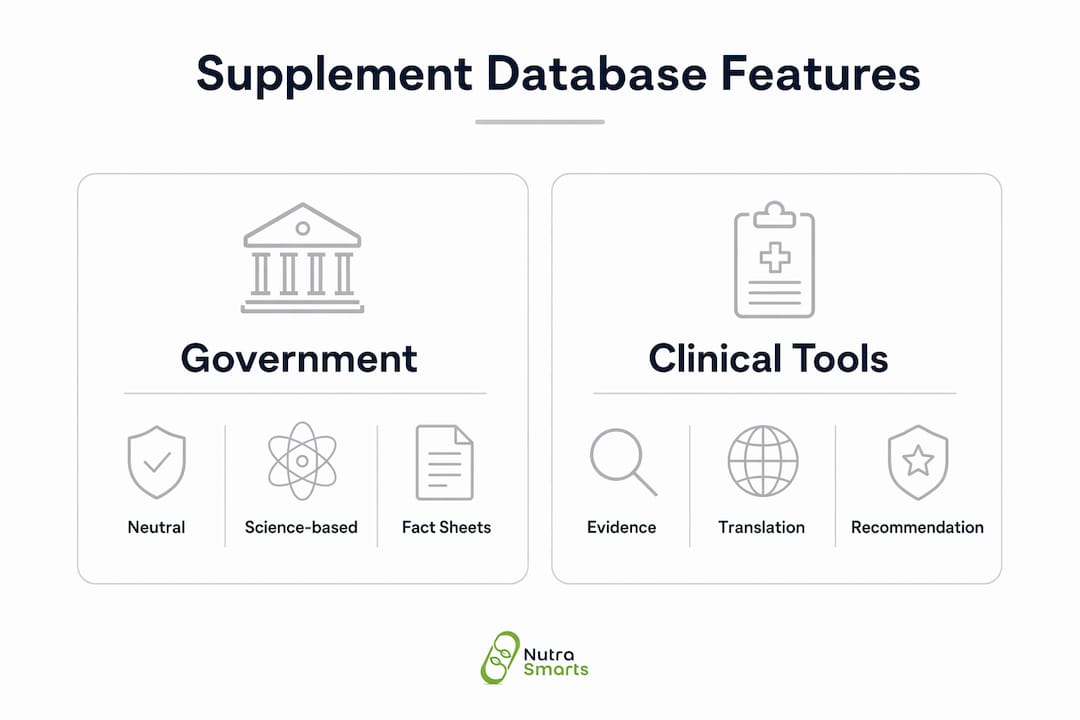
ODS is the lead federal entity for dietary supplement science, established under the Dietary Supplement Health and Education Act of 1994. Its fact sheets are thorough, neutral, and updated regularly. The problem is by design: ODS staff guidance makes clear the office does not offer medical endorsements or clinical recommendations. It tells you what the science says; it does not tell you what to do with it.
That gap drives most people to look for ods.nih.gov substitutes. Their specific needs tend to fall into a few categories:
- Clinicians need CME-approved education, clinical guidelines, and drug-nutrient interaction data they can act on with patients
- Formulators and manufacturers need FDA-compliant label generation tools, not just ingredient factsheets
- Consumers want personalized guidance tied to specific symptoms like fatigue, joint pain, or brain fog, not a neutral summary of population-level research
- Researchers need access to full biomedical literature and specialized nutrient composition datasets beyond what ODS hosts directly
- Regulatory professionals need label compliance features and up-to-date ingredient safety data in one place
ODS databases excel at neutral, science-based factsheets but require supplementation with clinical-grade tools for real-world application. That is not a flaw; it is a scope decision. The resources below pick up where ODS stops.
What each major US supplement database actually offers
Understanding the differences between these health supplement databases saves time and prevents the mistake of using a general resource for a specialized task.
-
NCCIH focuses specifically on botanical and integrative therapies, offering herb-specific fact sheets covering common names, uses, potential side effects, and research status. Its scope complements ODS's broader ingredient focus rather than duplicating it. Free, no registration required.
-
MedlinePlus provides consumer-friendly health summaries written and reviewed by the National Library of Medicine. PubMed sits alongside it as the full biomedical literature database, containing more than 35 million citations. PubMed is free and publicly available since 1996; full-text access depends on the publisher.
-
USDA FoodData Central maintains detailed nutrient composition data for foods consumed in the US, including specialized datasets for flavonoids, choline, iodine, fluoride, isoflavones, and glucosinolates. These datasets are particularly valuable for epidemiologic research. Free, no registration required.
-
Harvard T.H. Chan School of Public Health's Nutrition Source translates academic nutrition research into practical guidance. It covers macronutrients, disease prevention, dietary patterns, and food-specific research, reviewed by faculty researchers. Free, no registration required.
-
PCRM offers continuing medical education credits alongside its clinical nutrition tools, a feature absent from every standard government database. Its resources are built for practicing clinicians who need structured, evidence-based clinical guidance they can apply directly in patient care. Some CME content requires registration.
-
ClinicalTrials.gov, maintained by the National Library of Medicine, provides access to publicly and privately supported clinical studies across diseases and conditions. For supplement researchers tracking active trials on specific ingredients, it fills a gap that static factsheets cannot.
Pro Tip: When researching a botanical ingredient, cross-reference NCCIH's herb fact sheet with a PubMed search filtered to clinical trials. You get the safety overview and the primary literature in two steps.

What Nutrasmarts offers that government databases do not
Government databases are built for neutrality. Nutrasmarts is built for decisions. The platform links over 800 supplement ingredients to peer-reviewed studies and clinical trial citations, which means you are not just reading a summary; you are reading a summary with the evidence trail attached.
- Ingredient database with clinical citations: Each ingredient entry connects directly to the studies behind it, so professionals can evaluate the quality of evidence, not just the conclusion.
- FDA-compliant Supplement Facts label tool: The label creation tool generates accurate Supplement Facts panels without spreadsheets or manual formatting, which matters for formulators who need regulatory compliance built into their workflow.
- Symptom-targeted supplement search: Consumers can search by health concern, from joint pain to cognitive performance, and receive personalized supplement recommendations grounded in clinical evidence rather than marketing copy.
- Deficiency guides by group and symptom: The platform maps nutrient deficiency risk by population group (pregnancy, older adults, athletes) and by symptom, giving both clinicians and consumers a structured starting point.
For professionals who want to understand supplement efficacy evidence before recommending a product, Nutrasmarts connects the research layer to the practical layer in a way that static government databases are not designed to do.
How to use these resources together effectively
No single database covers every need. The most effective approach combines a foundational information source with a clinical translation tool, depending on your role.
- Start with ODS or NCCIH for a neutral overview of an ingredient's safety profile, recommended amounts, and known drug interactions before going deeper.
- Use PubMed to pull primary literature when the factsheet summary is not enough. Filter by study type (randomized controlled trial, systematic review) to prioritize the strongest evidence. Learning to evaluate supplement quality before reading a study makes this step faster.
- Cross-reference USDA FoodData Central when the question involves dietary sources of a nutrient rather than isolated supplementation.
- Use PCRM's clinical tools if you need CME credit or structured clinical guidelines. Combining foundational data with clinical guidelines is the standard for evidence-based supplement practice.
- Use Nutrasmarts when you need to move from research to action: generating a compliant label, identifying a supplement for a specific symptom, or checking a deficiency risk profile for a patient population.
- For international research context, the European Food Safety Authority (EFSA) publishes nutrient reference values and safety assessments for the EU market. These are not US regulatory standards, but they provide useful comparative data when evaluating ingredients with limited US trial data.
Practitioners who want a broader view of how these tools fit into clinical workflows can also explore holistic health platforms that integrate nutrition databases with practitioner-facing features. The key principle across all of these resources: ingredient transparency is the baseline, and clinical applicability is the goal.
Nutrasmarts gives you the research and the tools in one place
Most nutrition information sites hand you the data and leave the rest to you. Nutrasmarts is built differently. Its database of over 800 clinically studied ingredients, paired with an FDA-compliant label tool and symptom-based supplement search, covers the full path from research to regulatory compliance.
If you are a clinician looking for evidence behind a specific ingredient, a formulator who needs a compliant label without the spreadsheet headache, or a consumer trying to match a supplement to a real health concern, the platform is built for exactly that. Browse supplements by symptom to find options backed by clinical evidence for your specific concern, or use the free label tool to generate a Supplement Facts panel that meets FDA requirements.
Key Takeaways
The most effective approach to supplement research combines neutral government databases with clinical translation tools and a platform that connects evidence directly to practice.
| Point | Details |
|---|---|
| ODS is non-prescriptive by design | ODS provides neutral, science-based factsheets but does not offer clinical recommendations or label tools. |
| NCCIH, PubMed, and USDA fill specific gaps | NCCIH covers botanicals, PubMed provides primary literature access, and USDA FoodData Central offers nutrient composition datasets. |
| PCRM adds clinical education | PCRM offers CME credits and clinical nutrition tools that standard government databases do not provide. |
| Combine resources by task | Start with ODS or NCCIH for safety overviews, then use PubMed for primary evidence and clinical tools for application. |
| Nutrasmarts bridges research and practice | Nutrasmarts links over 800 ingredients to peer-reviewed studies and includes an FDA-compliant label creation tool and symptom-based supplement search. |