
A supplement can carry an organic claim only if it follows the USDA's National Organic Program (NOP) rules. Those rules set the claim by the share of organic ingredients: 100 percent, at least 95 percent, or at least 70 percent. The USDA seal is allowed on only the top two tiers. If you are a shopper, the claim tells you how the product was made and handled, not how well it works. If you are a formulator, the claim is a certification question before it is a design choice.
TL;DR
- Three claim tiers exist: "100 percent organic" (all ingredients), "organic" (95% or more), and "made with organic" (70% or more). Below 70%, organic ingredients may only be identified in the ingredient list.
- The USDA seal is allowed only on "100 percent organic" and "organic" products. "Made with organic" products may not carry it.
- Capsule weight counts toward the percentage, so many capsule products can only make a "made with organic" claim.
- The FDA does not regulate the word "organic." The USDA does. A compliant label must satisfy both agencies.
- You can check a certified operation in the public Organic Integrity Database and report a suspected violation to USDA's Agricultural Marketing Service (AMS).
Table of Contents
- Who regulates the word "organic" on a supplement
- The four labeling categories
- When certification is required
- The seal itself
- What an organic claim does and does not tell you
- Checking a claim before you buy or build on it
- What changed with Strengthening Organic Enforcement
- Putting it on a label
- Build the Supplement Facts panel
- Our perspective
- FAQ
- Sources
Who regulates the word "organic" on a supplement
Two agencies touch a supplement label, and they split the work. According to the FDA, it does not regulate the term "organic" on food labels. The USDA's National Organic Program does. Products under FDA jurisdiction that make organic claims must comply with both sets of rules. The FDA also says the USDA regulates the use of "organic" on dietary supplements through the NOP.
This was not always obvious to the industry. A 2018 industry guidance document reports that in August 2005 the NOP announced that any agricultural product meeting its standards can be labeled organic regardless of end use. Herbs, and vitamins or minerals sourced from organically produced plants or animals, can therefore carry the claim if they meet the regulation.
The organic claim sits beside the rest of the label. The FDA requires a product name, a "dietary supplement" statement, the name and place of business of the manufacturer or distributor, a Supplement Facts panel, an other-ingredients list, net quantity and a domestic address or phone number for reporting serious adverse events, as laid out in its dietary supplement Q&A. Our FDA supplement label requirements checklist walks through those elements one by one.
The four labeling categories
The percentage rules sit in 7 CFR 205.301, and USDA summarizes what each tier may display on its Labeling Organic Products page.
| Claim | Organic content | USDA seal | What the front panel may say |
|---|---|---|---|
| 100 percent organic | 100% organic ingredients, excluding water and salt | Allowed | The term, the seal and the certifier's mark |
| Organic | At least 95% organic; up to 5% nonorganic agricultural or National List ingredients | Allowed | The term, the seal and the certifier's mark |
| Made with organic (ingredient or food group) | At least 70% organic | Not allowed | Up to three organic ingredients named on the front panel |
| Specific organic ingredients | Under 70% organic | Not allowed | No organic term on the front panel; organic ingredients identified only in the ingredient statement, with the percentage on the information panel |
Two details trip people up. First, water and salt are excluded from the math and can never be identified as organic. Second, products labeled "organic" must identify each organic ingredient in the ingredient statement, as 7 CFR 205.303 spells out.
How the percentage is calculated
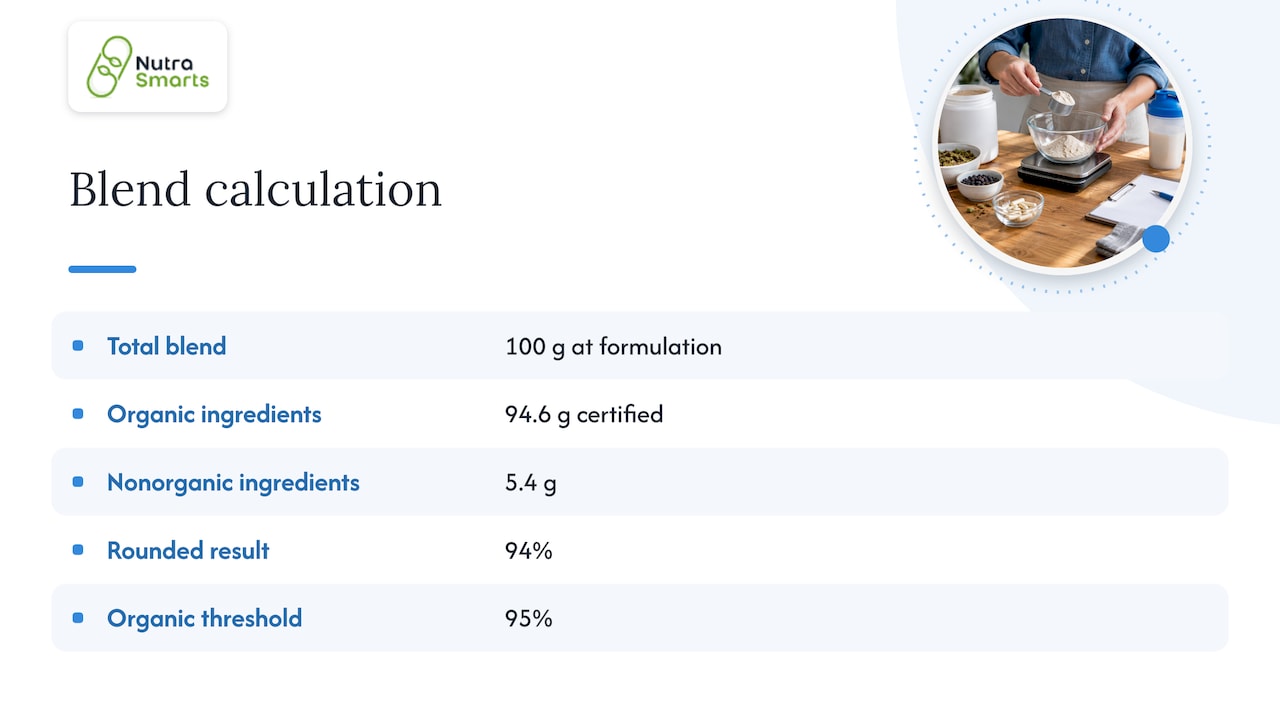
Per 7 CFR 205.302, you divide the net weight of the combined organic ingredients at formulation by the total weight of all ingredients at formulation, excluding added water and salt. The result is rounded down to the nearest whole number. The handler who affixes the label determines it, and the handler's certifying agent verifies it.
A worked example: a powder blend weighs 100 g at formulation, with 94.6 g from certified organic ingredients and 5.4 g nonorganic. The result is 94.6 percent, which rounds down to 94. That blend cannot be labeled "organic." It can use "made with organic" and name up to three organic ingredients on the front panel. Rounding down is the rule, and it catches formulas that look like they clear 95.
Why capsules change the answer
Capsules are where supplement formulas most often fall short. Industry guidance from the AHPA, QAI and OTA states that capsule weight counts toward the organic percentage. Because a capsule shell often weighs more than the 5% nonorganic allowance, most capsule products can only make a "made with organic" or ingredient-panel claim. To reach "organic," the capsule itself, such as gelatin or pullulan, has to be certified organic.
The same guidance covers nonorganic agricultural substances on the National List (7 CFR 205.606). They can appear in an "organic" supplement only after the manufacturer shows its certifier that the substance is not commercially available in organic form.
When certification is required
USDA does not certify operations directly. It accredits private, foreign and state certifying agents, who decide whether an operation complies, inspect it, and can suspend or revoke certification, according to the National Ag Law Center's legal guide to the NOP. The certificate of organic operation documents the result.
The USDA's Strengthening Organic Enforcement FAQ says any operation that produces or handles organic agricultural products must be certified, unless exempt. "Handle" is broad: it includes selling, processing, packaging, combining, storing, labeling, importing and exporting. The limited exemptions include:
- operations selling $5,000 or less in organic products per year,
- retail establishments selling directly to consumers,
- handlers of products with less than 70 percent organic content,
- customs brokers who only conduct customs activities.
Importing and exporting are not exempt. Imports need a certified exporter and importer and an electronic NOP Import Certificate.
In practice, a brand that wants "100 percent organic," "organic" or "made with organic" on the front panel needs a certified facility. The industry guidance says companies that make no organic claim on the front panel and only identify individual organic ingredients in the ingredient statement are exempt from certification. They still have to follow NOP labeling provisions and keep documentation for at least three years.
The $5,000 small-producer exemption does not give you the seal. USDA states that exempt producers may not display the USDA certified organic seal and that their products cannot be used as organic ingredients in processed products made by another operation. Every label for a certified product must also be approved by the certifying agent before it goes on the product, and a new product added to a certified line needs a new approval, per the USDA's Guide for Organic Processors.
If you are mapping the steps from application to inspection, this explainer on how organic certification works shows the general sequence an operation goes through with a certifier.
The seal itself
The USDA organic seal is a protected mark. USDA's Organic Seal page says it may be used only for products described in 7 CFR 205.301(a), (b), (e)(1) and (e)(2), which means "100 percent organic" and "organic" products. It must replicate the specified design and be printed legibly and conspicuously. USDA has also trademarked the seal, which limits its use to certified organic goods and services.
Misuse has a price. Under the Strengthening Organic Enforcement (SOE) rule, the civil penalty per violation was raised from $10,000 to $22,392 as of June 7, 2024, adjusted for inflation, according to the Congressional Research Service. The figure moves with annual inflation adjustments, so check the current schedule in 7 CFR 3.91 before you quote it.
What an organic claim does and does not tell you
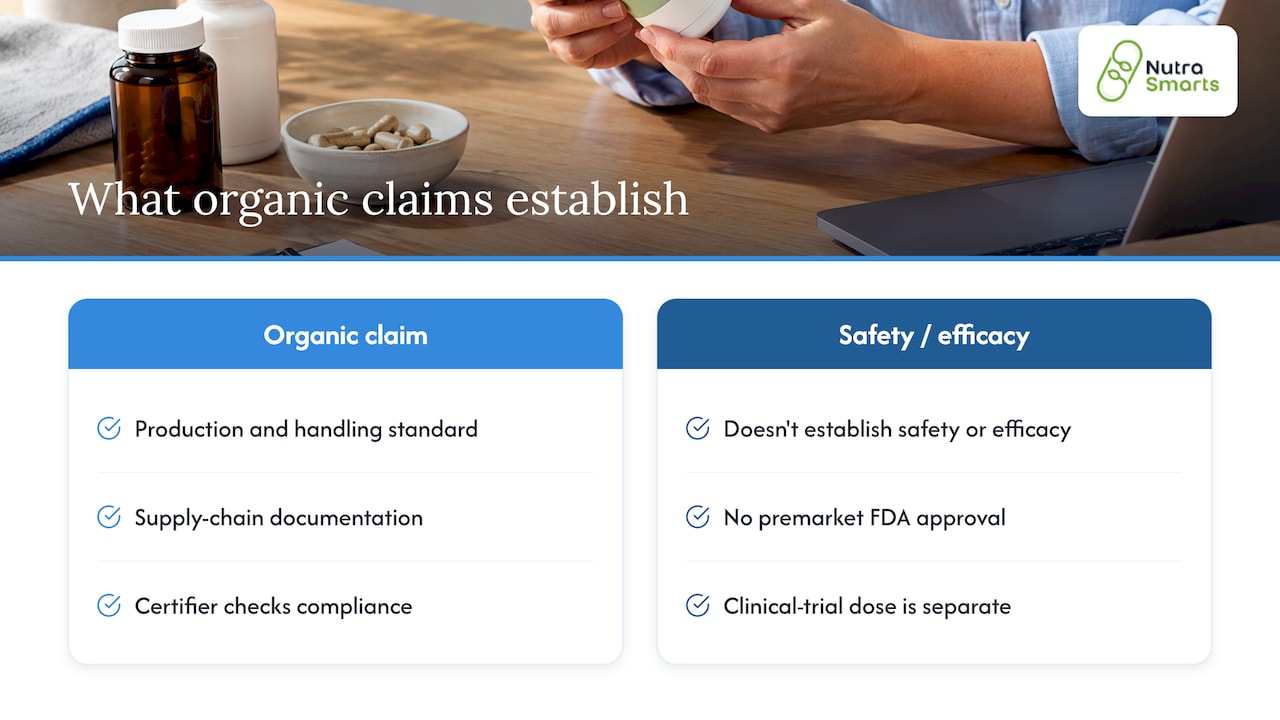
An organic claim describes how agricultural ingredients were produced and handled, and how the supply chain is documented. It is a process standard. It does not say the supplement is safe, effective or potent. The FDA explains that, unlike prescription drugs, dietary supplements are not approved by the government for safety or efficacy before marketing. The agency can act against adulterated or misbranded products after they reach the market, and a claim that a supplement treats, prevents or cures a disease makes it a drug.
So for a shopper, the organic claim answers one question: were the ingredients grown and handled to a federal standard, and did a certifier check it? Whether the dose matches what clinical trials used is a separate question, and it is one our ingredient profiles are built to answer with cited studies and dosage benchmarks. For background on the legal split between the two, see how supplements are regulated.
One more label detail for formulators: the National Bioengineered Food Disclosure Standard (7 CFR Part 66) exempts food certified under the NOP from bioengineered disclosure, while other foods, including supplements with detectable modified genetic material, must disclose. The AHPA labeling guide covers where that disclosure goes.
Checking a claim before you buy or build on it
The public Organic Integrity Database lists certified operations in the U.S. and abroad, with their location, certification status and certified products. Look up the brand or its manufacturer, then confirm the product type appears among the certified products. A "made with organic" claim should name a certifier on the information panel as "Certified organic by..."; the National Ag Law Center guide notes that requirement.
Simple label checks for consumers:
- Find the tier wording: "100 percent organic," "organic" or "made with organic."
- If the seal is present, the product should be in one of the top two tiers. A seal on a "made with organic" product is a red flag.
- Look for the certifier's name.
- Read the ingredient statement. Under 70 percent, organic ingredients may be identified only there.
If you suspect fraud, you can file a complaint with AMS with the brand name, the certifying agent and an explanation of the alleged violation. AMS reviews jurisdiction, investigates or refers the complaint, and may take enforcement action, as the CRS report describes.
What changed with Strengthening Organic Enforcement
The SOE final rule was published January 19, 2023, and full compliance has been required since March 19, 2024, per the USDA's SOE FAQ. For certified operations it requires:
- a fraud prevention plan in the Organic System Plan,
- audit-trail documentation and traceability back to the last certified operation,
- risk-based supply-chain traceability and mass balance audits,
- unannounced inspections of at least 5% of a certifier's operations each year,
- electronic NOP Import Certificates for certified organic imports.
The plan scales with risk. A producer handling only its own product may need a simple check of inputs, while a processor receiving many organic ingredients from many suppliers needs detailed practices developed with its certifier. A supplement maker buying organic botanical powders from several countries falls in the second group.
The CRS report adds that dietary supplements remain outside USDA's direct enforcement authority for fraudulent organic claims. A bill in the 118th Congress, S. 5335, would have required USDA to assess the issue but was not passed. For a reader, the takeaway is practical: certification and a traceable paper trail are the strongest signals on a label.
Putting it on a label
A formulator's order of work looks like this:
- Calculate the organic percentage at formulation, including the capsule, with water and salt excluded and the result rounded down.
- Pick the tier the number supports.
- Work with a certifying agent, who must approve the label before it is applied.
- Build the rest of the panel: Supplement Facts, other ingredients, the FDA disclaimer on any structure/function claim, allergens and the address for adverse events.
Our guides on the FDA disclaimer requirement, allergen statements and botanical part labeling cover the pieces that sit beside an organic claim.
Build the Supplement Facts panel
Our free, browser-based Supplement Facts label creator is FDA-compliant and replaces the spreadsheet work of formatting a panel. It suits formulators who have settled the organic tier and need the panel itself. If you are researching ingredients first, the same site offers evidence-rated profiles with clinical trial citations and a symptom-to-supplement search.
Start with the Free Supplement Facts Label Creator, or browse supplements by symptom if you are comparing products as a consumer.
Our perspective
An organic claim is a statement about production, and we treat it that way. It tells you how ingredients were grown and handled and whether a certifier checked the paper trail. It does not tell you the dose or the evidence behind the ingredient.
That is why we build NutraSmarts around the second question. Each ingredient profile links to peer-reviewed studies and clinical trial citations, with honest evidence ratings and dosage benchmarks, so a consumer, coach or researcher can see what the research used and compare it with the label in hand.
For formulators, the label is where compliance becomes visible. We offer a free, browser-based, FDA-compliant Supplement Facts tool so the panel is built correctly without spreadsheets, and our label guides cover the surrounding requirements. Read the tier, look for the certifier, then read the evidence.
NutraSmarts
FAQ
Can a supplement use the USDA organic seal?
Yes, if it is labeled "100 percent organic" or "organic" and produced by a certified operation. A product labeled "made with organic" may not display the seal. USDA's Organic Seal page states which tiers qualify.
Why do so many organic-ingredient capsules say "made with organic" instead of "organic"?
Capsule weight counts toward the organic percentage. A shell often outweighs the 5% nonorganic allowance, so the product usually lands between 70 and 94 percent. Using a certified organic capsule is the route to the "organic" tier.
Does "organic" mean the supplement is more effective?
No. The claim covers how agricultural ingredients were produced and handled. Effectiveness depends on the ingredient, the form and the dose, which is what clinical evidence addresses.
How do I check whether a brand is really certified?
Search the USDA's public Organic Integrity Database for the brand or its manufacturer and confirm the product appears among the certified products. If something looks wrong, you can file a complaint with USDA AMS with the brand name, certifier and a description of the problem.
Sources
- Organic on Food Labels | FDA
- Questions and Answers on Dietary Supplements | FDA
- Examining Dietary Supplements | FDA
- 7 CFR 205.301, Product composition | eCFR
- 7 CFR 205.302, Calculating the percentage | eCFR
- 7 CFR 205.303, Packaged products labeled 100 percent organic or organic | eCFR
- Labeling Organic Products | USDA AMS
- The Organic Seal | USDA AMS
- Strengthening Organic Enforcement FAQ | USDA AMS
- Guide for Organic Processors | USDA AMS
- Organic Agriculture Standards: Oversight and Enforcement | Congressional Research Service
- A Legal Guide to the National Organic Program | National Agricultural Law Center
- Guidance on Formulation and Marketing | AHPA, QAI, OTA
- Federal Labeling Requirements for Herbal Supplements | AHPA
- How organic certification works