
A "Made in USA" claim on a supplement is a legal promise about where the product comes from, not a promise about whether it works. Under the Federal Trade Commission's (FTC) rule, an unqualified claim requires that final processing happen in the U.S., that all significant processing happen here, and that all or virtually all ingredients and components be made and sourced here. If you are a formulator, that standard decides what you can print. If you are a shopper or coach, it tells you what the badge does and does not cover, and where to look for the evidence on the ingredients themselves.
TL;DR
- An unqualified "Made in USA" claim means the product is all or virtually all made and sourced in the U.S., including its ingredients, not just bottled here.
- Words like "made," "manufactured," "crafted" and "produced in America" count as the same claim, whether stated outright or implied.
- Supplements with imported ingredients can use clearly and prominently qualified wording instead, such as a statement that the product is made in the U.S. with imported ingredients.
- The FTC enforces the claim; it does not tell you whether an ingredient is effective or properly dosed. That takes ingredient-level evidence.
- Formulators should hold the substantiation records before the claim goes on the label, and the FTC's 2026 enforcement priorities make that more pressing.
Table of Contents
- What the law means by "Made in USA"
- How "all or virtually all" plays out for a supplement
- Three agencies, three different questions
- Qualified claims: when imported ingredients are part of the story
- The records behind the claim
- What happens when a claim is wrong
- What the badge does not tell a shopper
- For formulators: building a label that holds up
- Build the panel without the spreadsheet
- Our perspective
- FAQ
- Sources
What the law means by "Made in USA"
The FTC's Made in USA Labeling Rule is codified at 16 C.F.R. Part 323. It defines the claim broadly: any unqualified representation, express or implied, that a product is of U.S. origin. That includes "made," "manufactured," "built," "produced," "created" or "crafted" in the United States or in America. A flag graphic, a map of the country or a line like "American quality" can imply the same thing depending on context, so the safest reading is that the whole label and the surrounding marketing are judged together.
Section 323.2 of that rule makes it an unfair or deceptive act to label a product this way unless three conditions hold:
- The final assembly or processing of the product takes place in the United States.
- All significant processing that goes into the product takes place in the United States.
- All or virtually all ingredients or components are made and sourced in the United States.
The rule was finalized in the Federal Register on July 14, 2021, effective August 13, 2021. It formalized the "all or virtually all" standard and extended it to online and catalog mail-order materials, so a product page counts as a label for this purpose.
There is also a statute behind it. 15 U.S.C. § 45a says a "Made in the U.S.A." label must be consistent with FTC decisions and orders. It also allows labels for products with imported components when the label discloses that information clearly and conspicuously.
How "all or virtually all" plays out for a supplement
The FTC has not published a percentage. Its 1997 Enforcement Policy Statement, summarized in the FTC's Made in the USA workshop report, tells marketers to make an unqualified claim only with a reasonable basis that the product is all or virtually all made in the U.S. It looks at three factors: the share of total manufacturing costs that comes from U.S. parts and processing, how far removed any foreign content is from the finished product, and how important the foreign content is to the product's function.
For a capsule or powder, that means looking at every layer, not just the building where it was encapsulated. A practical way to walk through it:
| Layer | Question to answer | Risk for an unqualified claim |
|---|---|---|
| Active ingredients | Were they grown or synthesized and processed in the U.S.? | High if the main active is imported, since it is central to the product's function |
| Excipients and flow agents | Where do the fillers, binders and coatings come from? | Lower if minor, but they still count toward "virtually all" |
| Capsule shell or tablet coating | Is the shell made in the U.S.? | Often overlooked |
| Processing | Where do blending, encapsulation and filling happen? | Must be U.S. for the claim, and all significant processing must be here |
| Packaging | Bottle, cap, seal and label origin | Counts as a component |
A common trap is a finished product blended and bottled in a U.S. facility from imported raw materials. Processing in the U.S. may satisfy the first two conditions, but the third fails when the key ingredients come from abroad. A professional herbal industry labeling guide, revised in 2021, makes the same point: the FTC would likely treat a "Made in the USA" claim as misleading for a supplement with significant foreign ingredients, even when U.S. processing qualifies as a customs "substantial transformation."
That is worth knowing if you are comparing botanicals. Many plant ingredients are grown outside the U.S., so a fully unqualified claim on a botanical product needs a sourcing trail to match.
Three agencies, three different questions
Supplement origin claims sit at the intersection of several regulators, and mixing them up causes most label mistakes:
- The FTC enforces the "Made in USA" advertising claim under the FTC Act's ban on deceptive advertising.
- U.S. Customs and Border Protection (CBP) implements country-of-origin marking for imported goods under the Tariff Act. This is a separate question from whether you may advertise a product as made in the USA.
- The FDA regulates what a supplement label must contain, such as the Supplement Facts panel, ingredient list and manufacturer name, plus manufacturing quality rules.
The AHPA guide cited above spells out the first two distinctions. For the FDA side, manufacturers must meet 21 C.F.R. Part 111, which includes setting component identity specifications, specifications for purity, strength and composition, contamination limits, and label and packaging specifications. Meeting those quality rules does not make a product "Made in USA" for FTC purposes, and a valid origin claim says nothing about whether the manufacturer followed good manufacturing practice.
If you want the broader regulatory picture, our explainer on how supplements are regulated under DSHEA covers where each agency's authority begins and ends.
Qualified claims: when imported ingredients are part of the story
If a product is substantially transformed in the U.S. but is not all or virtually all U.S.-made, a qualified claim is the honest route. Examples of the pattern are "Made in USA with imported ingredients" or a statement that the product is made in the U.S. from domestic and imported ingredients. The FTC's Smoke Guard closing letter describes what makes the qualification work: clear language, prominent type size and style, proximity to the claim itself, and the absence of contrary claims elsewhere. A disclosure in fine print on the back, while the front shows a large flag and "American made," is the kind of mismatch that fails.
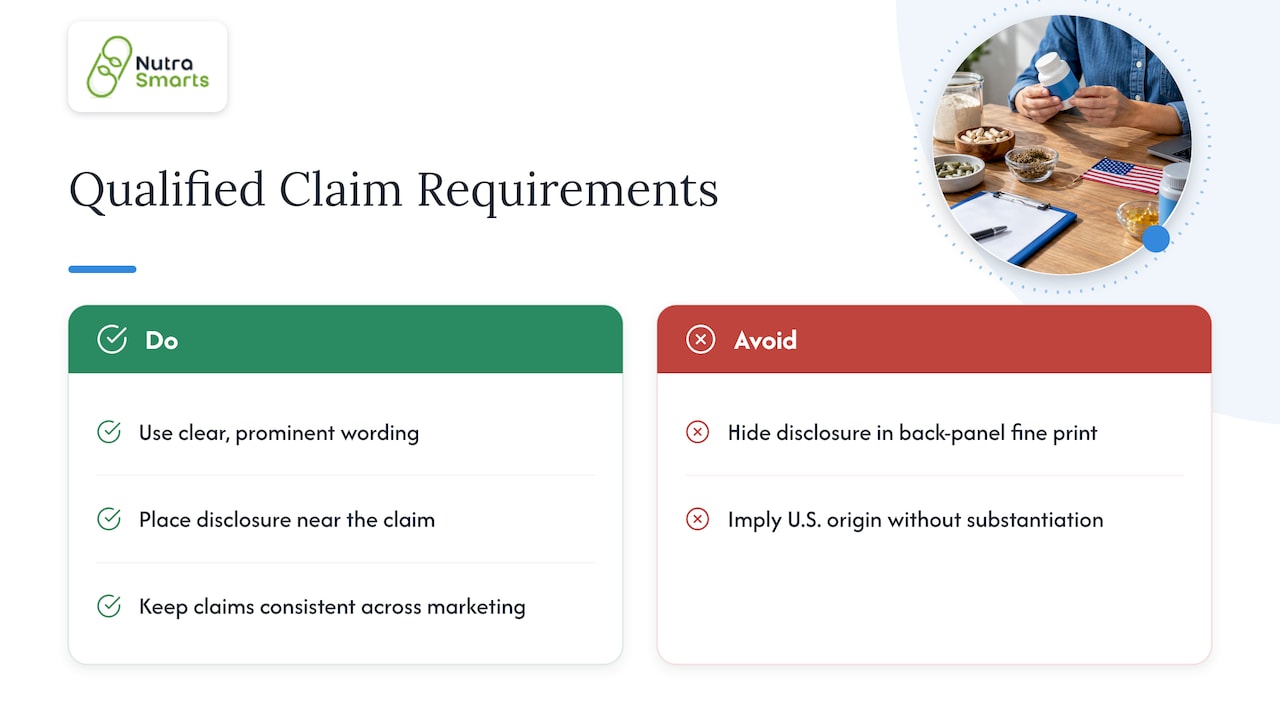
The same letter makes a useful distinction. Marketing may promote that a company employs American workers and performs functions in the U.S. What it should not do is state or imply that the products are wholly or partly made here unless the company can substantiate that. Accurate statements such as where the company is headquartered or where its team works are safer than a vague origin implication.
For type size and placement of any statement on the panel, see our guide to supplement label font requirements.
The records behind the claim
The claim has to be true before it is printed. In the FTC's order against Nectar Brand, reported at 166 F.T.C. 115, the company was required to have a reasonable basis for any origin representation, possessed and relied upon at the time it was made. The order also required it to keep, for five years, the materials relied upon and any evidence that contradicts, qualifies or calls the claim into question, including consumer complaints and government communications. That order binds that company, not every marketer, but it shows what the FTC treats as a sound file.
A formulator can borrow the structure. A claim file might hold:
- Supplier statements of origin for every ingredient, capsule shell and packaging component
- Records of where each processing step happens, including contract manufacturers
- A written note of how "all or virtually all" was judged against the three FTC factors
- Any complaint, retailer question or customs document that touches origin
- A date on each document, refreshed whenever a supplier changes
Supplier changes are the weak point. A raw material switched for cost or availability can turn a true claim into a false one without anyone touching the label. Treat every sourcing change as a label review trigger.
What happens when a claim is wrong
Violations of the Made in USA Labeling Rule are treated as rule violations under Section 18 of the FTC Act. The FTC's 2022 closing letter noted that the agency may seek civil penalties of up to $46,517 per violation. That ceiling is adjusted periodically, so check the FTC's current figure before relying on it.
In practice, the FTC describes its program as monitoring, counseling and targeted enforcement. According to its workshop report, staff reviews several hundred complaints a year, has closed more than 150 matters with closing letters for unintentionally misleading claims, and entered 24 administrative orders over 20 years. It started only two civil penalty proceedings in that period. Formal enforcement is reserved for intentional deception, refusal to comply or a return to deceptive claims after a closing letter.
That pattern points to a sensible response for any supplement marketer who finds a problem. The Smoke Guard letter lays out a remedial plan:
- Remove unqualified claims from all marketing, including social media.
- Update customer and distributor materials.
- Train staff.
- Write a policy on U.S.-origin claims with pre-claim procedures.
- Collect substantiation before any future qualified claim.
Because mislabeling problems often start with products that arrive from outside suppliers, it also helps to understand detecting mislabeled peptide products, which shows how label claims and actual contents can diverge in a less regulated corner of the market.
The 2026 enforcement signal
On March 13, 2026, Executive Order 14392 (published at 91 F.R. 13201) directed the FTC Chairman to prioritize enforcement against unlawful "Made in America" claims. It also asks the FTC to consider rules on how online marketplaces verify country of origin, and asks agencies that oversee origin labeling to consider rules promoting voluntary U.S.-origin labeling. For supplement sellers on marketplaces, expect more questions about origin claims, and keep the claim file ready.
What the badge does not tell a shopper
If you are buying, a lawful "Made in USA" claim tells you about geography. It does not tell you the dose is the one used in clinical trials, that the form of the nutrient is well studied, or that the ingredient has evidence for your concern. Those are separate questions, and they are the ones that determine whether a product is worth taking.
A better routine is to separate the questions:
- Origin: Is the claim qualified or unqualified, and does the wording sit close to the claim?
- Ingredient evidence: What do human trials show for each active, at what dose?
- Need: Is there a deficiency or symptom that justifies the ingredient at all?
On the second and third questions, NutraSmarts is built for the job. Our supplements by symptom search lets you start from a concern such as joint pain or anxiety and see ingredient profiles tied to clinical trial citations. If you suspect a shortfall, the deficiency guide lists symptoms and risk groups, with a by-symptom view and a by-group view for situations like pregnancy or older age. For individual medical decisions, talk with your doctor or a registered dietitian, especially if you take medication or have a health condition.
Wellness coaches can use the same pages to give clients ingredient information with citations rather than label slogans.
For formulators: building a label that holds up
An origin claim is one line on a label that has to be correct everywhere else too. A typical sequence for a compliant launch:
- Decide whether you need the claim. If your sourcing is mixed, a qualified statement or no origin statement at all avoids the problem.
- Map the supply chain using the table above and document every layer.
- Build the panel with accurate Supplement Facts, ingredient list, allergen statement and the FDA disclaimer where a structure/function claim appears.
- Review the whole label and web page together, since implied claims count.
- Store the file and revisit it whenever a supplier changes.
Our guides cover the surrounding requirements: the 2026 label requirements checklist, the FDA disclaimer requirement, allergen statements, botanical part labeling and examples of non-compliant labels. If you already have product on the market, see how to update an existing label for compliance. And if your label also carries benefit statements, our piece on proving structure/function claims covers the notification timeline.
Build the panel without the spreadsheet
The NutraSmarts Free Supplement Facts Label Creator runs in your browser and generates an FDA-compliant Supplement Facts panel, so you can skip the spreadsheet work. Pair it with our ingredient database, where each profile links to peer-reviewed studies and clinical trial citations, to check dosage benchmarks as you formulate. There is no sign-up and no paywall.
Start with the Supplement Facts Label Creator, or browse the research at nutrasmarts.com.
Our perspective
Origin claims and evidence claims get confused all the time. A flag on a bottle feels like a quality signal, but the law only asks where the product was made and sourced. It says nothing about the dose, the form of the ingredient or the trials behind it.
That is why we built NutraSmarts around the ingredient. Each profile is tied to PubMed-cited studies and clinical trial citations, with evidence ratings and dosage benchmarks, so you can judge a formula on what is in it. The symptom search, deficiency guide and side-by-side comparison tool are there for that purpose.
For formulators, the same thinking applies to the label. Our free Supplement Facts tool is designed to produce an FDA-compliant panel, and our label guides walk through the surrounding rules so the claims on the front match the facts on the back.
NutraSmarts
FAQ
Can a supplement say "Made in USA" if only the bottling happens here?
Not without qualification. An unqualified claim requires U.S. final processing, all significant processing in the U.S., and all or virtually all ingredients and components made and sourced here. If only bottling is domestic, a clear and prominent qualified statement about what is done in the U.S. is the safer route.
Does "Made in USA" mean a supplement is higher quality?
No. The claim concerns origin under FTC rules. Quality is a separate matter, covered by FDA manufacturing requirements and by the evidence behind each ingredient and dose. Reviewing the ingredient research tells you far more than the origin line does.
Is "Made in USA with imported ingredients" allowed?
Yes, when it is true and the qualification is clear and prominent. The FTC looks at clarity of language, type size and style, proximity to the claim and whether other claims on the product contradict it. The statute also permits labels for products with imported components when that information is disclosed conspicuously.
Who enforces origin claims on supplement labels?
The FTC enforces the "Made in USA" advertising claim. Customs and Border Protection handles country-of-origin marking for imported goods, and the FDA regulates supplement label content and manufacturing practices. They answer different questions, so satisfying one does not satisfy the others.
What should a company do if it finds an unsupported claim?
Remove the unqualified claim from every channel, including social media and distributor materials, train staff, adopt a written origin-claim policy and gather substantiation before making any qualified claim. This mirrors the steps in the FTC's Smoke Guard closing letter.
Sources
- eCFR: 16 CFR Part 323, Made in USA Labeling
- Federal Register: Made in USA Labeling Rule (July 14, 2021)
- 15 U.S.C. § 45a: Labels on products (119th Congress)
- 15 U.S.C. § 45a: Labels on products (current)
- FTC workshop report: Made in the USA
- FTC Smoke Guard closing letter
- Nectar Brand LLC, 166 F.T.C. 115
- eCFR: 21 CFR 111.70, Specifications
- AHPA Herbal Supplements Labeling Guide (revised 2021)